Why your latte art depends on the chemistry of melted marshmallows
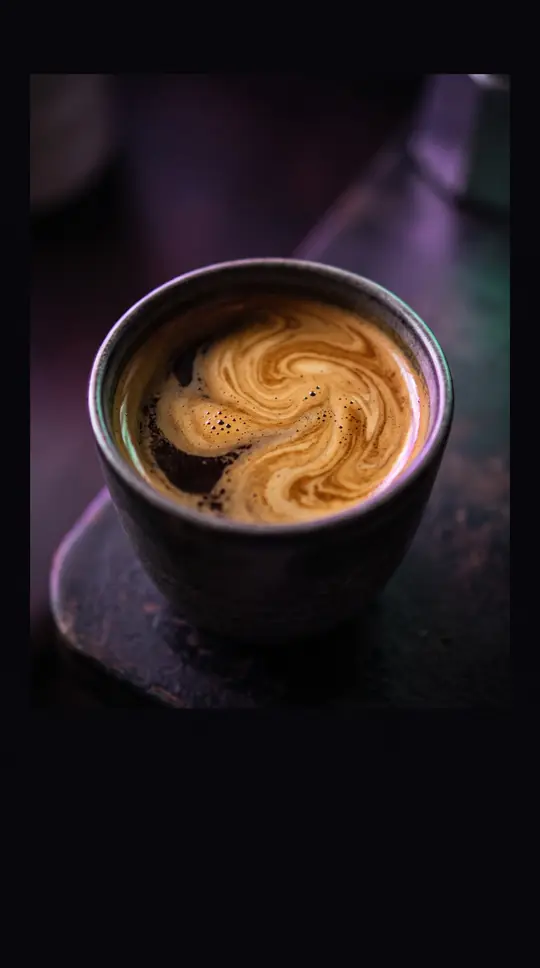
In short: Perfect latte art isn't just about steady hands; it's a feat of fluid dynamics and molecular biology. To create the signature "gooey" texture of microfoam, baristas must manipulate milk proteins and fats to create a metastable liquid-gas colloid that stays stable enough to hold a shape.
Microfoam is defined by its microscopic, uniform bubbles, giving it a shiny, thickened appearance similar to wet paint or melted marshmallows. This distinguishes it from macrofoam—the large- bubbled "dry" foam traditionally used for cappuccinos. Because microfoam is less viscous and more cohesive, it provides the necessary definition and stability for latte art, whereas macrofoam tends to disperse too quickly.
The science of this texture lies in milk's dual nature as both a fat emulsion and a protein sol. These two components work together to create a mechanically strong foam that doesn't collapse under its own weight. Initially, air bubbles are stabilized by the protein β-casein. However, as the milk heats up, the protein β-lactoglobulin becomes the primary factor in maintaining the foam's structure. This transition is temperature-dependent; for instance, milk fat denatures around 40 °C (104 °F), while the desired texture is typically achieved by steaming milk to about 70 °C (158 °F).
Baristas must balance these variables with precision. While fat content is inversely proportional to frothing potential, most professionals prefer whole milk over skim because it produces smaller, more homogeneous bubbles. If milk exceeds 82 °C (180 °F), it becomes "scalded," destroying the tertiary protein structure required to hold the foam. The process requires a two-stage technique: first, "stretching" the milk by immersing only the tip of the steam wand to introduce air, then "texturing" it by deepening the wand to 20–30 mm to create a turbulent vortex that integrates the foam into the liquid.
Stability is also a race against time. For pasteurized whole milk steamed at 70 °C (158 °F), the foam's half-life is roughly 150 minutes. However, because microfoam separates into layers faster than it loses volume, it must be served immediately to preserve the integrity of the art.
Opens the Intellect+ feed with this card first. Swipe up for the next one.
Sources
- Summary by Intellect · source: Microfoam
To cite this card, link to https://intellectplus.co.uk/app/food-microfoam.
How we source, check and correct cards: Editorial standards.
General information, not professional advice. Spotted an error? Flag the card or see corrections and complaints.
Intellect Plus is a visual educational discovery platform for exploring fascinating facts and ideas. Brain Food, Not Brain Rot. What is Intellect Plus?
Related
More in Coffee · More in Food & Drink · Latest · A–Z · All topics
