How two simple waves can create complex geometric knots
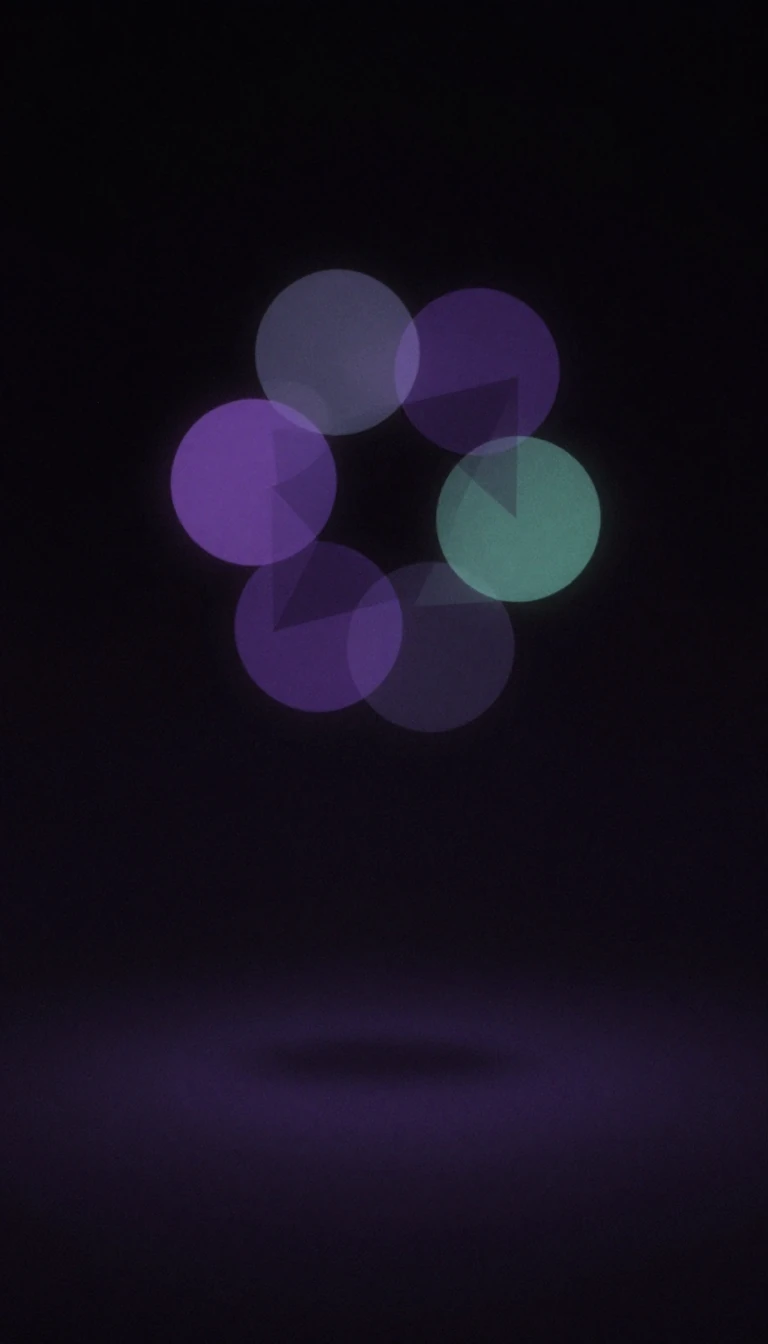
In short: By intersecting two perpendicular oscillations, mathematicians can reveal hidden patterns in motion. From simple straight lines to intricate, rotating loops, these figures serve as a visual language for understanding the precise relationship between frequency, phase, and amplitude in any harmonic system.
Known variously as Lissajous figures or Bowditch curves, these patterns emerge from the intersection of two sinusoidal curves at right angles. The American mathematician Nathaniel Bowditch first studied these curves in 1815, though they were later investigated in greater detail by French mathematician Jules-Antoine Lissajous between 1857 and 1858. Lissajous famously demonstrated these patterns by using a narrow stream of sand falling from a compound pendulum.
The resulting geometry is highly sensitive to the ratio of the two frequencies. When the frequencies are identical, the figure can manifest as a straight line, an ellipse, or even a circle. For instance, a phase difference of 9/270 degrees produces a circle, while specific phase shifts can result in lines at 45 or 135 degrees. If the frequencies differ but maintain a rational ratio, the pattern closes into a stable, connected figure. However, if the ratio is irrational, the curve appears to rotate or fail to close, creating a dense, shifting pattern.
Beyond their aesthetic beauty, these curves are vital tools in electronics. On an oscilloscope, the shape of a Lissajous figure allows engineers to identify the characteristics of an unknown electric signal by comparing it to a signal of known frequency and phase. The complexity of the figure—specifically the number of 'lobes'—is determined by the frequency ratio, while the relative width and height are governed by the ratio of their amplitudes. In advanced mathematics, certain configurations of these curves even relate to Chebyshev polynomials, providing a method for sampling points for complex function interpolation.
Opens the Intellect+ feed with this card first. Swipe up for the next one.
Sources
- Summary by Intellect · source: Lissajous figure | Oscillations, Harmonics, Waveforms | Britannica
- Also: Lissajous curve
To cite this card, link to https://intellectplus.co.uk/app/technology-lissajous-curve.
How we source, check and correct cards: Editorial standards.
General information, not professional advice. Spotted an error? Flag the card or see corrections and complaints.
Intellect Plus is a visual educational discovery platform for exploring fascinating facts and ideas. Brain Food, Not Brain Rot. What is Intellect Plus?
Related
More in Chemical engineering · More in Technology · Latest · A–Z · All topics
