How mathematicians turn abstract group structures into visual geometric maps
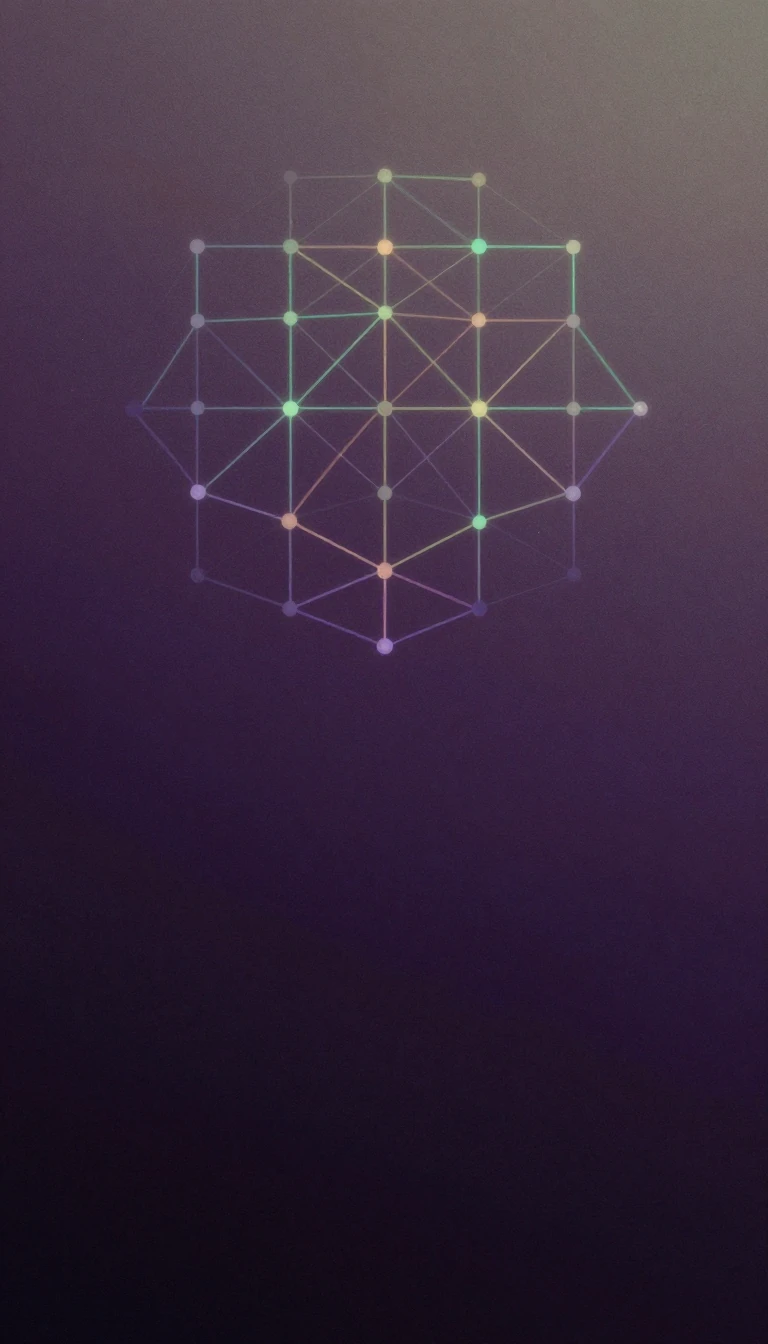
In short: A Cayley graph is a visual representation of an abstract group, turning complex algebraic structures into geometric networks. By mapping group elements to vertices and multiplication to edges, these diagrams reveal the hidden symmetry of mathematical systems, serving as a fundamental tool in geometric group theory and beyond.
At its heart, a Cayley graph encodes the structure of a group using a specific set of generators. Named after Arthur Cayley, these graphs function as directed, edge-colored networks where each vertex represents an element of the group. When a generator is self-inverse, the corresponding edge is typically undirected. This visual language allows mathematicians to study groups not just as abstract lists of operations, but as spatial objects with distinct topological properties.
The complexity of these graphs varies wildly depending on the group's underlying rules. For instance, the Cayley graph of an infinite cyclic group with a standard generator appears as a simple infinite path, while finite cyclic groups produce circulant graphs. In contrast, the free group on two generators creates a 4-regular infinite tree, a structure so significant it serves as a key ingredient in the famous Banach–Tarski paradox. These trees, often called Bethe lattices, act as universal covers for more complex graphs, bridging the gap between discrete algebra and topology.
Beyond simple shapes, Cayley graphs can exhibit surprising dimensional behaviors. The discrete Heisenberg group, for example, is embedded in three-dimensional space, yet its Cayley graph demonstrates four-dimensional volume growth. Because these graphs are constructed from generators, they are also ideal for building expander graphs—networks that are highly connected despite having few edges. By viewing group actions as movements across these graphs, researchers can analyze the symmetry of the group itself, as the set of edges and their colors remain preserved under left multiplication.
The utility of these diagrams extends into geometric group theory, where they are often assumed to be finite. By selecting different generators, the same group can produce vastly different visual representations, allowing for a nuanced exploration of group properties. Whether mapping the simple symmetry of a square or the infinite complexity of a non-commutative group, Cayley graphs remain a primary bridge between the abstract world of algebra and the intuitive world of geometry.
Opens the Intellect+ feed with this card first. Swipe up for the next one.
Sources
- Summary by Intellect · source: Cayley graph
- Also: www.homepages.ucl.ac.uk — Cayley Graph Explorer
To cite this card, link to https://intellectplus.co.uk/app/science-cayley-graph.
How we source, check and correct cards: Editorial standards.
General information, not professional advice. Spotted an error? Flag the card or see corrections and complaints.
Intellect Plus is a visual educational discovery platform for exploring fascinating facts and ideas. Brain Food, Not Brain Rot. What is Intellect Plus?
Related
More in Discrete mathematics · More in Science · Latest · A–Z · All topics
