Why the true contact area between two surfaces is rarely what you see
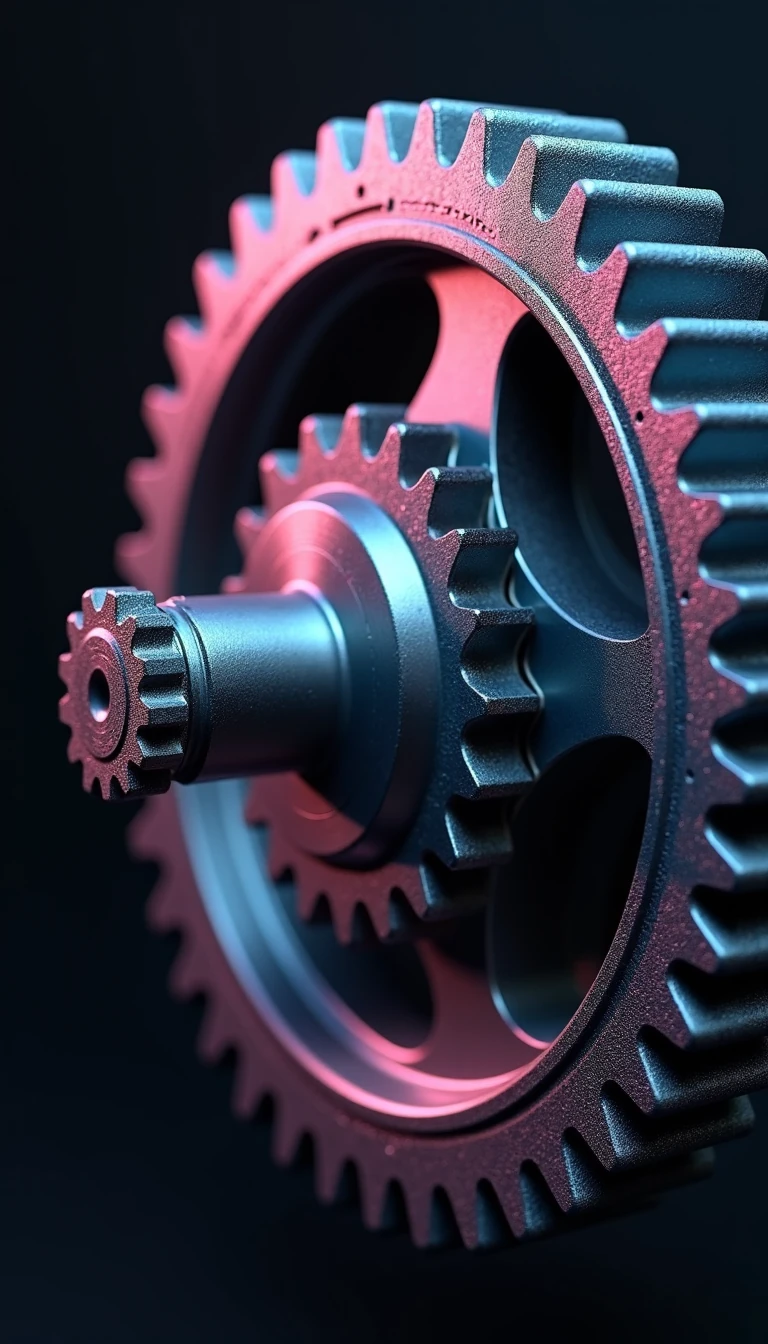
In short: When two objects touch, they rarely meet across their entire apparent surface. Thanks to microscopic roughness, the true contact area is often a tiny fraction of the whole. Understanding these hidden mechanics is essential for everything from designing durable tires and bearings to mastering the science of friction and wear.
Contact mechanics is the branch of mechanical engineering dedicated to how solids deform when they touch. At its core, the field distinguishes between normal stresses—forces pushing surfaces together—and shear stresses, which arise from friction. While the discipline now spans micro- and nanotechnology, its foundations were laid in 1881 by Heinrich Hertz. Hertz developed mathematical models to describe how curved surfaces deform under load, providing the essential framework for calculating fatigue life and load-bearing capacity in components like gears and bearings.
For decades, the field assumed surfaces were perfectly smooth. This changed in the mid-twentieth century when researchers like Frank Philip Bowden and David Tabor demonstrated that surface roughness is a critical factor. They discovered that the true contact area between two bodies is significantly smaller than the apparent area. Later work by J. F. Archard in 1957, and subsequently by James A. Greenwood and J. B. P. Williamson in 1966, established that this true contact area is generally proportional to the normal force applied, while the pressure and size of individual micro-contacts remain relatively stable regardless of the load.
The study of adhesion added further complexity. In the 1970s, a debate emerged between two competing theories: the Johnson–Kendall–Roberts (JKR) model and the Derjaguin–Muller–Toporov (DMT) model. This disagreement was not merely academic; it pushed the field to develop parameters—pioneered by Tabor and Daniel Maugis—to determine which model best predicts adhesive behavior for specific materials. Today, these principles are vital for optimizing technical systems, including locomotive wheel-rail contact, gasket seals, and ultrasonic welding, ensuring that modern engineering accounts for the invisible, microscopic interactions occurring at every interface.
Modern contact mechanics continues to evolve by integrating these historical insights into complex computational models. By analyzing how elastic, viscoelastic, and plastic bodies behave under static or dynamic conditions, engineers can better predict the performance of mechanical linkages and combustion engines. The ongoing challenge remains to refine these stress analyses, particularly as lubrication and advanced material design continue to reshape our understanding of friction and wear in high-precision environments.
Opens the Intellect+ feed with this card first. Swipe up for the next one.
Sources
- Summary by Intellect · source: Contact mechanics
To cite this card, link to https://intellectplus.co.uk/app/science-contact-mechanics.
How we source, check and correct cards: Editorial standards.
General information, not professional advice. Spotted an error? Flag the card or see corrections and complaints.
Intellect Plus is a visual educational discovery platform for exploring fascinating facts and ideas. Brain Food, Not Brain Rot. What is Intellect Plus?
Related
More in Mechanics · More in Science · Latest · A–Z · All topics
