Why the individual waves you see in a pond move faster than the group
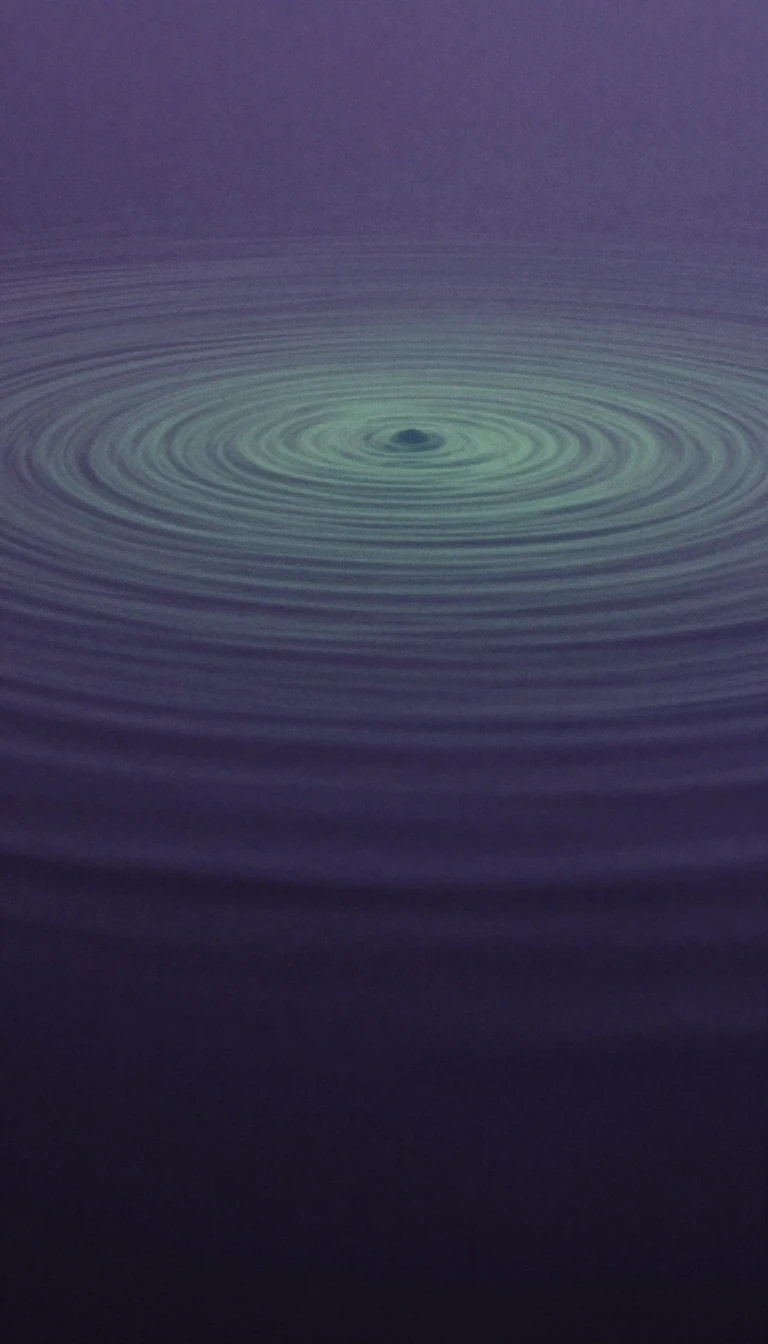
In short: When you toss a stone into a pond, the resulting ring of waves moves outward as a collective unit. Yet, if you look closely, the individual ripples inside that ring appear to travel faster than the group itself. This phenomenon, known as group velocity, reveals how wave packets actually propagate.
The concept of group velocity describes the speed at which the overall envelope or modulation of a wave packet travels through space. While we often perceive a wave as a single entity, it is frequently a collection of individual waves with varying frequencies. These internal components can move at a phase velocity that differs significantly from the speed of the group as a whole. This distinction was first proposed by W.R. Hamilton in 1839, with a comprehensive mathematical treatment later provided by Rayleigh in his 1877 work, Theory of Sound.
The relationship between these velocities is governed by the dispersion relation, which defines how a wave's angular frequency relates to its angular wavenumber. If the frequency is directly proportional to the wavenumber, the group and phase velocities are identical, and the wave packet travels without distortion. However, when this relationship is non-linear, the components of the packet travel at different speeds. This causes the envelope to distort over time because the group velocity—defined as the derivative of frequency with respect to wavenumber—varies across the range of frequencies present in the packet.
A classic example of this behavior is found in deep water gravity waves, where the group velocity is exactly half the phase velocity. This specific ratio is the underlying mechanism behind the Kelvin wake pattern observed behind ships and swimming objects. Regardless of the object's speed, provided it remains constant, the wake consistently forms an angle of 19.47 degrees with the line of travel. Understanding these mechanics is essential for predicting how pulses of light or sound behave as they move through different media, where the refractive index can further complicate the relationship between phase and group speeds.
Opens the Intellect+ feed with this card first. Swipe up for the next one.
Sources
- Summary by Intellect · source: Group velocity
To cite this card, link to https://intellectplus.co.uk/app/science-group-velocity.
How we source, check and correct cards: Editorial standards.
General information, not professional advice. Spotted an error? Flag the card or see corrections and complaints.
Intellect Plus is a visual educational discovery platform for exploring fascinating facts and ideas. Brain Food, Not Brain Rot. What is Intellect Plus?
Related
More in Waves · More in Science · Latest · A–Z · All topics
