The elegant symmetry of CMOS: how complementary transistors power almost every modern digital device.
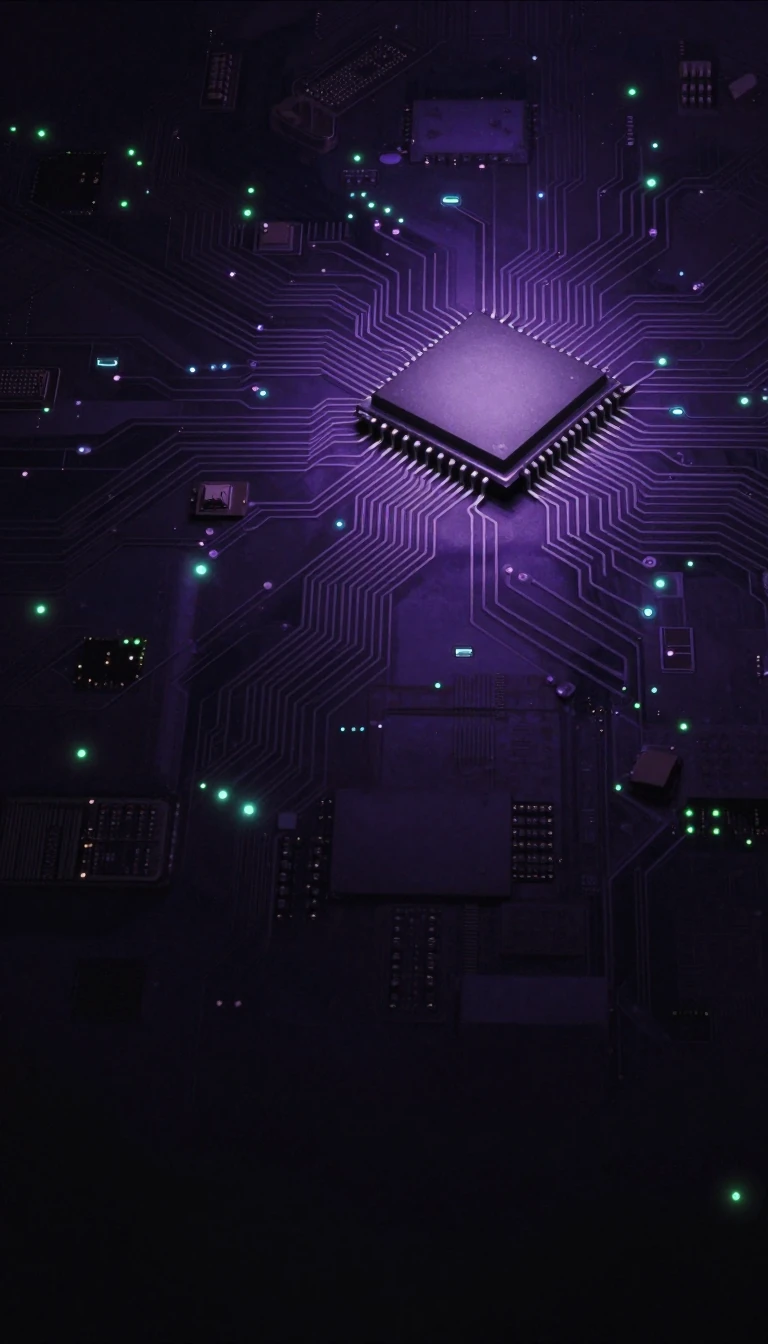
In short: Modern computing relies on a simple, brilliant trick: pairing two different types of transistors so that one is always off. This complementary design slashes power consumption and heat, allowing billions of switches to fit on a single chip. It is the invisible foundation of nearly every microprocessor and memory device today.
At the heart of CMOS—complementary metal-oxide-semiconductor—technology is the principle of complementary symmetry. A CMOS circuit pairs a p-type MOSFET with an n-type MOSFET. Because these transistors respond oppositely to the same input voltage, one is always in a high-resistance state while the other is low. This ensures that current flows only during the brief moment of switching, rather than continuously. This design is vastly more efficient than older logic families like NMOS or transistor-transistor logic, which suffered from constant standing current and significant waste heat.
The journey to this standard began with the 1948 patent of an insulated-gate transistor by John Bardeen and Walter Brattain. By 1963, Frank Wanlass and Chih-Tang Sah at Fairchild Semiconductor presented the CMOS process, which RCA later commercialized. While initially overlooked in favor of the more powerful NMOS, CMOS gained dominance in the 1980s as engineers optimized it for very large-scale integration. Innovations like the twin-well process introduced by Hitachi in 1978 allowed CMOS to match NMOS performance while consuming a fraction of the power, eventually making it the industry standard for everything from digital watches to the processors in NASA's Galileo spacecraft.
Today, CMOS is ubiquitous, accounting for 99% of integrated circuit chips as of 2011. The technology has scaled from 20-micrometer processes in the late 1960s to sub-20-nanometer nodes. As transistors have shrunk, power density has become a critical challenge, keeping the efficiency of CMOS essential. While non-planar FinFET technology is now replacing traditional planar CMOS for the smallest nodes, the fundamental logic of complementary pairs remains the bedrock of digital architecture, enabling the complex, high-density circuits that define the modern computing era.
Opens the Intellect+ feed with this card first. Swipe up for the next one.
Sources
- Summary by Intellect · source: CMOS
To cite this card, link to https://intellectplus.co.uk/app/technology-cmos.
How we source, check and correct cards: Editorial standards.
General information, not professional advice. Spotted an error? Flag the card or see corrections and complaints.
Intellect Plus is a visual educational discovery platform for exploring fascinating facts and ideas. Brain Food, Not Brain Rot. What is Intellect Plus?
Related
More in Technology today · More in Technology · Latest · A–Z · All topics
