The mechanical heartbeat that traded precision for the birth of modern time
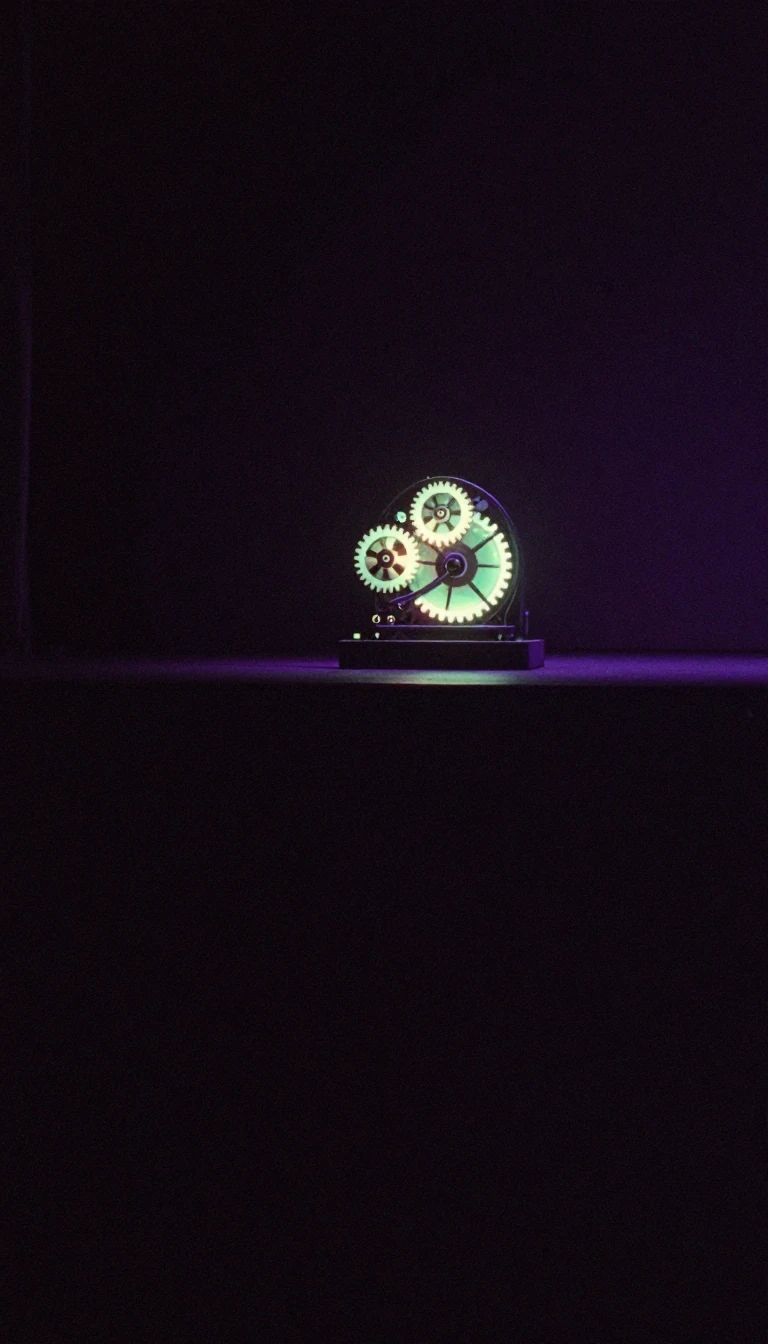
In short: Before the pendulum's steady beat, human civilization relied on a clunky, reciprocating dance of gears. The verge escapement was the first mechanism to break time into discrete ticks, moving us from flowing water to oscillating metal—a leap that defined every mechanical clock for four centuries.
Emerging in late 13th-century Europe, the verge escapement transformed how humanity measured existence. By converting the continuous force of a falling weight or unwinding spring into repetitive, oscillatory motion, it enabled the first all-mechanical clocks. These early timekeepers used a 'foliot'—a horizontal bar with weights at each end—which swung back and forth like a primitive balance wheel. To adjust the speed, users simply moved the weights further out or closer to the center, physically altering the moment of inertia.
The mechanism functions through a crown-shaped escape wheel with sawtooth teeth. A vertical rod (the verge) holds two pallets angled so that only one catches a tooth at a time. As the gears turn, a tooth pushes a pallet, rotating the foliot in one direction until it reaches an angle where the second pallet catches the opposite side of the wheel. This cycle repeats, providing a constant impulse to overcome friction while advancing the gear train by a fixed amount with every 'tick.'
Despite its historical importance, the verge was notoriously imprecise. Because the crown wheel teeth are constantly pushing the oscillator rather than letting it swing freely, the clock's rate is highly sensitive to changes in drive force; as a mainspring unwinds, the clock slows down. Furthermore, the mechanism suffers from 'recoil,' where the momentum of the foliot actually pushes the gear train backward momentarily. These flaws were so significant that by the mid-17th century, the invention of the pendulum and balance spring rendered the verge largely obsolete for precision work.
Today, very few original verge clocks survive because they were often rebuilt to accommodate newer technology. However, their legacy remains: they represent the fundamental shift from measuring time as a continuous flow (like water) to an oscillatory process—the very principle that governs every modern timepiece.
Opens the Intellect+ feed with this card first. Swipe up for the next one.
Sources
- Summary by Intellect · source: Verge escapement
- Also: Encyclopaedia Britannica: Verge escapement | device | Britannica
To cite this card, link to https://intellectplus.co.uk/app/technology-verge-escapement.
How we source, check and correct cards: Editorial standards.
General information, not professional advice. Spotted an error? Flag the card or see corrections and complaints.
Intellect Plus is a visual educational discovery platform for exploring fascinating facts and ideas. Brain Food, Not Brain Rot. What is Intellect Plus?
Related
More in Medieval clockmaking · More in Technology · Latest · A–Z · All topics
