A Roman floor mosaic captures the precise anatomy of a king's fear
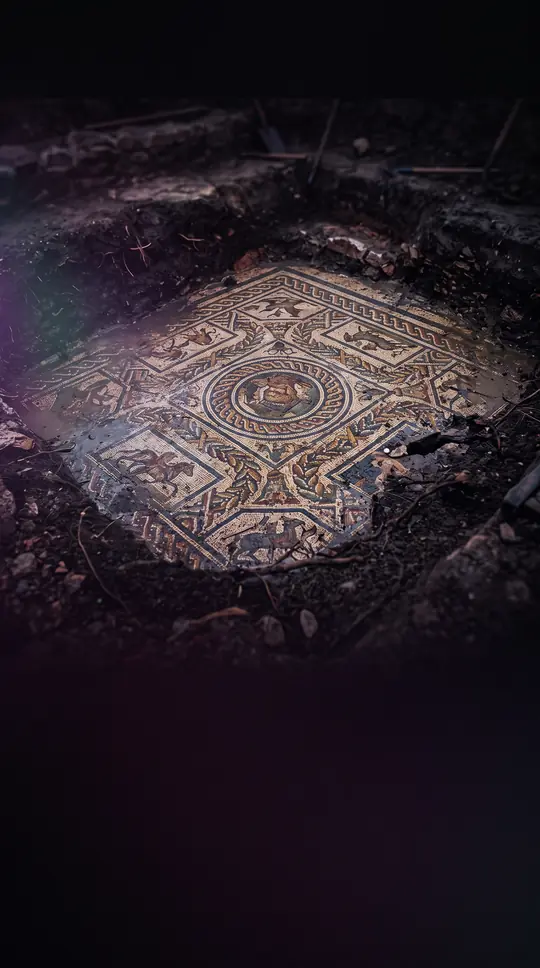
In short: In the House of the Faun at Pompeii, a floor mosaic depicts the chaotic clash between Alexander the Great and Darius III. It is so detailed that viewers can see the furrowed brows of a fleeing king and the frantic whip of a charioteer, rendered in over four million tiny stones.
The Alexander Mosaic, likely dating between 120 and 100 BC, is a Roman floor work that serves as a complex cultural bridge. While it depicts a Hellenistic battle—traditionally identified as the Battle of Issus—it is believed to be a copy of a lost 4th-century BC painting by masters like Philoxenus of Eretria or Apelles. This transition from Greek painting to Roman mosaic highlights a shift in artistic medium while preserving the 'naturalism' of Greek portraiture, specifically the ability to convey intense emotional tones and anatomical accuracy in a large group of over 50 soldiers.
The technical execution is staggering. The mosaic utilizes 'opus vermiculatum' (worm work), where approximately 1.5 million tiny colored tiles (tesserae) about 0.08 inches wide are arranged in gradual curves to mimic the slow motion of a crawling worm. By employing shading to suggest volume and mass, this method enables extreme foreshortening, exemplified by the horse positioned centrally and viewed from the rear. The color palette is restricted to reds, yellows, black, and white, derived solely from naturally occurring marble.
The placement of the work in a private Roman residence reveals deep socio-political aspirations. Because Roman leaders emulated Alexander’s power, civilians displayed his image to signal their own ambitions. The mosaic was positioned in an 'exedra'—a seating area for conversation—where it was the first decorative object a guest would see. Modern research suggests the Romans even removed columns from the nearby colonnade to improve the lighting for this specific floor piece. It was preserved for centuries by the volcanic ash of Mount Vesuvius in AD 79, eventually being rediscovered in 1831.
Scholars debate the significance of the Roman copy versus the Greek original. Some argue that interpreting the mosaic solely through the lens of the original Greek painting strips away the achievement of the Roman artists who adapted the work for a new cultural context. Others note that the mosaic contains specific details that would have been lost if created more than a few hundred years after the battle, suggesting a high degree of fidelity to the source material.
Opens the Intellect+ feed with this card first. Swipe up for the next one.
Sources
- Summary by Intellect · source: Alexander Mosaic
To cite this card, link to https://intellectplus.co.uk/app/wars-alexander-mosaic.
How we source, check and correct cards: Editorial standards.
General information, not professional advice. Spotted an error? Flag the card or see corrections and complaints.
Intellect Plus is a visual educational discovery platform for exploring fascinating facts and ideas. Brain Food, Not Brain Rot. What is Intellect Plus?
Related
More in Ancient & biblical wars · More in Wars & Conflicts · Latest · A–Z · All topics
