How your brain and computers turn moving pictures into 3D worlds
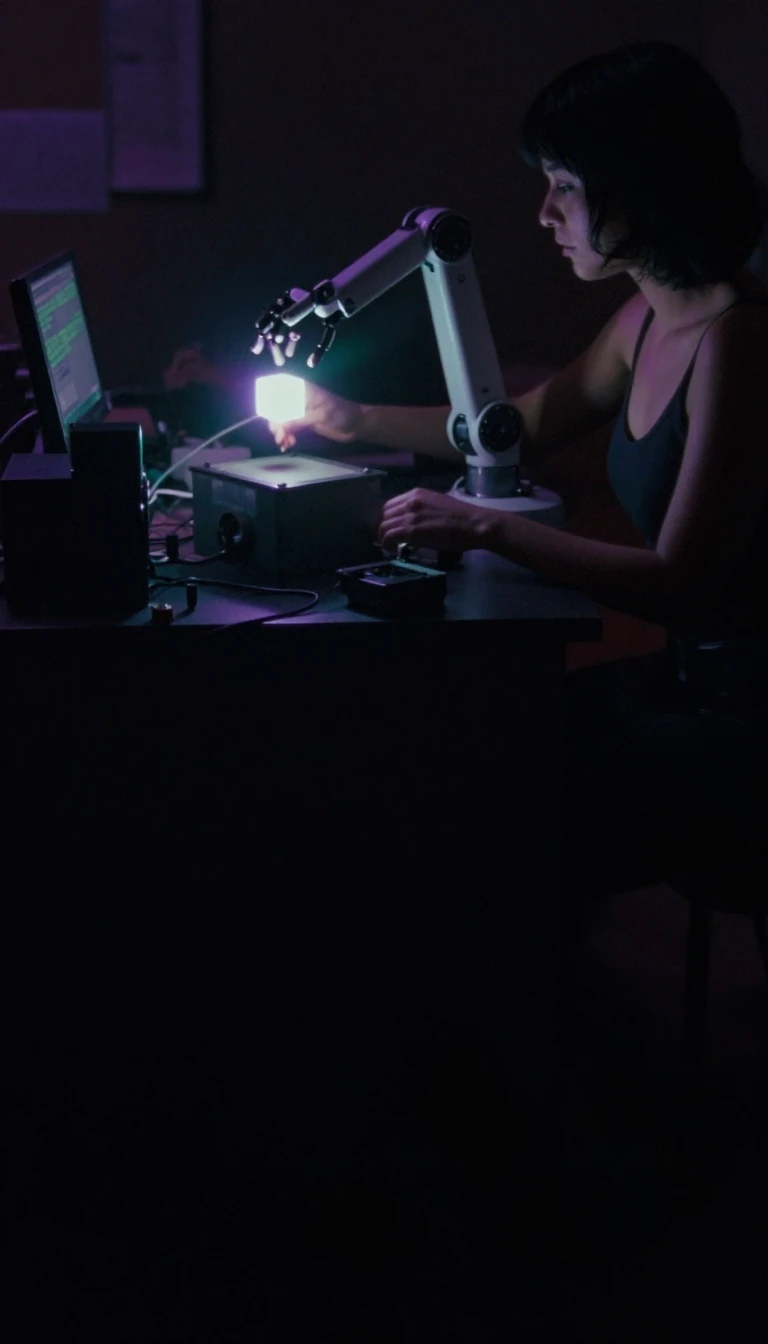
In short: Humans perceive depth by moving around objects, watching how they shift against the background. This biological trick, known as motion parallax, is the fundamental principle behind Structure from Motion (SfM)—a sophisticated photogrammetric technique that allows computers to reconstruct 3D environments from simple 2D image sequences.
Structure from motion (SfM) operates on the principle of motion parallax: when an observer moves, objects at different distances shift at different rates. By analyzing these relative movements across a sequence of images, algorithms can estimate the 3D structure of a scene and the path of the camera. This mirrors a core problem in visual perception—how biological creatures interpret their surroundings—while serving as a classic challenge in computer vision. To achieve this, the system must find 'correspondences' between images. It identifies specific features like corner points, which have gradients in multiple directions. Two primary detectors are used: Scale-Invariant Feature Transform (SIFT), which is highly accurate but slower, and Speeded-Up Robust Features (SURF), which uses a Hessian matrix-based blob detector to achieve faster speeds at the cost of some positional accuracy.
For environments where distinct points are scarce, such as man-made structures, 'pointless SfM' can be used to track general curves instead. Once features are detected, they are matched using tools like the Lucas–Kanade tracker. Because some matches are inevitably incorrect, the RANSAC (random sample consensus) algorithm is employed to filter out these outliers. The resulting trajectories of these features are then used to calculate 3D positions. Depending on the scale, these reconstructions can be 'incremental' (adding poses one by one), 'global' (solving all poses simultaneously), or 'out-of-core' (integrating partial reconstructions into a global solution).
SfM is increasingly vital for high-precision, non-invasive surveying. It can generate hyperscale landform models with density comparable to laser scanning but at a fraction of the cost. It is particularly effective in rugged environments—like fault zones, coral reefs, or landslides—where traditional equipment might fail. Beyond geosciences, it serves as a flexible tool for digitizing historical documents and performing non-invasive structural monitoring of cultural heritage sites where installing physical surveying pillars is impossible.
Opens the Intellect+ feed with this card first. Swipe up for the next one.
Sources
- Summary by Intellect · source: Structure from motion
To cite this card, link to https://intellectplus.co.uk/app/history-structure-from-motion.
How we source, check and correct cards: Editorial standards.
General information, not professional advice. Spotted an error? Flag the card or see corrections and complaints.
Intellect Plus is a visual educational discovery platform for exploring fascinating facts and ideas. Brain Food, Not Brain Rot. What is Intellect Plus?
Related
More in History by topic · More in History · Latest · A–Z · All topics
