The rock cycle is not just a terrestrial loop but a cosmic, interstellar process.
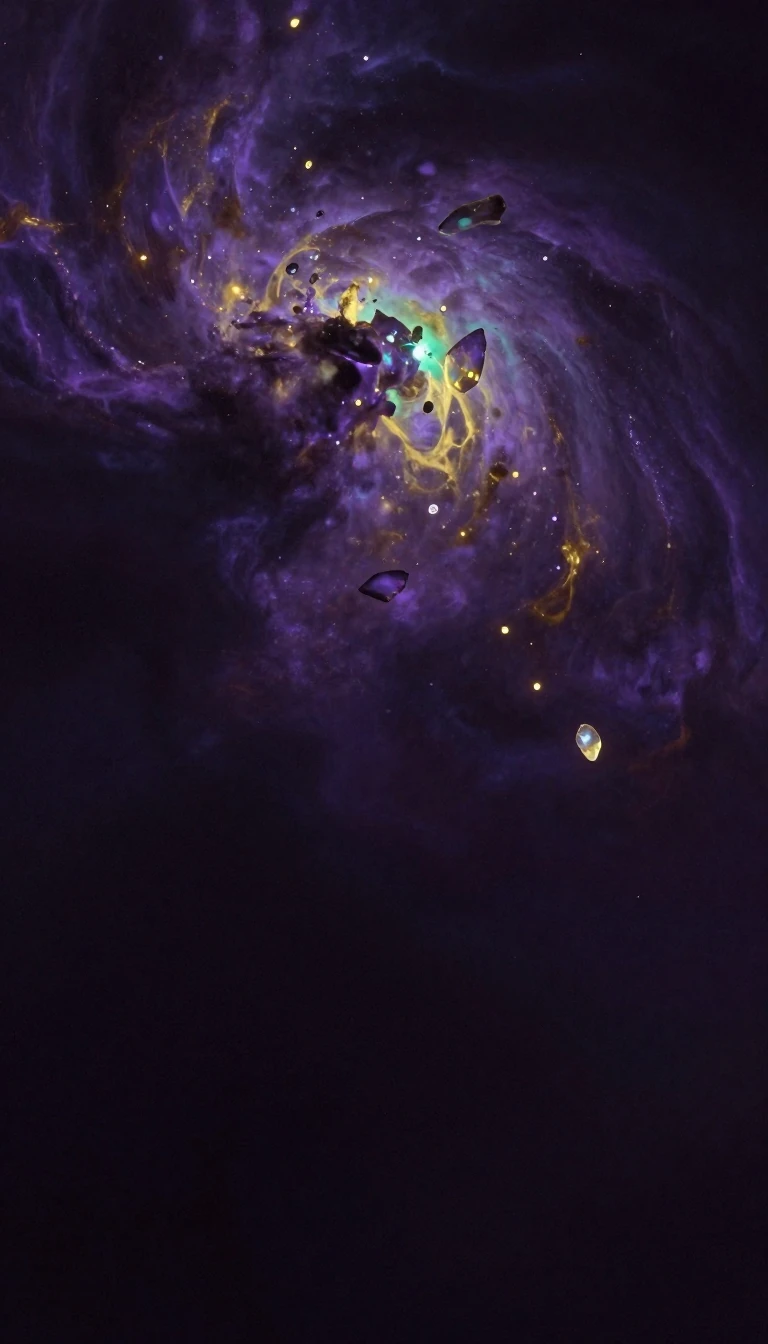
In short: For centuries, geologists viewed the rock cycle as a closed, Earth-bound system. Modern science reveals a far grander reality: rocks are part of a universal evolution, linking stellar death to planetary formation. From interstellar dust to asteroid collisions, the cycle of creation and destruction operates on a truly cosmic scale.
Traditionally, the rock cycle was taught as a terrestrial phenomenon driven by plate tectonics and the water cycle. In this view, igneous, sedimentary, and metamorphic rocks transition between states through weathering, burial, melting, and pressure. While these processes are vital—with water mediating everything from mineral dissolution to magma generation above subduction zones—they represent only one local manifestation of a much broader, universal mechanism.
Planetary science now reframes this as a cosmic rock cycle. It begins in interstellar space, where stellar winds and supernova explosions concentrate matter into molecular clouds. Presolar grains, such as silicon carbide and diamond, serve as mineralogical evidence of this inheritance, predating the Sun itself. Within protoplanetary disks, these materials undergo early cycles of fragmentation and remelting, forming tiny objects like chondrules before accreting into larger bodies.
Asteroids and other planetary bodies exhibit their own distinct cycles. Primitive asteroids undergo aqueous alteration, where internal water transforms minerals, while hypervelocity collisions induce shock metamorphism—a process far more frequent in space than on Earth. Even erosion takes on new forms, such as space weathering caused by cosmic rays and solar wind on airless surfaces. Earth itself is not isolated; it receives approximately 52 million kilograms of interplanetary dust annually, integrating extraterrestrial material into its own geological history.
This expanded perspective moves beyond 'geological geocentrism.' By incorporating tidal heating on moons like Io, cryovolcanism on icy worlds, and the exchange of material through impacts, scientists are building a unified framework. This approach bridges the gap between geology, astrophysics, and planetary science, affirming that the transformation of rocky matter is a fundamental, ongoing process throughout the universe.
Opens the Intellect+ feed with this card first. Swipe up for the next one.
Sources
- Summary by Intellect · source: Rock cycle
- Also: learningzone.oumnh.ox.ac.uk — The rock cycle
To cite this card, link to https://intellectplus.co.uk/app/nature-rock-cycle.
How we source, check and correct cards: Editorial standards.
General information, not professional advice. Spotted an error? Flag the card or see corrections and complaints.
Intellect Plus is a visual educational discovery platform for exploring fascinating facts and ideas. Brain Food, Not Brain Rot. What is Intellect Plus?
Related
More in Geology · More in Nature · Latest · A–Z · All topics
