Did one man master both the stars and the deepest secrets of number theory?
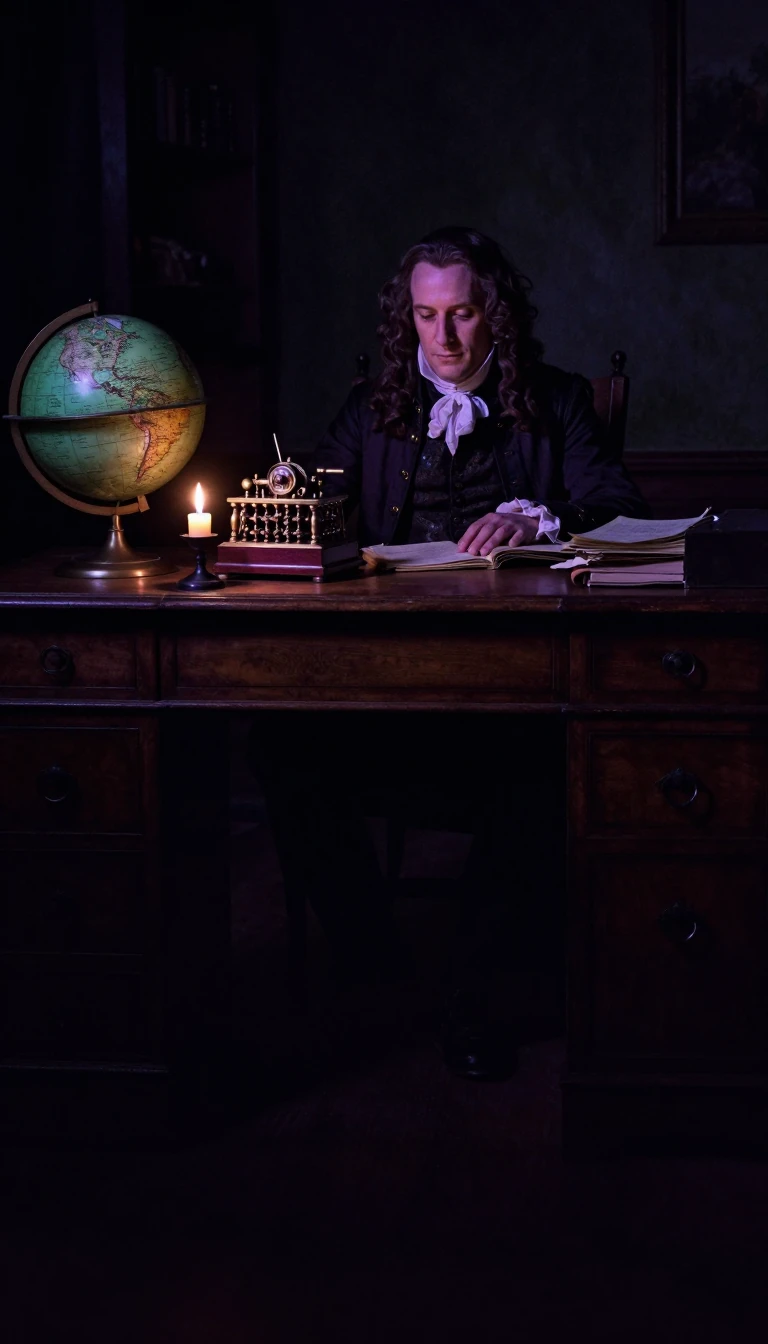
In short: Abu Ja'far al-Khazin was a tenth-century polymath whose work spanned the heavens and the abstract realm of integers. While his astronomical instruments were legendary, his mathematical legacy is shrouded in mystery, including a strange intellectual rivalry over the impossibility of cubic sums that still puzzles historians today.
Born around 900 in Khurasan, al-Khazin became a prominent figure in the court of the Buyid dynasty in Rayy. Under the patronage of the ruler Adud ad-Dawlah, who reigned from 949 to 983, al-Khazin was tasked with significant scientific duties, including a precise measurement of the obliquity of the ecliptic in 959/960 using a four-meter ring. His astronomical expertise was best captured in his work Zij al-Safa'ih, which detailed an advanced astrolabe fitted with specialized tables. This work was so highly regarded by his successors that it became a standard reference, though a physical copy of the instrument famously vanished in Germany during World War II.
Beyond astronomy, al-Khazin engaged deeply with number theory, specifically the congruum problem. He demonstrated how to find a square number that, when added to or subtracted from a given natural number, results in another square. His smallest example, 24, illustrates this: adding 24 to 5 squared yields 7 squared, while subtracting it leaves 1 squared. This work showcased his analytical rigor, yet his reputation remains complex. Some scholars debate whether the 'al-Khazin' who excelled in number theory was the same individual who wrote on astronomy, or if two distinct mathematicians shared the name.
The mystery deepens regarding his correspondence with al-Khujandi, who claimed to have proven the n=3 case of Fermat’s Last Theorem. Al-Khazin publicly criticized this proof as defective. However, historians like Roshdi Rashed have uncovered manuscripts attributed to al-Khazin that contain the very same flawed logic he had previously denounced. Whether this indicates a failed attempt at his own proof or a deeper, unresolved contradiction in his work remains a subject of intense academic inquiry. His critique of Ptolemy’s solar model—based on the observation that the sun's apparent diameter did not vary as Ptolemy’s theory predicted—further highlights his commitment to empirical observation, even when his tools were not yet sensitive enough to detect the subtle variations he sought.
Opens the Intellect+ feed with this card first. Swipe up for the next one.
Sources
- Summary by Intellect · source: al-Khazin - Biography
- Also: Abu Ja'far al-Khazin
To cite this card, link to https://intellectplus.co.uk/app/science-abu-ja-far-al-khazin.
How we source, check and correct cards: Editorial standards.
General information, not professional advice. Spotted an error? Flag the card or see corrections and complaints.
Intellect Plus is a visual educational discovery platform for exploring fascinating facts and ideas. Brain Food, Not Brain Rot. What is Intellect Plus?
Related
More in Mathematicians · More in Science · Latest · A–Z · All topics
