How eighteenth-century star gazing evolved into the modern science of chemical analysis
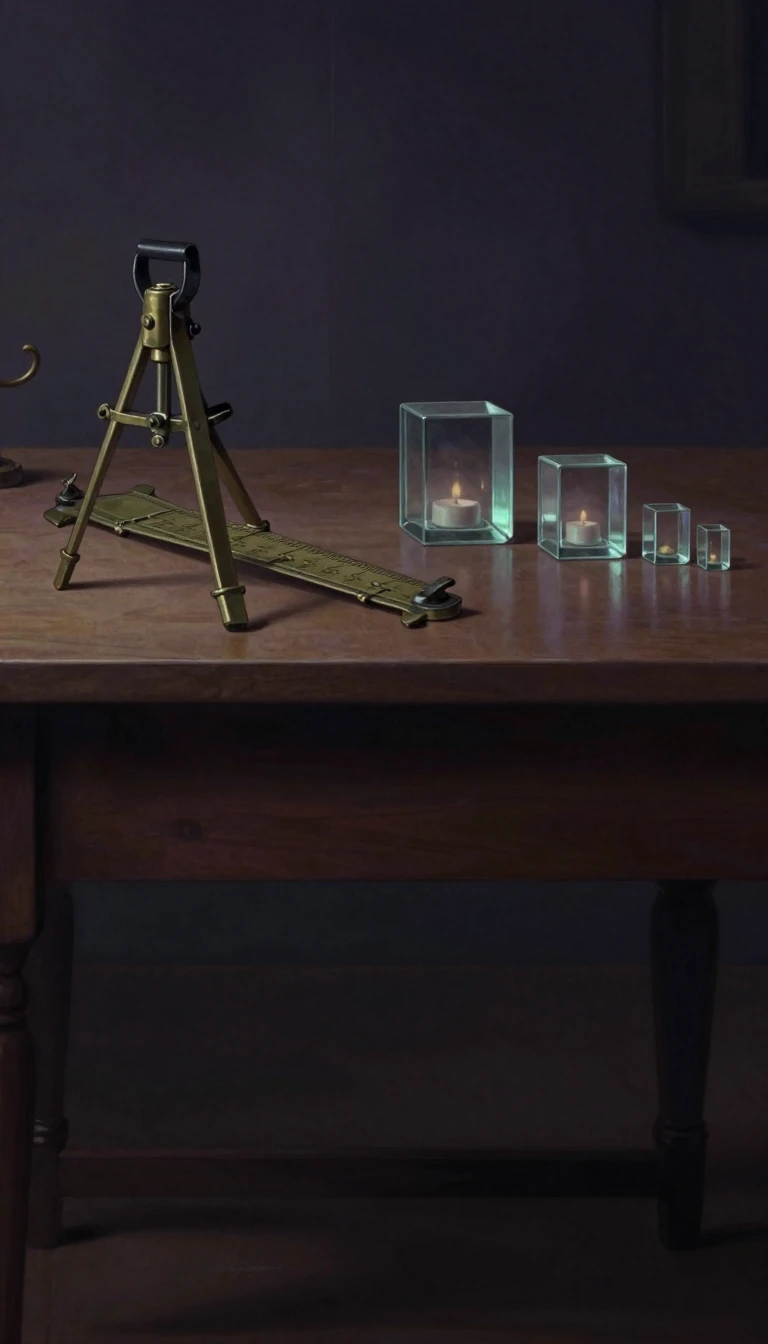
In short: The Beer-Lambert law links the light-absorbing properties of a solution to its concentration. While it is now a staple of chemistry, its origins lie in the early 1700s, when astronomers used light intensity to measure the height of the atmosphere. It remains the fundamental mechanism for quantifying matter through light.
The Beer-Lambert law describes a linear relationship between the amount of light a substance absorbs and its concentration. While modern chemistry uses this to identify substances in solution, the concept began with Pierre Bouguer in 1729. Bouguer studied how starlight intensity changed as it passed through the atmosphere, discovering that light intensity decreased exponentially with the distance traveled. Johann Heinrich Lambert later formalized these observations in his 1760 work, Photometria, establishing the mathematical foundation for how light propagates through a medium.
In 1852, August Beer applied similar principles to colored solutions. Beer focused on homogeneous liquids, where light attenuation is primarily due to absorption rather than the scattering caused by atmospheric dust. Although Beer did not explicitly reference the earlier astronomical work, modern physics integrates both perspectives by combining scattering and absorption into a single extinction coefficient. This synthesis allows scientists to calculate the concentration of a substance by measuring how much light passes through a sample of known thickness.
The law operates on the principle that the extinction process is linear regarding radiation intensity and the amount of matter present. Whether using decadal logarithms favored by chemists or natural logarithms preferred by physicists, the core logic remains consistent: absorbance is the product of absorptivity, path length, and concentration. For complex materials with multiple interacting species, the total absorbance is simply the sum of the individual absorbances of each component. This mathematical framework remains essential for everything from laboratory analysis to radiation shielding and atmospheric science.
Opens the Intellect+ feed with this card first. Swipe up for the next one.
Sources
- Summary by Intellect · source: Beer–Lambert law
To cite this card, link to https://intellectplus.co.uk/app/science-beer-lambert-law.
How we source, check and correct cards: Editorial standards.
General information, not professional advice. Spotted an error? Flag the card or see corrections and complaints.
Intellect Plus is a visual educational discovery platform for exploring fascinating facts and ideas. Brain Food, Not Brain Rot. What is Intellect Plus?
Related
More in Waves · More in Science · Latest · A–Z · All topics
