Chemical waves that mimic life: the Belousov–Zhabotinsky reaction
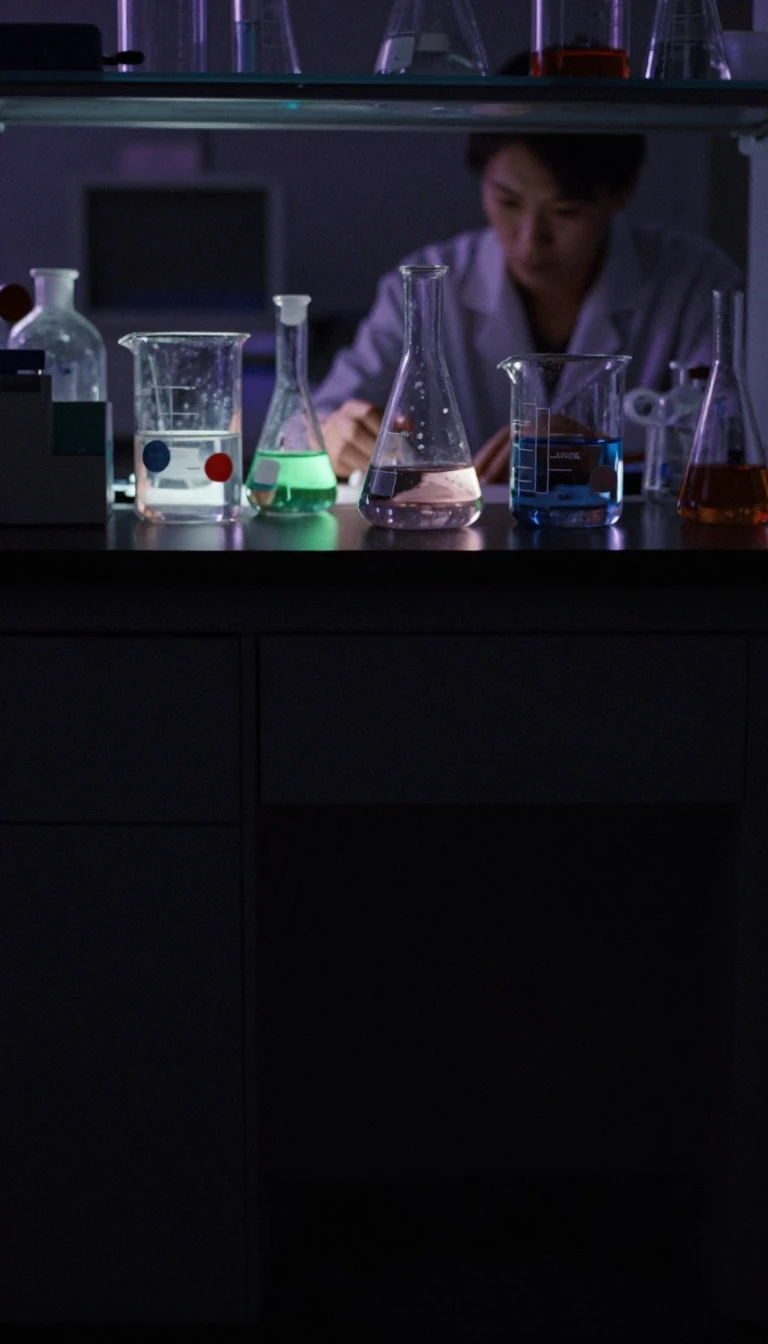
In short: How does a liquid spontaneously organize into expanding spirals and concentric rings? The Belousov–Zhabotinsky reaction creates complex patterns from simple chemicals, moving far from thermodynamic equilibrium to create a nonlinear chemical oscillator. It is a bridge between inorganic chemistry and the mysterious self-organizing behaviors of biological life.
Boris Belousov identified this reaction during 1951 research into non-organic Krebs cycle mimics, using a combination of sulfuric acid, citric acid, malonic acid, cerium(IV) sulfate, and potassium bromate. The result is a solution that oscillates between yellow and colorless (or red-brown and colorless depending on the catalyst). This happens because cerium(IV) ions are reduced to cerium(III) by malonic acid, then oxidized back to cerium(IV) by bromate(V) ions.
The reaction is a classic example of non-equilibrium thermodynamics. Unlike most reactions that seek a stable equilibrium state, this system remains far from equilibrium for significant periods, evolving chaotically or into ordered patterns. It exhibits "excitability," where stimuli can trigger self-organizing activity in a quiescent medium. In petri dishes, these interactions form expanding spirals similar to cyclic cellular automata. Theoretically, the reaction resembles an ideal Turing pattern: a system emerging from reaction-diffusion equations where a promoter and inhibitor diffuse at different rates.
The implications reach far beyond chemistry. Because it mimics biological phenomena like the growth patterns of Dictyostelium discoideum (a soil amoeba colony), researchers use it to explore "wet computers" and liquid logic gates. In 1968, it was revealed to the West that this reaction could even be used to create a chemical Turing machine capable of recognizing specific languages. Even after the reagents are consumed, some variants can experience a "rebirth," resuming activity after 5 to 20 hours.
The history of its recognition is as complex as the chemistry. Belousov's initial attempts to publish were rejected because he could not satisfy editors with an explanation for his results. It wasn't until 1959 that it appeared in a non-reviewed journal, and it was Anatol Zhabotinsky who investigated the sequence in detail starting in 1961.
Opens the Intellect+ feed with this card first. Swipe up for the next one.
Sources
- Summary by Intellect · source: Belousov–Zhabotinsky reaction
- Also: A simple oscillating reaction
To cite this card, link to https://intellectplus.co.uk/app/science-belousov-zhabotinsky-reaction.
How we source, check and correct cards: Editorial standards.
General information, not professional advice. Spotted an error? Flag the card or see corrections and complaints.
Intellect Plus is a visual educational discovery platform for exploring fascinating facts and ideas. Brain Food, Not Brain Rot. What is Intellect Plus?
Related
More in Organic compounds · More in Science · Latest · A–Z · All topics
