The invisible force that guides the dance of quantum particles
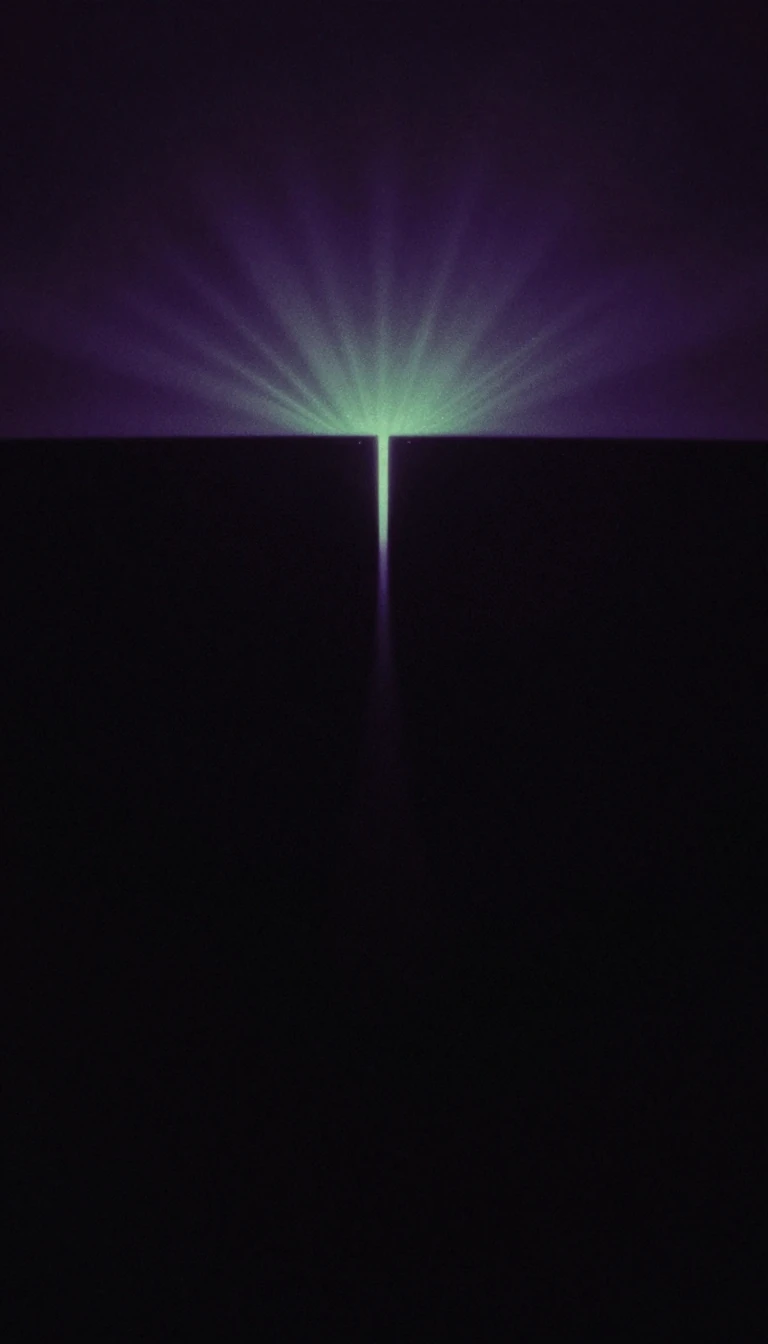
In short: In the standard view of quantum mechanics, particles exist in a haze of probability. But a different perspective suggests an invisible, information-rich potential is actually guiding their trajectories, potentially linking the entire universe into a single, unbroken whole.
In 1952, physicist David Bohm introduced the concept of the quantum potential as a central element of the de Bro relatively–Bohm formulation of quantum mechanics. While Louis de Broglie had proposed a 'pilot wave' as early as 1925, he was unable to derive a specific guidance equation for particles. Bohm’s breakthrough provided a more complete framework, later elaborated by Bohm and Basil Hiley as an 'information potential' that acts upon a quantum particle.
Mathematically, the quantum potential emerges from the real part of the Schrödinger equation when using a polar decomposition of the wave function. It appears as a specific term in a modified Hamilton–Jacobi equation, distinguishing quantum physics from classical mechanics. Unlike classical forces, this potential depends on the curvature of the wave function's amplitude. Crucially, because it is tied to the intensity of the field, it does not necessarily diminish as distance increases, providing a mathematical basis for nonlocality.
This mechanism offers a radical alternative to the 'wave function collapse' found in the Copenhagen interpretation. In the de Broglie–Bohm approach, measurement does not destroy a wave; instead, the quantum potential can develop unstable bifurcation points. These points separate particle trajectories into distinct 'channels,' allowing for processes like state transitions or fission to occur without needing a human observer. In 1975, Bohm and Hiley used this to propose a vision of 'unbroken wholeness' for the entire universe, where the potential carries information about the entire experimental arrangement.
The implications of this theory extend to complex systems. For an n-particle system, the wave function is represented in a configuration space with three dimensions per particle. While the total quantum potential of a separable system is simply the sum of individual potentials, true separability is physically unlikely because environmental interactions destroy such factorization, maintaining the interconnected nature of the system.
Opens the Intellect+ feed with this card first. Swipe up for the next one.
Sources
- Summary by Intellect · source: Quantum potential
To cite this card, link to https://intellectplus.co.uk/app/science-quantum-potential.
How we source, check and correct cards: Editorial standards.
General information, not professional advice. Spotted an error? Flag the card or see corrections and complaints.
Intellect Plus is a visual educational discovery platform for exploring fascinating facts and ideas. Brain Food, Not Brain Rot. What is Intellect Plus?
Related
More in Mechanics · More in Science · Latest · A–Z · All topics
