Why the orbital period of a low-altitude satellite depends only on density
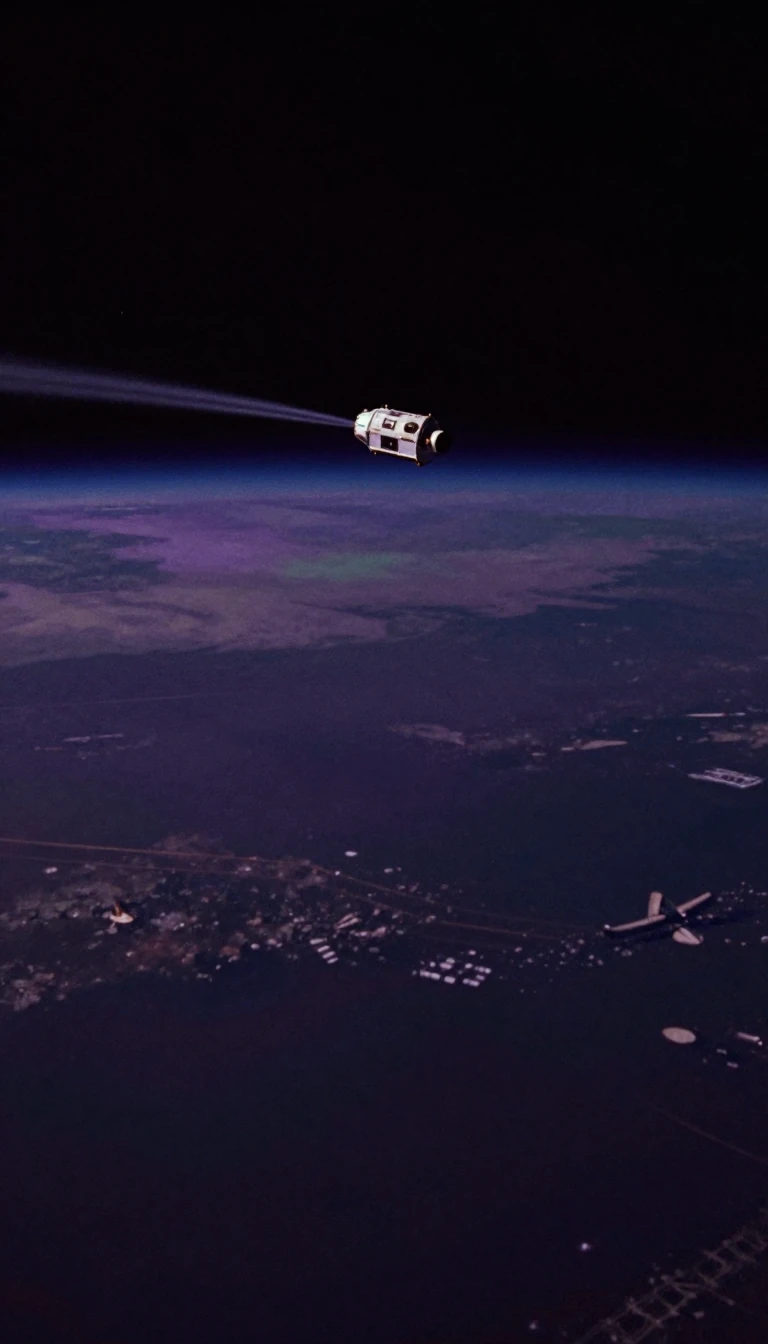
In short: An object in a low orbit does not care about the size of the body it circles. Whether it is a planet or a small sphere, the time required to complete one revolution is determined entirely by the central object's mean density. It is a surprising shortcut in celestial mechanics.
In celestial mechanics, the orbital period is the time an object takes to complete a 360-degree revolution around a primary body. While Kepler's Third Law provides the standard calculation based on the semi-major axis and the mass of the central body, a fascinating simplification emerges for objects in low orbits. When a body orbits barely above the surface of a sphere, the orbital period depends solely on the sphere's mean density, regardless of its physical size.
This relationship allows astronomers to use density as a universal reference. For instance, a sphere made of water, with a density of approximately 1,000 kg/m3, would result in an orbital period of 3 hours and 18 minutes for any object skimming its surface. This principle holds for any spherically symmetric body, such as Earth, which has a mean density of about 5,515 kg/m3. Because density is the governing factor in these low-altitude scenarios, it serves as a practical alternative to using the gravitational constant in complex calculations.
However, orbital periods are rarely straightforward in practice. Beyond the basic sidereal period—the time taken to complete an orbit relative to fixed stars—astronomers must account for various definitions. The synodic period, for example, measures the time between repeated alignments, such as when Jupiter returns to opposition every 398.8 days. Other variations, like the draconitic period or the anomalistic period, arise from the precession of orbital planes and the movement of periapsis. These complexities, alongside perturbations from other celestial bodies and general relativity, require precise astrometry to fully map the dance of objects in space.
Opens the Intellect+ feed with this card first. Swipe up for the next one.
Sources
- Summary by Intellect · source: Orbital period
To cite this card, link to https://intellectplus.co.uk/app/technology-orbital-period.
How we source, check and correct cards: Editorial standards.
General information, not professional advice. Spotted an error? Flag the card or see corrections and complaints.
Intellect Plus is a visual educational discovery platform for exploring fascinating facts and ideas. Brain Food, Not Brain Rot. What is Intellect Plus?
Related
More in Cars · More in Technology · Latest · A–Z · All topics
