Can you carve a human body like a sculptor chips away at cold marble?
In short: In 1972, artist Eleanor Antin challenged the rigid boundaries of sculpture by documenting her own weight loss as a form of carving. Decades later, Charles Ray explored the life cycle of wood by recreating a fallen log. Both works redefine carving as an act of intentionality, transformation, and inevitable decay.
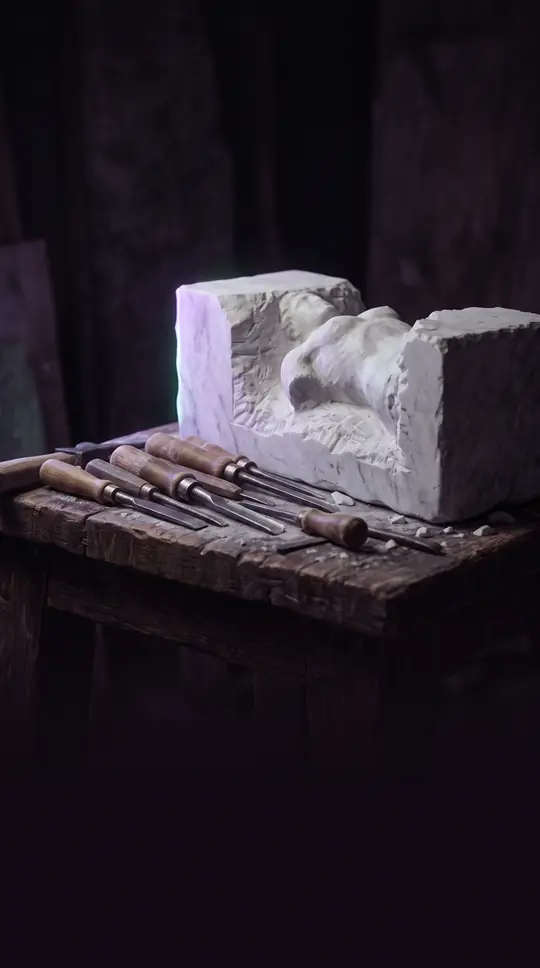
Carving is traditionally defined as the subtractive process of shaping solid materials by scraping away portions to reveal a form. While methods using malleable substances like clay allow for additive shaping, carving demands the removal of material, a labor-intensive technique historically associated with stone and wood. Eleanor Antin’s 1972 work, Carving: A Traditional Sculpture, subverted this classical tradition. By documenting her 10-pound weight loss over 37 days through 148 photographs, she treated her own body as the block of marble, mimicking the Greek sculptor’s method of discarding the unnecessary to find an ideal form.
The conceptual weight of carving shifts when applied to organic matter. In 2007, Charles Ray created Hinoki, a sculpture based on a fallen log he discovered in California. Rather than simply casting the log, Ray collaborated with master woodworker Yuboku Mukoyoshi in Osaka, Japan, to carve the form into hinoki cypress. This choice was rooted in the Japanese tradition of remaking objects that are beyond restoration, such as ancient temples or Buddha statues. For Ray, the act of sculpting from the inside out became a way to manifest the 'pneuma'—or breath—of the tree.
The life cycle of such a sculpture is not static. When Ray questioned Mukoyoshi about the longevity of the hinoki wood, he was told the material would remain stable for 400 years before entering a two-century period of splitting and cracking, followed by a 400-year decline. This realization allowed Ray to accept that the sculpture, like the original log, possessed its own autonomous existence. Both Antin and Ray demonstrate that carving is less about the final object and more about the trajectory of life, intentionality, and the eventual surrender to time.
Opens the Intellect+ feed with this card first. Swipe up for the next one.
Sources
- Source: Art Institute of Chicago — Hinoki · CC0 (data); description CC BY 4.0
- Also: Carving
- Also: CARVING: A Traditional Sculpture
To cite this card, link to https://intellectplus.co.uk/app/art-carving.
How we source, check and correct cards: Editorial standards.
General information, not professional advice. Spotted an error? Flag the card or see corrections and complaints.
Intellect Plus is a visual educational discovery platform for exploring fascinating facts and ideas. Brain Food, Not Brain Rot. What is Intellect Plus?
Related
More in Visual arts · More in Art · Latest · A–Z · All topics
