The hidden science behind the perfect chocolate snap
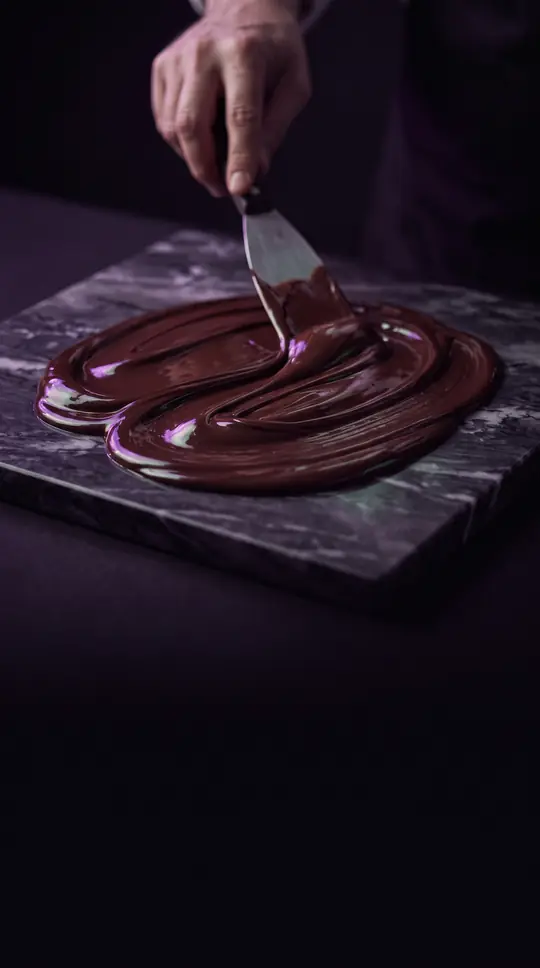
In short: Ever wondered why some chocolate is glossy and smooth while others look dull and white? The secret lies in a complex thermal dance called tempering. It is a precise manipulation of crystal structures that transforms liquid cocoa butter into a stable, professional-grade masterpiece.
At the heart of chocolate making is polymorphism, the ability of cocoa butter to crystallize into six distinct structures, labeled I through VI. While all these forms exist, only Form V provides the coveted glossy finish, smooth texture, and clean snap. Without precise temperature control, chocolate can develop 'bloom'—that unappealing white, powdery substance on the surface—or a gritty texture caused by crystals with melting points higher than human body temperature.
The tempering process is a deliberate cycle of heating, cooling, and agitation. It begins by heating chocolate to 40 °C (104 °F) to ensure all fats are completely melted. The liquid is then cooled—for example, to 32 °C (90 °F)—to initiate crystallization. Crucially, the chocolate is then slightly reheated to a range of 29–31 °C (84–88 °F). This step is vital because it melts away unstable, low-energy crystals while leaving behind the heat-resistant Form V nuclei to guide the rest of the fat.
Achieving this is particularly difficult with milk chocolate. The presence of milk fat lowers the temperature required for crystals to seed to approximately 29.4 °C (84.9 °F), compared to 34.5 °C (94.1 °F) for dark chocolate. In professional settings, large-scale machines use high shear to break down crystals and distribute nuclei throughout the mass. In artisanal workshops, makers may use marble tables with different temperature zones or even test the temper by feeling for a specific cooling sensation on their lips.
The chemistry is further complicated by additives. Sugar can act as a nucleus for crystallization, while lecithin is often added to slow the process by coating sugar molecules. While the technique's origins are often attributed to Jean Tobler, the underlying molecular mechanics of these crystal structures were not fully understood by scientists until the 1970s.
Opens the Intellect+ feed with this card first. Swipe up for the next one.
Sources
- Summary by Intellect · source: Tempered chocolate
To cite this card, link to https://intellectplus.co.uk/app/food-tempered-chocolate.
How we source, check and correct cards: Editorial standards.
General information, not professional advice. Spotted an error? Flag the card or see corrections and complaints.
Intellect Plus is a visual educational discovery platform for exploring fascinating facts and ideas. Brain Food, Not Brain Rot. What is Intellect Plus?
Related
More in Chocolate & sweets · More in Food & Drink · Latest · A–Z · All topics
