Why are cells microscopic? The physical limits of diffusion dictate the size of life.
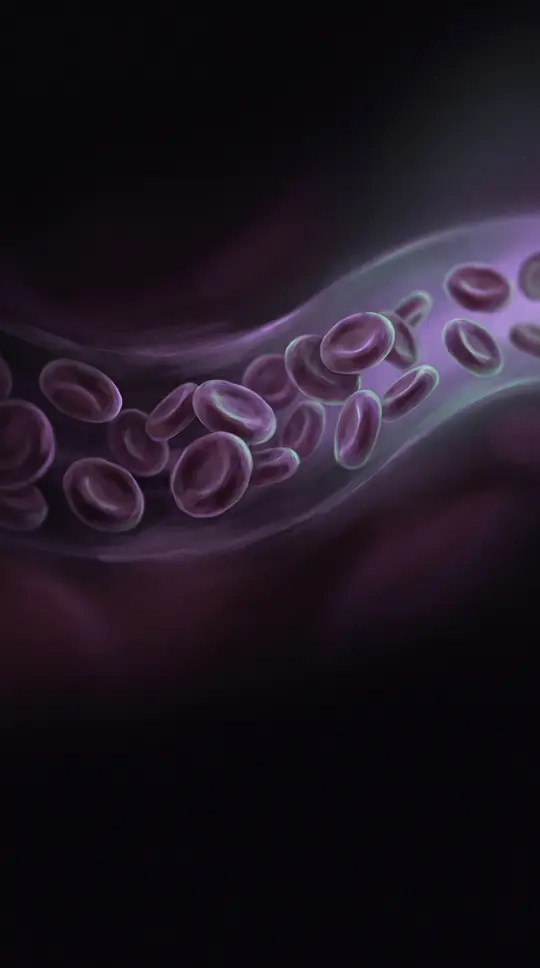
In short: Cells are not small by accident. The rate at which molecules diffuse through a cell is a fixed physical constant, creating a theoretical limit on how large a cell can grow. If a solute starts in the center of a bacterium, it takes about one millisecond to reach the membrane.
Biological membranes act as the gatekeepers of life, using a thin, oily hydrophobic core to control which solutes enter or exit. This barrier is semipermeable, allowing water to pass while blocking most biochemicals and salts. This fundamental concept of unequal permeability was established by Charles Overton in the 1890s. The barrier's effectiveness depends on the density of the lipid bilayer; more tightly packed lipids result in lower permeability.
The movement of these solutes is governed by Fick's laws of diffusion, defined by Adolf Fick in 1855. Diffusion is a passive process where molecules move from high to low concentration. Because larger molecules have lower diffusion coefficients, they move more slowly. This speed limit is absolute under physiological conditions, meaning a cell cannot simply speed up the process to accommodate a larger volume. This constraint forces most cells to remain microscopic to ensure nutrients can reach their destination in time.
While most cells are tiny, there are exceptions that store nutrients for embryos, such as the ostrich egg, which weighs about 3.3 pounds and is the size of a cantaloupe. Fossilized dinosaur eggs have been found as large as a basketball. These are specialized storage vessels rather than typical cells. For standard cells, however, the physics of diffusion remains the primary architect of their scale, ensuring that the internal environment remains balanced and functional.
Environmental factors like temperature also shift membrane behavior. For example, large unilamellar vesicles made from DPPC show a phase transition at 41.3°C. Permeability is lowest in the tightly packed gel state and high in the liquid disordered state. Interestingly, maximum permeability occurs at the transition temperature itself, where porous boundaries form between coexisting gel and liquid domains, allowing solutes to pass through more readily than in either pure state.
Opens the Intellect+ feed with this card first. Swipe up for the next one.
Sources
- Summary by Intellect · source: Membrane Transport
- Also: Membrane transport
To cite this card, link to https://intellectplus.co.uk/app/science-membrane-transport.
How we source, check and correct cards: Editorial standards.
General information, not professional advice. Spotted an error? Flag the card or see corrections and complaints.
Intellect Plus is a visual educational discovery platform for exploring fascinating facts and ideas. Brain Food, Not Brain Rot. What is Intellect Plus?
Related
More in Cell biology · More in Science · Latest · A–Z · All topics
