A cloud overhead is almost never really stationary
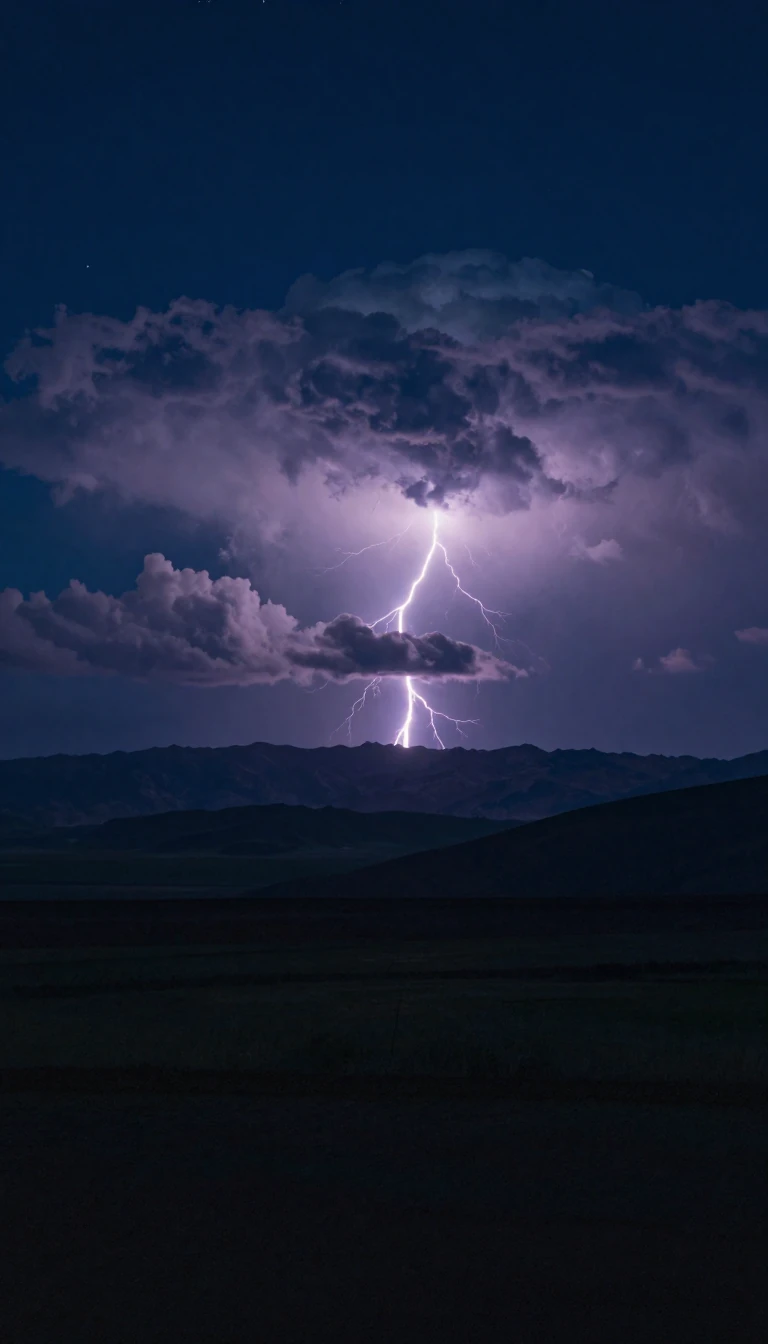
In short: Every cloud is carried by moving air, even when it looks frozen. Distance and perspective do most of the work: a cloud drifting at 20 or 30 kilometres per hour, several kilometres up, seems to crawl, much like a jet at cruising altitude. The cloud is simply visible air, and that air is always on the move.
A cloud is not a solid object pushing itself across the sky. It is a visible region where water vapour has turned into tiny droplets or ice crystals, and that region sits inside the wider flow of the atmosphere. When the wind carries the air from west to east, the cloud goes with it at roughly the same speed. Wind, in turn, comes from differences in air pressure. Because the sun heats land faster than water and the equator more than the poles, pressure varies from place to place, and air drifts from high-pressure zones toward low-pressure ones. The Earth's rotation bends that flow into the large patterns that steer weather systems.
Altitude sets the pace. Clouds below about two kilometres usually travel between 15 and 50 kilometres per hour, slowed by friction with the ground. Mid-level clouds often move faster, and high cirrus made of ice crystals can be carried by the jet stream, a narrow band of strong wind that forms where warm and cold air masses meet, at more than 150 kilometres per hour. Wind can also change with height, so two layers of cloud sometimes drift in quite different directions.
Why do some clouds seem to hang in one spot for hours? Distance is the main reason. High clouds are many kilometres away, and motion parallax, in which far-off objects appear to move more slowly, makes a fast cloud look almost still. Weak pressure differences can also leave the air gently moving, letting fair-weather cumulus linger over one valley. Meteorologists turn this movement into data: satellite cloud-tracking helps estimate wind at cloud level, especially over the open ocean and remote deserts where weather stations are scarce.
The same principle applies on other worlds. On Venus, the thick cloud layer circles the planet in roughly four to five Earth days, even though the planet turns very slowly, a effect called atmospheric superrotation. The details differ greatly from Earth, but the cause is still uneven heating driving the air. A cloud is never truly stationary; it is a visible marker of air in motion.
Opens the Intellect+ feed with this card first. Swipe up for the next one.
Sources
- Summary by Intellect · source: Are Clouds Moving? The Science Behind Cloud Movement - Biology Insights
- Also: Why Do Clouds Move Slowly
- Also: Why Do Clouds Move So Fast in the Sky? - ScienceInsights
To cite this card, link to https://intellectplus.co.uk/app/science-why-do-clouds-move.
How we source, check and correct cards: Editorial standards.
General information, not professional advice. Spotted an error? Flag the card or see corrections and complaints.
Intellect Plus is a visual educational discovery platform for exploring fascinating facts and ideas. Brain Food, Not Brain Rot. What is Intellect Plus?
Related
More in Science · Latest · A–Z · All topics
