Newborn stars announce their arrival by blasting supersonic jets into deep space
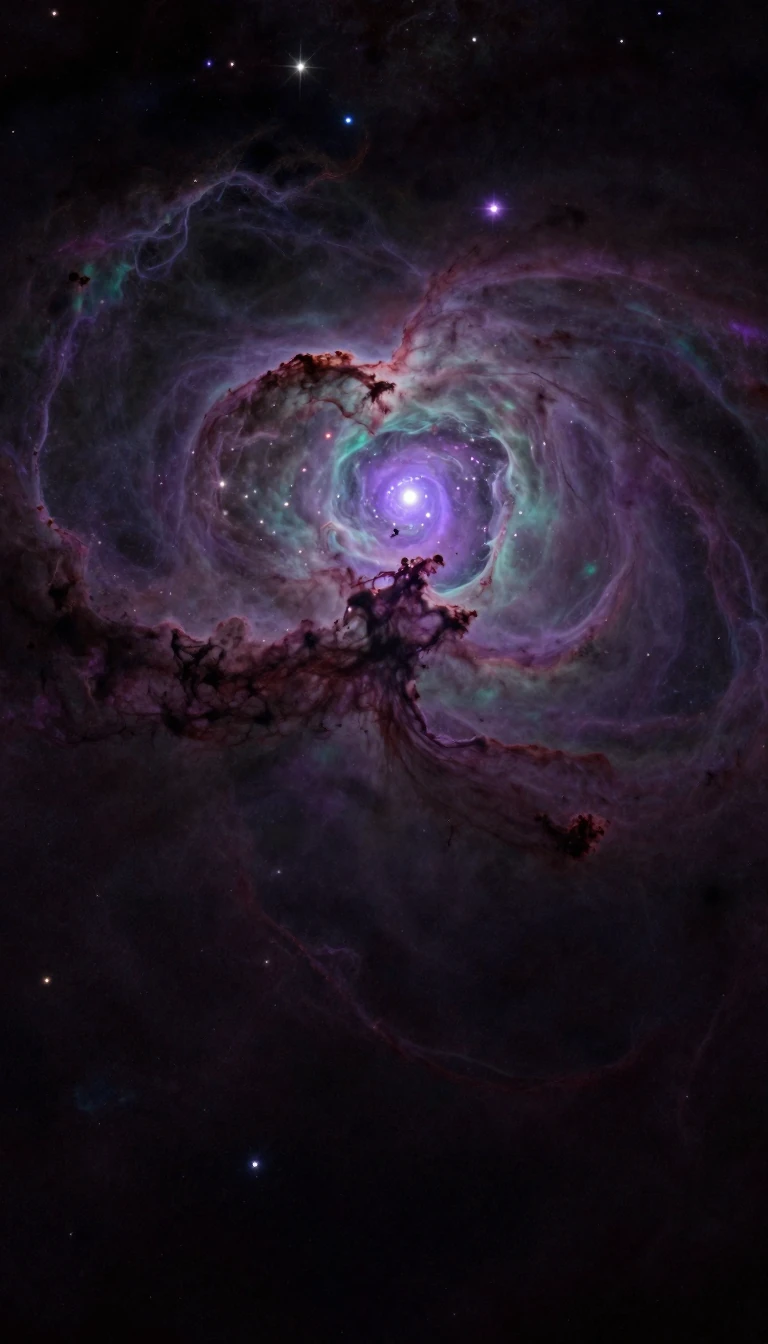
In short: When a star is born, it does not emerge quietly. As it feeds on surrounding gas, it ejects powerful, narrow jets of plasma that collide with interstellar dust at immense speeds. These violent impacts create glowing, transient structures known as Herbig-Haro objects, marking the turbulent infancy of stellar evolution.
Herbig-Haro objects serve as luminous signposts for protostars, the embryonic stages of stellar development. As a protostar grows, it draws material from a surrounding disk of gas and dust. To maintain stability, the star must shed excess angular momentum; it does this by launching collimated jets of ionized gas along its rotational axis. When these high-speed outflows strike the cold, dense clouds of the interstellar medium, they generate shockwaves that heat surrounding molecules to thousands of degrees, causing them to emit light.
These features are often hidden from view by the very clouds that birthed the stars. Because young stars remain embedded in thick cocoons of dust, their jets are best observed in infrared light. Instruments like the James Webb Space Telescope allow astronomers to peer through this obscuring material, revealing intricate details of the shocks. For instance, recent observations of HH 797, located near the IC 348 cluster, demonstrated that what previously appeared to be a single outflow was actually a pair of parallel jets produced by a binary star system.
The transient nature of these objects makes them dynamic subjects for study. As they travel away from their parent stars, they can change appearance over just a few years as they encounter clumpy material in space. While early researchers like George Herbig and Guillermo Haro identified these nebulae in the 1940s, modern technology has refined our understanding of their mechanics. By analyzing the velocity and composition of the excited gas, scientists can now map the complex, chaotic environments where stars are forged, proving that the birth of a sun is a violent, messy affair.
Understanding these outflows is essential for grasping how stars reach maturity. Without the ability to eject material, a protostar would rotate too rapidly to survive the gravitational collapse required for nuclear fusion. These jets act as a pressure valve, clearing vast cavities in the surrounding molecular clouds and shaping the architecture of the star-forming region. Every Herbig-Haro object is a fleeting snapshot of this critical process, lasting only a few tens of thousands of years before fading into the background of the galaxy.
Opens the Intellect+ feed with this card first. Swipe up for the next one.
Sources
- Summary by Intellect · source: Webb Telescope: A prominent protostar in Perseus - NASA
- Also: Herbig–Haro object
- Also: Awakening Newborn Stars - NASA Science
To cite this card, link to https://intellectplus.co.uk/app/space-herbig-haro-object.
How we source, check and correct cards: Editorial standards.
General information, not professional advice. Spotted an error? Flag the card or see corrections and complaints.
Intellect Plus is a visual educational discovery platform for exploring fascinating facts and ideas. Brain Food, Not Brain Rot. What is Intellect Plus?
Related
More in Stellar astronomy · More in Space · Latest · A–Z · All topics
