Before stars reach maturity, they pass through a volatile, planet-forming phase called T Tauri.
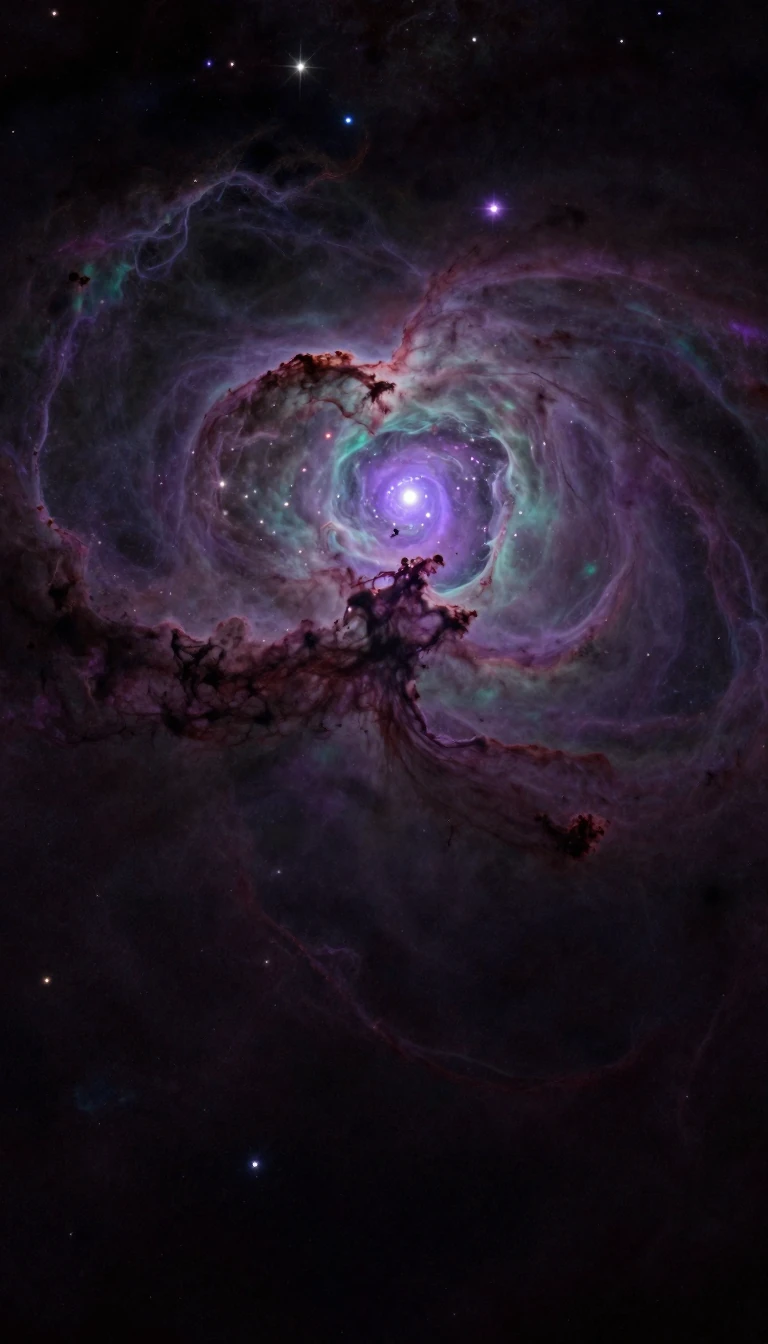
In short: T Tauri stars are the restless adolescents of the cosmos. Less than ten million years old, these infant stars are not yet powered by nuclear fusion. Instead, they glow from the heat of their own gravitational collapse, spinning rapidly and shedding energy through intense stellar winds and erratic brightness fluctuations.
Named after the prototype discovered in 1852, T Tauri stars represent a critical pre-main-sequence stage in stellar evolution. These objects, typically less than two solar masses, are found near molecular clouds. Unlike the Sun, which is powered by hydrogen fusion, T Tauri stars generate energy through gravitational contraction as they move along the Hayashi track. Because their radii are significantly larger than those of main-sequence stars, they appear much more luminous despite having similar surface temperatures. This phase is relatively brief, lasting until the star develops a radiative zone or begins nuclear fusion, a process that takes about 100 million years to reach completion.
The environment surrounding these stars is remarkably dynamic. Roughly half of them host circumstellar disks—protoplanetary systems that serve as the nurseries for future planets. Astronomers believe that the star's active magnetic fields and powerful stellar winds, driven by Alfvén waves, transfer angular momentum from the star to these disks. This mechanism may explain how our own Sun shed its angular momentum during its early youth, allowing the surrounding material to coalesce into the planets of our Solar System. The variability observed in these stars is often caused by large starspots, intense X-ray and radio emissions, or even the movement of protoplanetary clumps within the disk.
Lithium abundance serves as a unique diagnostic tool for these stars. Because lithium is destroyed at temperatures exceeding 2,500,000 K, its presence in the spectra of T Tauri stars provides a window into their internal processes. Studies suggest that 'lithium burning' via the p-p chain during the unstable stages of the Hayashi contraction may actually contribute to the star's energy output. As the star ages, it spins faster due to the conservation of angular momentum, which improves internal mixing and accelerates the transport of lithium into deeper, hotter layers where it is destroyed. Consequently, the rate of lithium depletion acts as a cosmic clock, allowing researchers to estimate the age of these young stellar objects.
Opens the Intellect+ feed with this card first. Swipe up for the next one.
Sources
- Summary by Intellect · source: T Tauri star
- Also: www.cfa.harvard.edu — T-Tauri Stars | Center for Astrophysics | Harvard & Smithsonian
- Also: www.britannica.com — T Tauri star | Young Stellar Object, Protostar & Pre-Main-Sequence | Britannica
To cite this card, link to https://intellectplus.co.uk/app/space-t-tauri-star.
How we source, check and correct cards: Editorial standards.
General information, not professional advice. Spotted an error? Flag the card or see corrections and complaints.
Intellect Plus is a visual educational discovery platform for exploring fascinating facts and ideas. Brain Food, Not Brain Rot. What is Intellect Plus?
Related
More in Stellar astronomy · More in Space · Latest · A–Z · All topics
