 Intellect Plus
Measurement
229 cards. Each one is a 40-second story with a five-minute read behind it. Page 3 of 4.
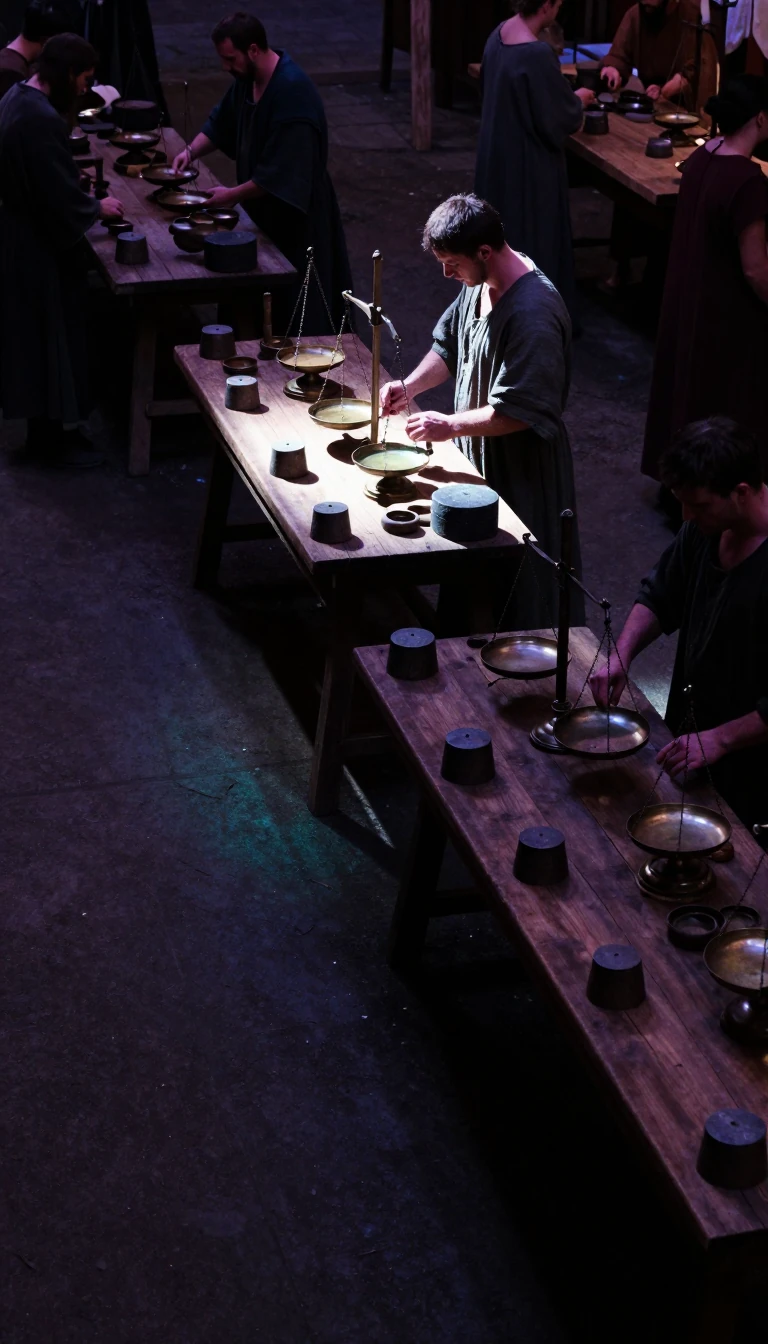 The Picul: How an Ancient Shoulder-Pole Load Became a Global Trade StandardDefined originally as the weight a person could carry on a shoulder-pole, the picul evolved from an ancient Chinese grain measure into a vital lingua franca for maritime trade. Fr…
 Why the pint is a global measurement nightmare disguised as a simple drinkThe pint is a unit of volume defined by history rather than logic. While it is traditionally one-eighth of a gallon, the actual amount you receive depends entirely on your locatio…
 Why your high-resolution monitor might look blurry when you finally print it out.Pixel density, or pixels per inch, is the bridge between digital files and physical reality. While your screen resolution dictates how much information you see, pixel density dete…
 The poise measures how much a fluid resists flowing under a specific forceBeyond its common meaning of grace and balance, the poise is a precise scientific unit for dynamic viscosity. It quantifies the internal friction of fluids, revealing how much for…
 Why the pound is both a unit of mass and a unit of forceThe pound is a linguistic chameleon, often causing confusion in engineering. While we typically use it to measure mass, the pound-force is a distinct unit of force. Understanding …
 Why your tire pressure gauge ignores the weight of the atmosphere pressing on youThe pound per square inch is a standard unit of pressure in the United States, but it hides a secret. Whether you are checking your car tires or a scuba tank, the number you see o…
 Why this traditional East Asian unit of area refuses to disappear from real estateAcross Korea, Japan, and Taiwan, the pyeong remains a stubborn ghost in the machine of modern property markets. Despite official bans and the global dominance of the square meter,…
- Why the quart is a shape-shifting unit of measurement across the globeThe quart sounds like a simple quarter of a gallon, but its reality is far more chaotic. Depending on where you are and what you are measuring, a quart can represent three distinc…
 Unlike a classical bit, a qubit exists in a coherent superposition of multiple states.A classical bit is strictly zero or one, but a qubit defies this binary constraint. By existing in a coherent superposition, it holds complex probability amplitudes that allow for…
 The rad is a legacy measurement of radiation energy that persists in American industry.Defined in 1962, the rad measures the energy deposited by ionizing radiation into matter. While the international scientific community has largely transitioned to the gray, the ra…
 Why the radian is the most natural way to measure circular motionWhen an object moves in a circle, we often track its speed in meters per second. But to understand how fast it rotates, we use radians per second. This unit, represented by the Gr…
 Why engineers use a temperature scale that starts at absolute zero but measures in FahrenheitThe Rankine scale is an absolute temperature system that anchors zero at the theoretical point of minimum molecular energy. While the Kelvin scale dominates scientific research, R…
 From ticking clocks to interstellar dust, how fast can the universe actually spin?Revolutions per minute is a common measure of rotational speed, but it is not an official SI unit. While a clock hand moves at a steady 1 rpm, the extremes of rotation span from s…
 The rod: a medieval surveyor's tool that still dictates modern land boundaries todayBefore GPS, surveyors used a simple rod to map the world. Standardized at 16.5 feet, this humble unit helped Henry VIII seize church lands and still influences property titles, pi…
 The Japanese foot: How a hand-span measurement became a modern industrial standardDerived from the distance between a thumb and forefinger, the shaku is a traditional Japanese unit of length that has evolved from a variable local measurement into a standardized…
 Why the shannon is the only precise way to measure true information contentWe often confuse the physical storage of data with the information it actually carries. While a computer uses bits to store binary signals, the shannon measures the actual informa…
- Why the word ton is one of the most confusing measurements in historyIn the United States, a ton is typically 2,000 pounds, but if you step into a naval shipyard or look at global grain statistics, that definition might shift beneath your feet. Und…
 Why the world's most precise measurements no longer rely on physical objectsFor over a century, the global standard for mass was a single, fragile metal cylinder kept in a vault near Paris. Today, that relic is obsolete. Modern science has shifted to a mo…
 The slug is a unit of mass, but it has nothing to do with molluscs.In the world of physics, the slug is a specialized unit of mass used in British Imperial and United States customary systems. Despite its name, which implies a slow-moving creatur…
 Why astronomers use our Sun as the universal yardstick for measuring stellar powerThe Sun is more than just our local star; it is the fundamental unit of measurement for the entire universe. By defining stellar output in terms of solar luminosity, astronomers c…
 Why astronomers use the Sun as the ultimate cosmic scale for everything elseThe solar mass is a fundamental unit in astronomy, roughly equal to 2x10^30 kilograms. Because we cannot weigh the Sun directly, we calculate its mass using orbital mechanics. Thi…
- Why the Sun's exact size remains a moving target for modern astronomersWe define the Sun's radius as 695,700 kilometers, but this is a nominal convention rather than a static physical truth. Because the Sun is a rotating, non-spherical body with a co…
- How do astronomers measure the size of objects scattered across the vast celestial sphere?When you look at the night sky, how do you quantify the size of a constellation or the moon? Astronomers use the square degree, a unit of solid angle that maps the curvature of th…
 Why medieval city walls and modern golf courses often share the same footprintThe square kilometre is a standard unit of area, yet it serves as a surprisingly consistent benchmark for human geography. From the defensive perimeters of ancient European settle…
- Why a square kilometre is not just one thousand times a square metreThe square metre is the foundational unit of area in the International System of Units. While it seems straightforward as the area of a square with one-metre sides, the math chang…
 Why a square mile is not the same as a mile squareThe square mile is a staple of imperial measurement, yet its name frequently leads to confusion. While it sounds like a simple geometric description, the distinction between a squ…
 Why the ancient Greek stadion remains a measurement mystery for modern historiansThe stadion was the standard ancient Greek unit of length, defined as 600 feet. Yet, because the physical length of a foot varied across the Greek world, the exact modern equivale…
 Why the world relies on a fixed, artificial number for Earth's gravityStandard gravity is not a measurement of the actual pull of Earth at any specific spot. Instead, it is a fixed, nominal constant defined by international agreement. This precise v…
 Why the British still measure their own bodies in stones instead of kilogramsThe stone is a relic of a time when weights were as local as dialects. While most of the world shifted to the metric system, the British and Irish held onto this ancient unit for …
 Why your ruler and a scientist's laser are speaking two different languagesMeasurement systems began as local standards based on a king's thumb or stride. Today, we have moved toward a universal metric system, yet pockets of customary units persist. From…
 Why your kitchen teaspoon is a dangerous tool for measuring liquid medicineWhile a standard teaspoon is defined as exactly 5 mL for medical dosing, household spoons are notoriously unreliable. Research shows that common kitchen utensils vary wildly in vo…
 Telemetry is the invisible nervous system connecting remote machines to human intelligence and control.Derived from Greek roots meaning far-off measurement, telemetry is the automatic collection and transmission of data from remote locations. From monitoring steam engines in the 18…
 Why nuclear yields are measured in TNT, despite TNT being a poor energy proxy.The explosive power of nuclear weapons is measured in TNT equivalent, a convention that simplifies massive energy releases into a familiar scale. Yet, this unit is an arbitrary st…
 Why the ton is a shape-shifting unit of mass, volume, and pure slangThe ton is not just a heavy weight; it is a historical chameleon. Depending on where you stand and what you are measuring, it can represent a specific mass, a volume of cargo spac…
 Why the unit of pressure named after a barometer inventor is technically not mercury.Named for Evangelista Torricelli, the torr was once synonymous with a millimeter of mercury. Yet, modern science has decoupled the two. Today, the torr is defined by the standard …
 Why your digital fonts are measured by a standard born in the 18th centuryTypography relies on a complex web of historical units that predate modern digital screens. From the French Royal inch to the American Johnson pica, these measurements were design…
 Why the unit of account is the silent architect of our entire economic realityA unit of account is more than just currency; it is the essential standard for measuring value, debt, and performance. Without this abstract yardstick, modern commerce, accounting…
- Why the way we measure digital information is fundamentally tied to logarithmsInformation is not just about bytes and bits. At its core, the capacity to store data is defined by the number of possible states in a system, a principle formalized by Claude Sha…
 Why your cocktail is never just the sum of its partsWhen you mix ethanol and water, the final volume is actually less than the sum of the ingredients. This counterintuitive reality reveals why volume fraction—a simple ratio of a co…
 Before modern standards, England used a chaotic patchwork of different gallons for different goods.In 17th-century England, a gallon was not a fixed volume. Depending on whether you were trading corn, ale, or wine, you used a different measurement entirely. The Winchester Measu…
 The yard was once a royal arm, a tax loophole, and a shrinking metal bar.Before it became a standardized international measurement, the yard was a chaotic relic of royal anatomy and merchant rebellion. From medieval kings using their own limbs as ruler…
 The nuclear physics unit of time derived from a lamb's tailIn the high-stakes world of nuclear fission, seconds are far too long. To track the near-instantaneous progression of a chain reaction, scientists needed a much smaller scale. The…
 How a single unit of speed governs roads, rails, and sportsMiles per hour is more than just a dashboard reading. From the vast rail networks of North America and Ireland to the cricket pitches of the Commonwealth, this measurement defines…
 Why the ratio of mass stays constant even as temperatures changeWhen chemists analyze a mixture, they need a reliable way to describe its composition. Unlike volume or molarity, which can fluctuate, the mass fraction provides a stable, dimensi…
 The United States has been officially metric for over a centuryDespite the prevalence of customary units, the United States is technically a metric nation. This video explores the surprising history of the US commitment to the metric system a…
- Why the Harvard Bridge is officially measured in a unit called the smootDiscover the origin of the smoot, a non-standard unit of measurement used to quantify the length of the Harvard Bridge. This video explores the history behind this peculiar metric…
 The metric system was born from a revolutionary quest that ended in scientific errorBorn during the French Revolution, the metric system aimed to unify a chaotic world with rational, natural measures. Yet, the ambitious mission to define the meter by Earth’s dime…
 Why is our day divided into twenty-four hours of sixty minutes each?Timekeeping feels like a natural constant, but our system is a human invention. This video explores the origins of our clock, the definition of a second, and the authorities respo…
 Why the length of a furrow still shapes the modern city gridThe furlong, a unit dating back to Anglo-Saxon agriculture, was once the distance oxen could pull a heavy plough before needing a rest. Though largely abandoned in official record…
 Why the median lethal dose is a flawed but essential measure of toxicityThe LD50, or median lethal dose, is the amount of a substance required to kill half of a test population. While it serves as a standard benchmark for acute toxicity, it is notorio…
 How a minor Cabinet post became the engine of American industrial and economic standardsOnce dismissed as a sleepy office for managing lighthouses and fish, the U.S. Department of Commerce was transformed in the 1920s into a powerhouse of national efficiency. Today, …
 Why the title of tallest mountain on Earth is surprisingly impossible to defineAsking which mountain is the tallest seems like a simple geography quiz, but the answer depends entirely on how you define the measurement. Because our methods rely on various ass…
 Is the Second a Natural Constant or a Human Convention?We take the second for granted, yet its definition is anything but simple. Modern civilization's intricate machinery—from global finance to satellite navigation—rests on this seem…
 Magna Carta demanded one measure of ale for all of EnglandAmong the promises barons extracted from King John in 1215 was a surprisingly practical one. Clause 35 of Magna Carta required a single measure for wine, ale and corn throughout t…
 For decades America ran on two slightly different feetUntil recently the United States used two feet. The international foot, fixed in 1959, is exactly 0.3048 metres; the older survey foot, kept for land mapping, is a hair longer. Th…
 The volt was sized to match a telegraph battery cellWhen scientists fixed the volt in 1881, they chose a value close to the push of a Daniell cell, the workhorse battery of telegraph lines. Today the unit is realised with arrays of…
 Why the weekday planets skip around instead of following their sky orderOur days honour seven classical sky wanderers, the Sun, the Moon and five planets, yet not in their traditional order of distance. Each day's planet sits three places along that o…
 The words year and hour grew from the same ancient rootEnglish year, German Jahr and Old Norse ár all trace back to a Proto-Indo-European word meaning year or season. The same ancestor produced Greek hora, a season or stretch of time,…
- The sievert and the gray are both joules per kilogram, yet mean different thingsOn paper, the gray and the sievert are identical: one joule of energy per kilogram. But the gray records physical energy deposited in matter, while the sievert estimates the long-…
 A whole sphere contains about 12.57 steradians, the unit of solid angleA radian measures a slice of a circle; a steradian measures a cone's worth of a sphere. Stand at the centre of any sphere and the whole surrounding view spans four pi steradians, …