Technology · Mars Rover Operations
How do Mars rovers operate remotely?
The short answer
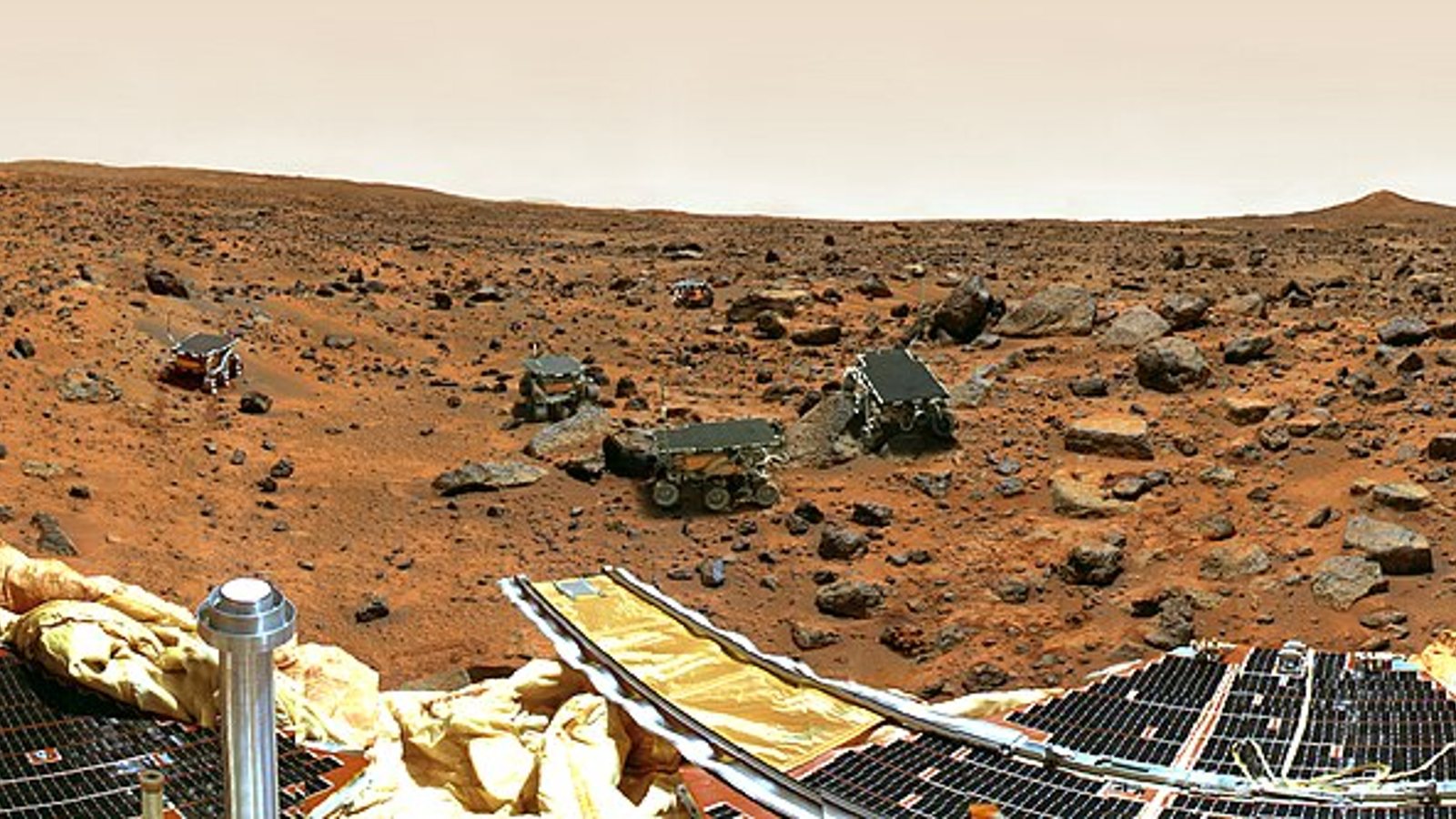
Mars rovers operate through a combination of autonomous software and remote human commands12. Direct teleoperation is impractical because radio signals take between 3 and 42 minutes to travel12. Instead, a command team plans and sends a full sol of operational commands at one time1. Rovers use autonomy software to make decisions based on sensor observations1. They also rely on relay satellites to link with ground controllers56. Humans still provide input to identify targets and determine how to position the rover for solar energy2.
What the evidence shows
Communication Challenges
Direct teleoperation is impractical due to communication times ranging from 8 to 42 minutes1. Radio signals travel too slowly for real-time control2. Sending a signal from Mars to Earth takes between 3 and 21 minutes2.
NASA's Mars missions can experience a communications blackout when the sun is between Earth and Mars6. Communications can be put on temporary standby due to solar conjunction6.
Autonomous Navigation
Rovers are capable of operating autonomously with little assistance from ground control for navigation and data acquisition2. They use autonomy software to make decisions based on observations from their sensors1.
The Mars Exploration Rovers can generate 15,000 to 40,000 3D points1. The Sojourner rover could generate 20 3D navigation points from each pair of stereo images1.
Relay Systems
Mars rovers and landers are linked to ground controllers via relay satellites5. The 2001 Mars Odyssey and Mars Reconnaissance Orbiter currently serve as relay satellites56.
NASA plans to use the MAVEN science orbiter as a backup telecommunications relay by lowering its orbit5. A new Mars telecom orbiter is envisioned for the late 2020s5.
Our take
This part is our own interpretation, not a sourced finding.
The fact that rovers can be operated even when they do not have their eyes on the ground3 is notable. This highlights the sophisticated level of autonomy and remote planning required for Martian exploration.
What we can't say for sure
Some sources assume operators are on Mars with no time delay4, while others state real-time control is impractical12.
Sources
- Comparison of embedded computer systems on board the Mars rovers - Wikipedia. en.wikipedia.org. other website, accessed 1 November 2026.
- Authority control databases GND. Rover (space exploration) - Wikipedia. en.wikipedia.org. other website, accessed 1 November 2026.
- Timeline of Mars Science Laboratory - Wikipedia. en.wikipedia.org. other website, accessed 1 November 2026.
- University Rover Challenge - Wikipedia. en.wikipedia.org. other website, accessed 1 November 2026.
- Next Mars Orbiter - Wikipedia. en.wikipedia.org. other website, accessed 1 November 2026.
- Timeline of Mars Reconnaissance Orbiter - Wikipedia. en.wikipedia.org. other website, accessed 1 November 2026.
Published 1 November 2026. Sources last checked 1 November 2026. Prepared with automated tools and checked against the sources named here: how we work. Spotted a mistake? Tell us.
Keep exploring in Intellect Plus
 CardWhy the most advanced drivers in the solar system are millions of miles away.
 VideoCan an astronaut operate a rover with sub-millimetre precision from orbit?
 VideoCan an astronaut drive multiple rovers from orbit?
 VideoHow engineers keep a Mars rover running for a decade without any human repairs
 VideoHow engineers test Mars rovers before sending them millions of miles away
 VideoAstronauts are practicing remote-controlling robots to explore distant planets
 VideoHow astronauts remotely operate robotic explorers from the International Space Station
 VideoHow driving remote-controlled cars from orbit prepares us for Mars
VideoHow driving a rover from orbit prepares us for Mars
 VideoHow astronauts navigate the dark using an orbital internet backbone
VideoHow a swarm of suitcase-sized robots will explore the Moon
 VideoThe logistical headache of keeping a 9-to-5 on Mars
More questions
 TechnologyWhy are satellites important?
 EarthWhy does the sky turn green before a storm?
 HistoryWhy do samurai carry two swords?
 SpaceWhat causes Jupiter's Great Red Spot?
 SpaceWhy is Pluto not a planet?
 Everyday ScienceWhy do coffee keep you awake?
 Everyday ScienceHow does rust form?
 Everyday ScienceHow does boiling work?
