Space · The Moon
Why can you see the Moon during the day?
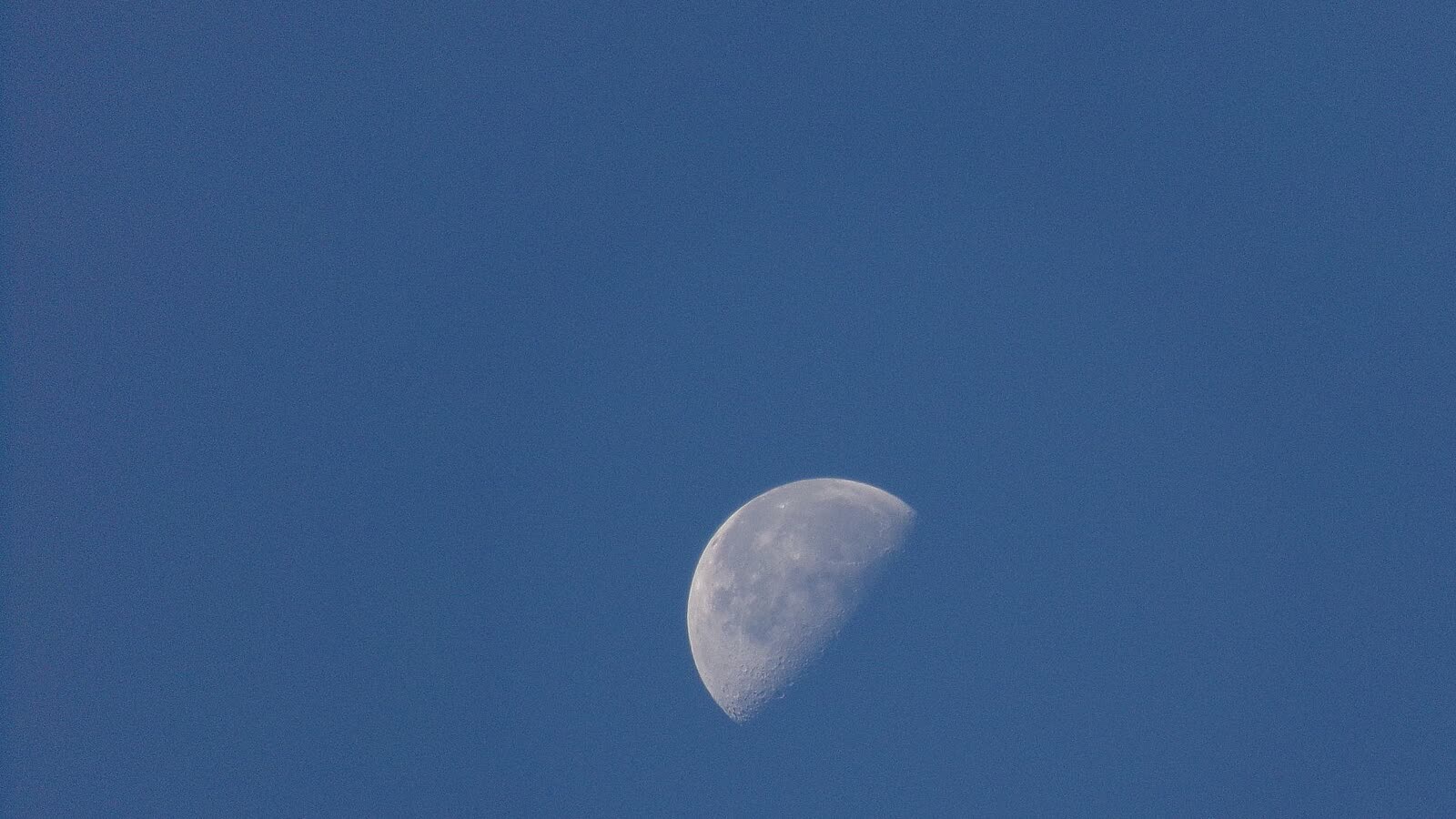
The short answer
Because the Moon is often above the horizon while the Sun is up, and it is bright enough to show through the daylight. It makes no light of its own: we see sunlight reflecting off its surface, by day as by night.1 Stars are up there during the day too, but the sky is too bright for us to see them.1 The daytime Moon can be seen on most days of the month, apart from those closest to the full Moon and the new Moon.2
What the evidence shows
It isn't really a night-time object
NASA scientist Sarah Noble points out that we think of the Moon as belonging to the night because books, films and weather symbols show it that way, when it spends almost as much time in the daytime sky as at night.1
The Moon is above the horizon for about 12 hours a day, but those hours don't always line up with daylight.2 At mid-latitudes in winter, shorter days leave less time to see it by day.2
The phase tells you when to look
The Sun always lights half of the Moon, and the cycle of phases repeats about every 29.5 days.3 Where the Moon is in that cycle sets when it rises and sets, and so whether it shares the sky with the Sun.3
| Phase | Rises | Sets |
|---|---|---|
| Waxing crescent | In the morning, after the Sun is up | At night, after the Sun is down |
| First quarter | Around midday | Around the middle of the night |
| Waxing gibbous | In the afternoon, before sunset | In the early hours, before sunrise |
| Full | At sunset | At sunrise |
| Waning gibbous | At night, after sunset | In the morning, after sunrise |
| Third quarter | Around the middle of the night | Around midday |
| Waning crescent | In the very early morning, before sunrise | In the afternoon, before sunset |
| New | With the Sun | With the Sun, and not visible in the daytime sky |
Why it looks so pale
NASA describes the daytime Moon as often visible as a faint, pale presence.3 The light reaching you is the same reflected sunlight as at night,2 now seen against a bright sky instead of a dark one.
Our take
This part is our own interpretation, not a sourced finding.
We like this question because the answer is mostly about us. The Moon's timetable has nothing to do with our day and night, so a daytime Moon isn't unusual. It only feels that way because we were taught to draw it next to the stars.
What we can't say for sure
The rise and set times above are the general pattern. Exact times change with your location and the date, so check local predictions if you want to plan a sighting.
Sources
- Sarah Noble (speaker); Tricia Talbert (editor). Why Can You See the Moon During the Day? We Asked a NASA Scientist: Episode 19. NASA, 2022-01-05. Government science agency, accessed 1 November 2026.
- Martin McGuigan. Daytime moon: Why can we sometimes see the moon in broad daylight?. Live Science, 2024-05-29. Science journalism, accessed 1 November 2026.
- NASA Science. Moon Phases. NASA. Government science agency, accessed 1 November 2026.
Published 1 November 2026. Sources last checked 1 November 2026. Prepared with automated tools and checked against the sources named here: how we work. Spotted a mistake? Tell us.
Keep exploring in Intellect Plus

More questions
 SpaceWhat causes Jupiter's Great Red Spot?
 SpaceWhy is Pluto not a planet?
 SpaceHow do black holes exist?
 NatureWhy does the sea glow blue at night?
 TechnologyWhy are satellites important?
 Everyday ScienceHow does rust form?
 NatureWhy does ice float on water?
 EarthWhy does the sky turn green before a storm?
