Nature · Oceans
Why does the sea glow blue at night?
The short answer
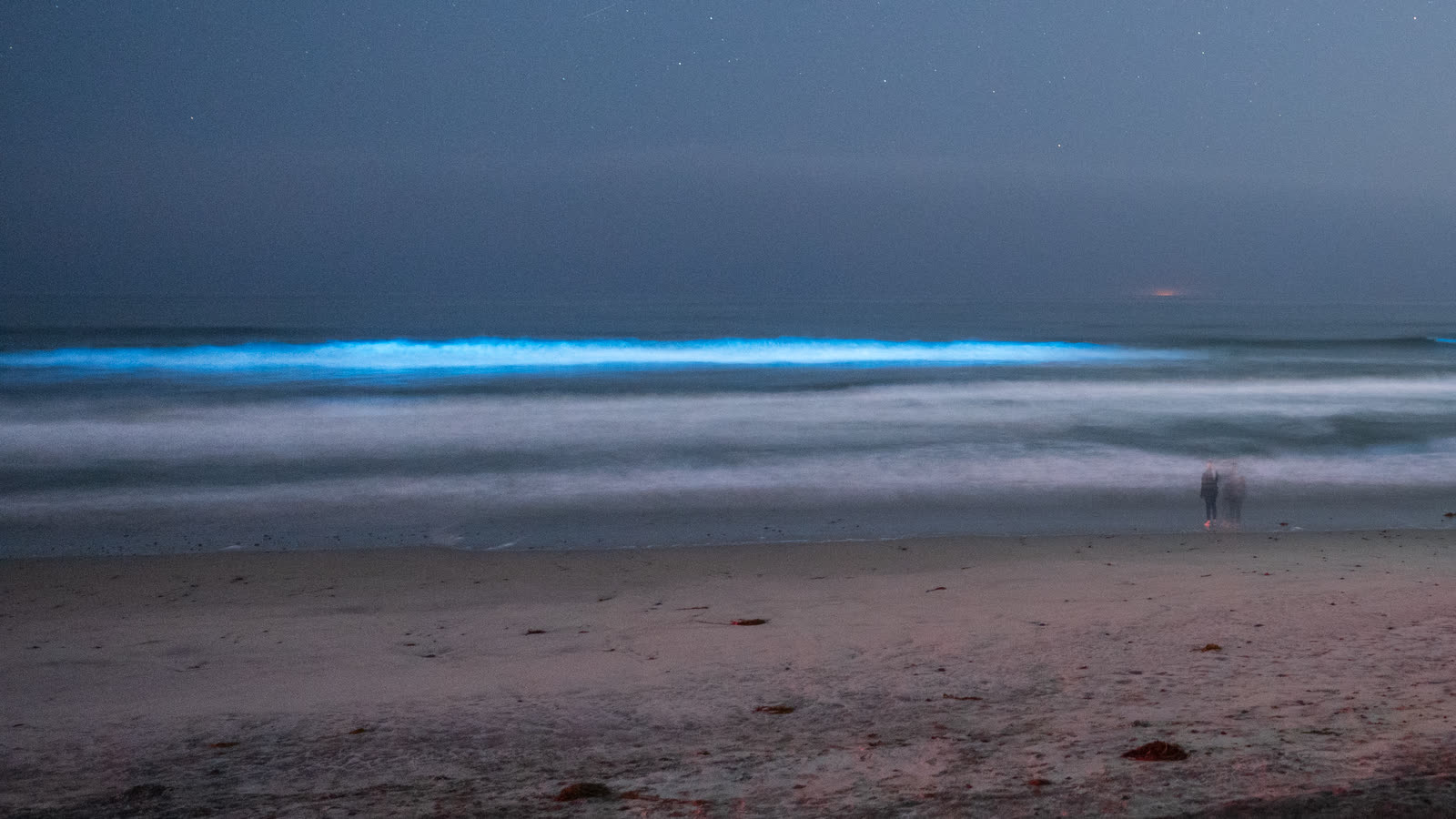
A blue glow in breaking waves is living light. Single-celled plankton called dinoflagellates make it with a chemical reaction, and they flash when the water around them is disturbed. They produce most of the glow seen at the ocean's surface.1 It shows at night because many of these species keep their light almost off during the day, and it is brightest where their populations are dense.1
What the evidence shows
The light comes from a chemical reaction
Bioluminescence is light made and given off by a living thing, using energy released by chemical reactions in the organism. Bioluminescent creatures live throughout the sea, from the surface to the deep seafloor.2
In dinoflagellates the light is made inside tiny structures called scintillons, which hold a light-making molecule (luciferin) and an enzyme (luciferase). When the luciferin is oxidised it releases a brief flash of blue light, at a wavelength of about 475 nanometres.1 As of that 2013 review, the exact details of the chemical step were still unknown.1
Why waves set it off
The cells mainly respond to mechanical force. Shear in the water, such as a breaking wave or contact with an animal that grazes on them, triggers the flash.1 That is why the brightest light tends to follow the moving edge of the surf.
Why you see it at night
In photosynthetic dinoflagellates an internal circadian clock controls the light, leaving it almost undetectable by day and brightest at night. Daylight itself can also suppress it.1
What the flash may be for
A widely accepted idea is the "burglar alarm": a flash set off by a grazer attracts a bigger predator, which then eats the grazer. The findings of the two key experiments on it agreed, using very different mixes of species.1 It is still a theory about what the light is for, so we treat it as the best current explanation and not as settled fact.
Our take
This part is our own interpretation, not a sourced finding.
The surprise here is that the light is a reaction, not a display. A glowing wave is close to a map of where the water is being pushed hardest, drawn by organisms far too small to see.
What we can't say for sure
Other things can make the sea look bright at night, and not every marine glow comes from dinoflagellates. This page explains the blue flashes of breaking waves, the case the research above describes.
Sources
- Valiadi, M. and Iglesias-Rodriguez, D.. Understanding Bioluminescence in Dinoflagellates: How Far Have We Come?. Microorganisms (MDPI), 2013. Peer-reviewed review, accessed 1 November 2026.
- National Ocean Service. What is bioluminescence?. US National Oceanic and Atmospheric Administration. Government science agency, accessed 1 November 2026.
Published 1 November 2026. Sources last checked 1 November 2026. Prepared with automated tools and checked against the sources named here: how we work. Spotted a mistake? Tell us.