Why the secret to walking a high-wire is actually about lowering your center of gravity
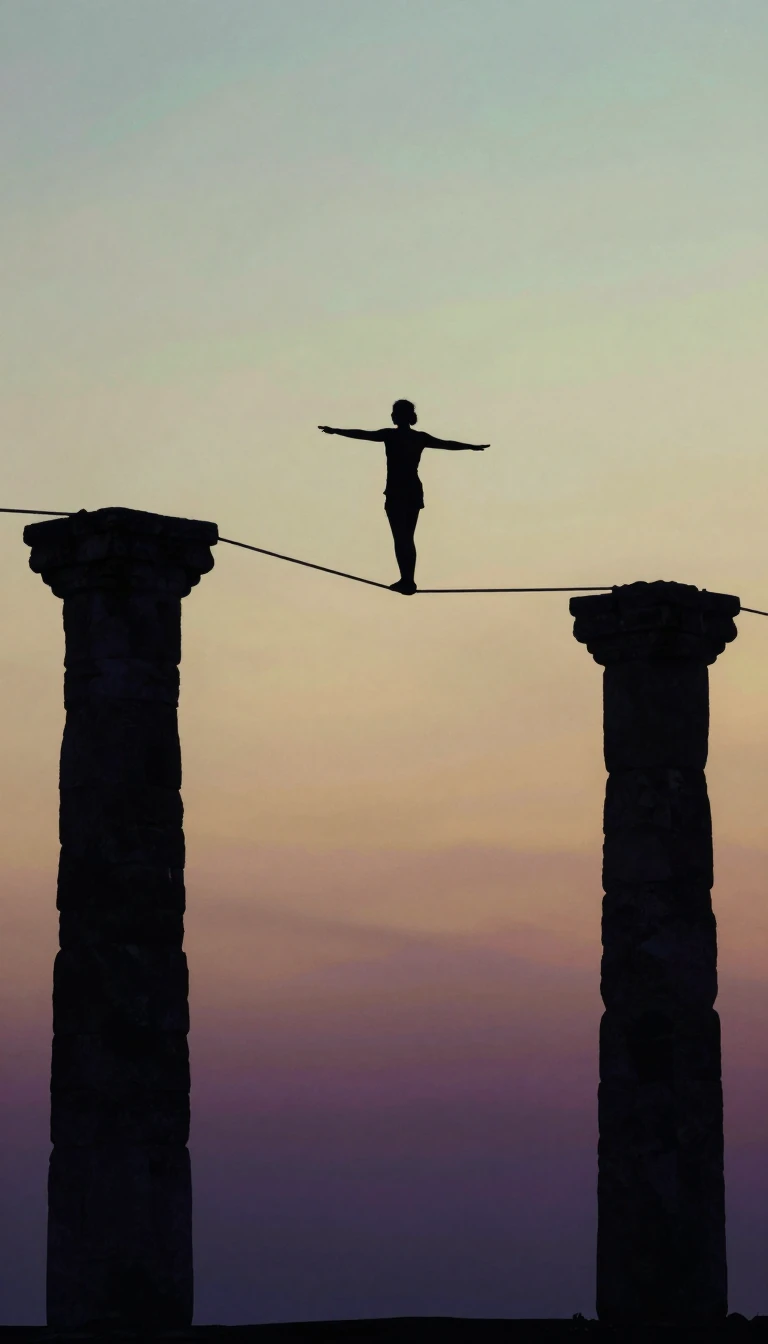
In short: Walking a tightrope is less about raw courage and more about mastering the physics of the human body. By manipulating your center of gravity and rotational inertia, you can turn a terrifying void into a space of simplicity, provided you understand how to fight the wire's natural urge to rotate.
The fundamental challenge of tightrope walking is maintaining balance while suspended over a void. According to Sonja Harpstead, an instructor at New York City's Circus Warehouse, the most critical factor is posture. Amateurs often mistakenly lean forward, which disrupts their sense of spatial orientation. Instead, the most effective technique is to stand upright and lower the hips by bending the knees. This shifts the body's center of gravity closer to the wire, making the walker significantly more stable, much like a stout vase is harder to topple than a tall, slim one.
Beyond positioning, the walker must contend with the wire itself. As a person steps onto the cable, it tends to rotate underfoot. To counteract this, walkers increase their rotational inertia, often by extending their arms horizontally or carrying a long balancing pole. Philippe Petit, famous for his 1974 walk between the Twin Towers, utilized a 26-foot pole to stabilize his movements. The pole serves a dual purpose: it allows the walker to make corrective adjustments by rotating the pole to create an equal and opposite torque, and its downward-bending ends further lower the center of gravity.
The environment and equipment also dictate success. Paolo Paoletti of the University of Liverpool notes that an infinitely taut wire is the ideal scenario; any slack causes the cable to undulate, complicating balance. Interestingly, the science of tightrope walking extends beyond performance art. Healthcare professionals are exploring the use of tightrope exercises as a diagnostic tool to identify early muscle degradation in elderly patients. Because walking on a wire is far more demanding than moving on solid ground, it can reveal muscular issues that would otherwise remain masked, offering a unique method for physical therapy and musculoskeletal strengthening.
Opens the Intellect+ feed with this card first. Swipe up for the next one.
Sources
- Summary by Intellect · source: What Happens to Your Body When You Walk on a Tightrope?
- Also: Tightrope walking
To cite this card, link to https://intellectplus.co.uk/app/art-tightrope-walking.
How we source, check and correct cards: Editorial standards.
General information, not professional advice. Spotted an error? Flag the card or see corrections and complaints.
Intellect Plus is a visual educational discovery platform for exploring fascinating facts and ideas. Brain Food, Not Brain Rot. What is Intellect Plus?
Related
More in Performing arts · More in Art · Latest · A–Z · All topics
