 Intellect Plus
Philosophy
492 cards. Each one is a 40-second story with a five-minute read behind it. Page 7 of 9.
 The Yoga Sutras are a patchwork of ancient wisdom, not a single unified manual.Often viewed as the definitive guide to classical yoga, the Yoga Sutras of Patanjali are actually a complex compilation of diverse philosophical strands. Far from a singular, cohe…
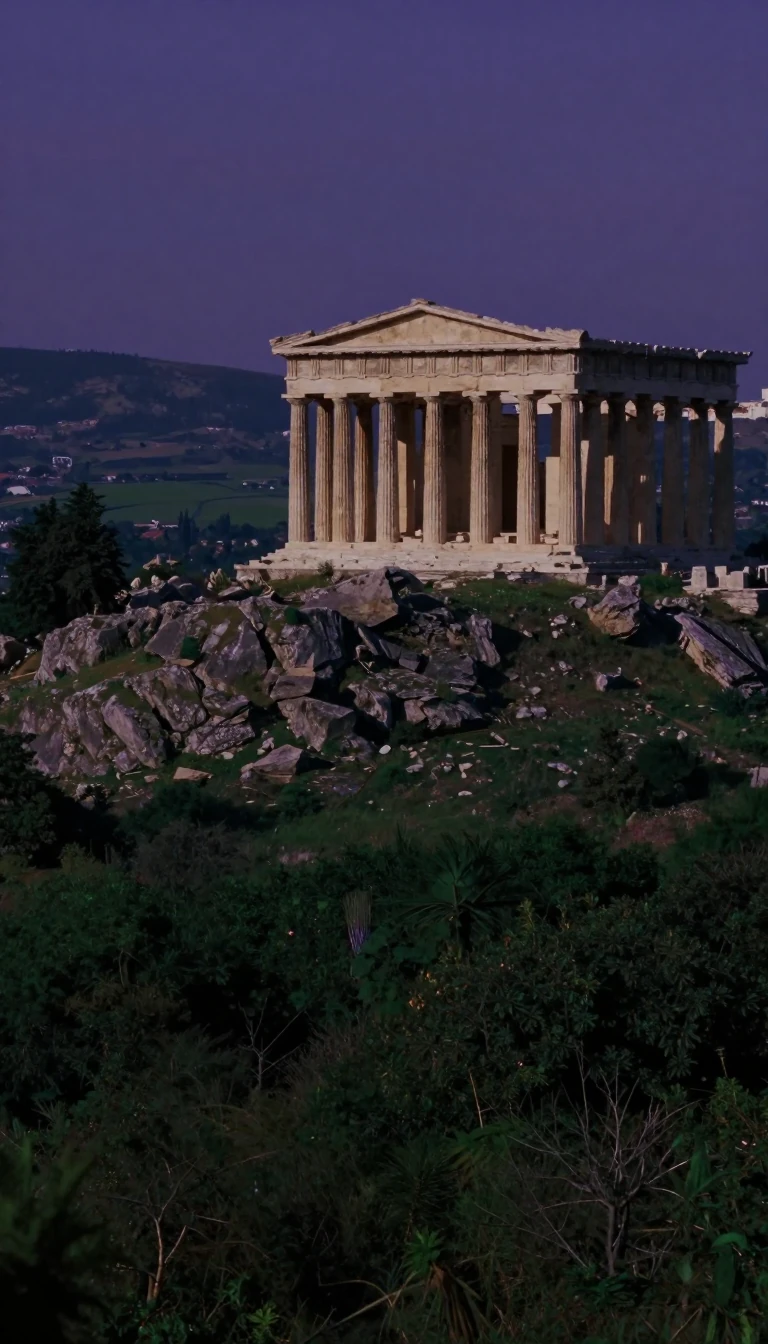 Plato’s Academy was not a school, but a sacred grove for intellectual inquiryLong before it became the West's first institution of higher education, the Academy was a site dedicated to Athena. It lacked a formal curriculum, fees, or even a clear distinctio…
 Is existence inherently flawed, or is the human experience simply defined by endless striving?Philosophical pessimism suggests that life carries a negative value, arguing that suffering is not merely a byproduct of existence but its fundamental core. By examining the mecha…
 If your future is already written, is there any point in trying to change it?Fatalism is the belief that human events are inevitable and outside our control. Whether through divine decree, logical necessity, or cosmic destiny, this doctrine suggests that o…
 Pan-Islamism seeks to unite the global Muslim community under a single political entity.Far from a modern invention, Pan-Islamism is a political movement that prioritizes religious allegiance over ethnicity or national borders. By advocating for a unified Islamic sta…
 A fatwa is not a binding decree, but a legal opinion from a scholar.Often misunderstood as a mandatory edict, a fatwa is historically a nonbinding response to a specific question about Islamic law. Issued by a qualified jurist known as a mufti, th…
 Is morality good because God loves it, or does God love it because it is good?This ancient question, posed by Socrates in Plato's Euthyphro, forces a choice between two uncomfortable extremes. Either morality is independent of God, limiting his sovereignty,…
 Are wormholes merely mathematical curiosities or potential shortcuts through the fabric of our universe?Wormholes are theoretical tunnels connecting distant points in spacetime, potentially allowing for travel across vast distances or even through time. While general relativity perm…
 Can a single mathematical framework describe every physical phenomenon in our vast universe?Physicists are hunting for a theory of everything—a unified framework to bridge the gap between gravity and quantum mechanics. While the Standard Model explains most forces, it le…
 Why post-structuralists believe the author is dead and meaning is never fixedPost-structuralism emerged in 1960s France as a radical critique of structuralism. By rejecting the idea that language provides a stable, objective map of reality, these thinkers …
 Is the world an illusion? Madhyamaka philosophy argues that nothing truly exists independently.Madhyamaka, or the Middle Way, is a profound Buddhist tradition founded by Nāgārjuna between 150 and 250 CE. It challenges our deepest assumptions about reality, arguing that all …
 Is misanthropy a rational response to human flaws or a path to misery?Misanthropy is more than just hating people. It is a deep, often intellectualized negative evaluation of humanity based on perceived moral, intellectual, and aesthetic flaws. From…
 Why ancient China's most practical school of thought vanished after achieving peace.Mohism was a rigorous, utilitarian philosophy that championed impartial care and scientific inquiry. Its followers were master siege-defense engineers who traveled the warring sta…
 Platonism asserts that abstract objects exist in a realm beyond space, time, and consciousness.Platonism is not merely an ancient philosophy but a living framework that shapes how we understand numbers, truth, and reality. By positing that perfect, eternal forms exist indep…
 Are we born as blank slates, or is our nature written before we arrive?The concept of tabula rasa suggests humans enter the world as empty vessels, shaped entirely by experience. While this idea fueled centuries of philosophy and empiricism, modern s…
- Why your favorite historical drama is likely lying to you about the pastAnachronisms are chronological inconsistencies, from misplaced objects to modern ideas projected onto ancient lives. While sometimes used as a deliberate aesthetic choice to help …
 Is your mind a blank slate, or does it carry the ghosts of humanity?Carl Jung proposed that beneath our personal memories lies a universal, inherited layer of the mind called the collective unconscious. This psychic stratum contains archetypes—inn…
- What if your entire life were destined to repeat itself for all eternity?The concept of eternal return suggests time is an infinite loop where every joy, pain, and thought recurs exactly as before. From ancient Pythagorean teachings to Friedrich Nietzs…
 Are we getting smarter, or just better at taking tests? The Flynn effect explained.Throughout the 20th century, IQ scores rose steadily across the globe, a phenomenon named after researcher James Flynn. While some argue this reflects a genuine increase in human …
 Why empathy is a critical tool for a functioning democracyIn an era of deep social division, some figures dismiss empathy as a weakness. However, scholars argue it is actually a vital cognitive and moral muscle. By learning to imaginativ…
 Can a prince truly hide from death behind the walls of his abbey?Prince Prospero believes he can outsmart a devastating plague by retreating into a fortified abbey with his court. This video explores Edgar Allan Poe's classic tale, examining th…
 Why does Plato compare a democratic state to a ship in a storm?Plato’s Ship of State thought experiment illustrates the dangers of leadership without expertise. This video examines a vessel where the crew ignores skilled navigators in favor o…
 Can the wisdom of ancient philosophy help us thrive among the stars?Living a good life requires more than just survival, whether on Earth or in orbit. By blending philosophical inquiry with the technical rigors of space exploration, experts are dr…
 Five ways the universe might end and what that means for our present livesCosmologist Katie Mack joins host Debbie Millman to discuss the ultimate fate of the cosmos. From the lingering glow of the Big Bang to the five potential scenarios for the end of…
- Why the best music never moves in a straight lineGrammy-winning musician Jacob Collier explores the concept of the wiggle, a sensation he identifies within great musical compositions. By deconstructing melody, rhythm, and harmon…
 Is atheism a religion or simply the absence of one?When we talk about atheism, we often frame it as the opposite of faith. But is it a distinct system of belief, or merely a refusal to accept the existence of the divine? Understan…
 Why saying your cereal is asbestos-free makes people think it might be dangerous.We follow unspoken guidelines in every conversation that shape how we interpret meaning. Understanding these Gricean maxims explains why certain phrasing feels suspicious even whe…
 How Voltaire Used a Mathematical Loophole to Build His Massive FortuneBefore he was a celebrated Enlightenment philosopher, Voltaire was a struggling writer who found wealth through a clever, technically legal scheme. This video details how a chance…
 How did a regime built on atrocities gain such widespread public support?Philosopher Hannah Arendt sought to understand the rise of Nazi totalitarianism. This video examines her theories on why these regimes emerge and how societies can recognize and c…
- How a chance encounter with a stranger transformed a scholar into a legendary poetJalaluddin Muhammad Rumi was a respected academic until a mysterious, disheveled man challenged his understanding of knowledge. This video explores the life and philosophical evol…
 Is the secret to a meaningful life found in achievement or something deeper?Philosopher Meghan Sullivan argues that a good life depends on our capacity for love. Drawing from ancient wisdom and modern psychology, she provides practical guidance on how to …
 Predictions are not just forecasts; they are calculated attempts to seize power.Philosopher Carissa Véliz explains why we should be wary of those claiming to know the future. From ancient Roman bans on prophets to modern AI, predictions often function as self…
 Why Ancient Greeks Believed Music Was Essential for Building a Virtuous CitizenryIn ancient Greece, music was not merely entertainment; it was the bedrock of education and civic life. Philosophers argued that musical training was essential for cultivating virt…
 Why do we lock people away? The hidden power structures behind modern prison systemsFor centuries, experts have debated whether prisons exist to punish, deter, or rehabilitate. Yet, the true origins of the modern prison remain deeply entangled with societal power…
 Was Plato just an imitator of Moses? Ancient thinkers argued exactly that.Ancient Jewish authors writing in Greek, such as Philo and Josephus, famously reframed Moses not just as a prophet, but as the ultimate lawgiver. By comparing him to Greek icons l…
 Why Ancient Greeks Believed Music Was Essential for Building a Virtuous CitizenryIn ancient Greece, music was not merely entertainment; it was the bedrock of education and civic life. Philosophers viewed musical training as a vital tool for shaping the soul an…
 Was Karl Marx a revolutionary economist or a threat to democracy and society?Karl Marx remains a polarizing figure, viewed by some as the ultimate solution to the failures of capitalism and by others as a dangerous enemy of democratic values. By examining …
 Would you drink a potion that makes you immortal?Imagine finding a sparkling liquid in an attic that promises eternal life. Your body would remain frozen at its current age forever, but the change is irreversible. This video exp…
- The Greek word for philosopher may have been borrowed from EgyptPhilosophy is usually hailed as a Greek invention, and modern scholars largely agree. Yet the Greeks themselves credited Egypt, and recent work by Egyptologists suggests even the …
 The phrase meaning of life is younger than the steam locomotivePeople have always wondered why they exist, but the English words meaning of life first appeared in Thomas Carlyle's Sartor Resartus in the 1830s. German Romantics had coined the …
- Why "Can you open the window?" is not really a questionTaken literally, a teacher asking whether you can open the window is enquiring about your arm strength. Everyone hears a request instead. That gap between what a sentence says and…
- Modern philosophy opened with a man trying to doubt absolutely everythingIn six short meditations, René Descartes set out to throw away every belief he could, from physical objects to mathematics. The one thing left standing was the fact that he was do…
 Water, air or fire: the first monists each bet on a single stuffThales said everything is ultimately water, Anaximenes said air, Heraclitus fire. Each was guessing at one underlying principle, and that instinct, that reality is at root a singl…
 Cicero invented the Latin word behind morality to translate one Greek termMorality comes from the Latin mos, meaning manner or custom, and Cicero coined the adjective moralis to render the Greek word for ethics. Chaucer brought it into English around 13…
 No pile of facts, Hume warned, adds up to a single moral dutyIn one short paragraph of his 1739 Treatise, David Hume noticed moralists sliding from describing how things are to declaring how they ought to be, without explaining the jump. Th…
 Arabic falsafa reshaped almost every branch of medieval European thoughtWhen Latin scholars translated Arabic philosophical texts, nearly every discipline in medieval Europe was transformed, from psychology to metaphysics. The Arabic word for this ent…
 Stop at the only real barn in fake-barn country: do you know it's a barn?A driver passes a string of fake barn facades, pulls up by chance at the one genuine barn, and believes there is a barn in front of them. The belief is true and well grounded, yet…
 China's harshest school of statecraft may never have been a schoolLegalism helped the state of Qin conquer its rivals and found China's first imperial dynasty, then took the blame for Qin's cruelty. Yet the label was invented afterwards by Han-e…
 Golfers handed a so-called lucky ball actually played betterIn a 2010 study, golfers told their ball was lucky outperformed those who were not. Luck may be nothing but chance, as Daniel Dennett insists, yet believing in it seems to work a …
 Some materialists doubt that beliefs, as we picture them, exist at allMaterialism says matter comes first and mind arises from it, but its boldest modern form goes further. Paul and Patricia Churchland argued that some everyday mental notions may be…
 Aquinas, the towering medieval thinker, refused to call himself a philosopherTo medieval scholars, philosophers were pagans like Plato and Aristotle. Thomas Aquinas even complained that they fell short of true wisdom. Yet thinkers who saw philosophy as the…
 Can a bad mood be about anything? A theory of mind hinges on itMost cognitive scientists think the mind works by shuffling internal symbols that stand for things in the world, even things that never existed. The theory faces an awkward test c…
 Metaphysics may owe its grand name to a librarian's shelving decisionAristotle never used the word metaphysics. An editor roughly two centuries after him, probably Andronicus of Rhodes, seems to have titled a book that way simply because it came af…
 One modern dualist compares the soul to a magnetic fieldDescartes split reality into thinking stuff and extended stuff in 1641, and medicine largely followed his split for three centuries. Today's dualists are more inventive. William H…
 Humanism began as a school syllabus before it became a worldviewLong before it meant a life without gods, humanism meant a reading list. Renaissance teachers used it for grammar, rhetoric, poetry, history and moral philosophy. A Bavarian theol…
 The word hypothesis once meant the plot summary of a Greek playIn ancient Greek the word literally meant placing something underneath, and theatre audiences used it for a synopsis of a drama. Today it names a proposed explanation that must ri…
 What if mind, not matter, is the bedrock of everything?Idealists argue that reality is at bottom mental: spirit, consciousness or ideas come first, and physical things depend on them. The claim sounds exotic, yet it has champions from…
 One medieval Indian catalogue counted sixteen schools, including one that prized mercuryClassical India produced a crowded marketplace of philosophies, sorted by whether they accepted the Vedas. The familiar count is six orthodox schools and five heterodox ones, but …
 Draw three black balls from an urn of twenty, and guess what?Pull four balls from an urn holding twenty, see three black and one white, and you might guess fifteen black in total. That is one of seventeen possible answers. Inductive reasoni…
- A winning Siberian football team could betray a secret weapons cityPicture an American in 1950s Moscow reading that a tiny, snowbound Siberian town keeps beating the capital at football. The sensible leap is that the town is no longer tiny, and t…