 Intellect Plus
Philosophy
492 cards. Each one is a 40-second story with a five-minute read behind it. Page 6 of 9.
 Is nothing actually something? From ancient logic to quantum physics, the void is full.For millennia, philosophers and scientists have wrestled with the concept of nothing. While early thinkers debated whether a true void could exist, modern physics suggests that wh…
 Why the universe speaks in repeating shapes, from river meanders to fractal forestsPatterns are the fundamental language of reality, appearing in everything from the symmetry of starfish to the chaotic flow of wind-swept dunes. Whether through the lens of mathem…
 Is perfection a state of supreme excellence or merely a finished, complete work?The word perfection traces back to the Latin perficere, meaning to bring to an end. While we often equate it with flawlessness, history reveals a shifting landscape of meaning, fr…
 What makes you a person? The answer has shifted from theater masks to law.The concept of a person is not a fixed biological fact but a fluid category shaped by history, theology, and law. From ancient stage masks to modern debates over artificial intell…
 Why everything you see is merely a filtered version of realityIn everyday speech, a phenomenon is a remarkable event. In philosophy, it is the only reality we can ever truly know. Immanuel Kant argued that our minds act as a barrier, allowin…
 Is logic a set of universal laws or just a tool for human thought?Logic is often called the study of correct reasoning, yet philosophers debate whether it describes objective truths or merely codifies linguistic habits. By moving beyond classica…
 Is history a straight line toward progress or a repeating cycle of decay?For centuries, thinkers have debated whether human history is a linear march toward enlightenment or a cyclical pattern of rise and fall. From ancient myths of golden ages to mode…
 Why eighteenth-century tourists hunted for the picturesque like big-game hunters in the wildBefore it meant merely pretty, the picturesque was a radical aesthetic movement. It emerged as a mediator between the rational beauty of symmetry and the terrifying, vast sublime.…
 Posthumanism asks us to stop viewing humans as the center of the universe.Posthumanism is not about abandoning humanity, but rather rethinking our place in a world shared with animals, ecosystems, and technology. By rejecting human exceptionalism, this …
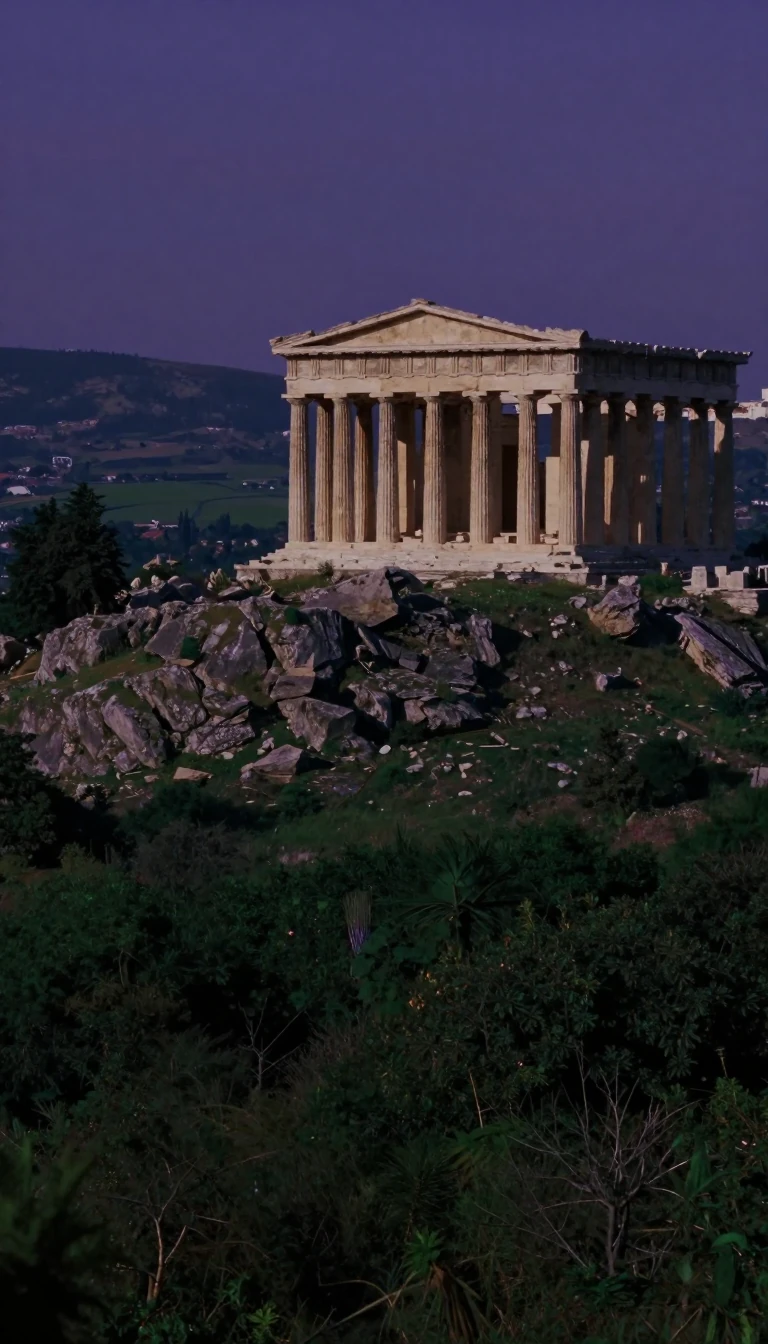 Before Socrates, ancient Greek thinkers sought natural laws to explain the entire universe.Long before the classical age of Athens, early Greek philosophers abandoned myths to investigate the cosmos. By proposing that nature operated through rational principles rather t…
 Why predicting the future is a scientific triumph in physics but a failure in economicsPrediction is the art of saying something about the future, yet its reliability depends entirely on the domain. While scientists can routinely forecast eclipses with absolute prec…
 Why your choices are rarely as rational as economic models claim they areWe often assume our decisions follow a logical, consistent path. Yet, preference is a complex psychological and economic construct, shaped by upbringing, culture, and unconscious …
- Principles are the invisible architecture that turn abstract values into concrete human action.We often treat principles as vague moral guidelines, but they are actually the foundational rules that make systems—from physics to law—operational. Whether defining the behavior …
 Do general categories like 'horse' exist in reality, or are they just names?When you call two different animals horses, you are using a universal. But does 'horseness' exist as a real, eternal thing, or is it just a convenient label? This ancient metaphys…
 Is the idea of progress a universal truth or merely a modern mythology?For three millennia, the concept of progress has anchored Western civilization, promising that human society is moving toward a refined, superior state. Yet, from Enlightenment th…
 Are the properties of an object intrinsic to it, or just in your head?We use the word quality to describe everything from wine to nicotine, but philosophy struggles to pin down what a quality actually is. Is it a fixed attribute of an object, or a s…
 Why do humans often make irrational decisions despite our capacity for brilliant logical reasoning?Rationality is the use of knowledge to attain goals, yet we frequently stumble. From overestimating rare risks to ignoring statistical base rates, our minds often bypass formal lo…
 Should you always follow moral rules, even when breaking them saves a life?Rule utilitarianism argues that moral actions are defined by their adherence to rules that maximize overall good. While this approach avoids the chaos of judging every individual …
 How a small, impoverished nation became the intellectual powerhouse of the eighteenth-century Western world.In the 1700s, Scotland transformed from a peripheral kingdom into a global engine of progress. By prioritizing practical reason, scientific inquiry, and a unique educational netwo…
 Can we build a moral framework without relying on supernatural guidance or religious texts?Secular ethics suggests that morality is not a divine gift but a human achievement. By using logic, empathy, and reason, we can derive principles for living that transcend religio…
- Can human beings be truly moral without the guidance of a divine authority?For millennia, many have argued that religion is the essential bedrock of morality. Yet, secular thinkers, philosophers, and sociologists increasingly challenge this, pointing to …
 Why are you you, and not someone else? The philosophy of the self.You are a subject of experience, but why is it your consciousness that is live? Philosophers call this the vertiginous question. From the Buddhist doctrine of non-self to the tele…
 Why one small decision can feel like a slide toward total catastropheThe slippery slope argument warns that a single, seemingly harmless choice triggers an unstoppable chain reaction toward disaster. While often dismissed as a fallacy or fearmonger…
 Why social philosophy examines the moral fabric of our collective human existenceSocial philosophy moves beyond mere observation to investigate the ethical foundations of our institutions. By prioritizing values over empirical data, it seeks to understand how …
 Why do we accept government? The philosophical answer lies in our natural state.Before laws and borders, what defined human existence? Philosophers like Hobbes and Locke used the state of nature as a thought experiment to justify political authority. By imagi…
- Why attacking a fake version of your opponent's argument is a losing strategyA straw man fallacy occurs when you replace an opponent's position with a weaker, distorted version, then defeat that fabrication instead of the real argument. While it creates th…
 Are you a unified self or just a bundle of fleeting perceptions?The divide between the subject—the observer—and the object—the observed—is a cornerstone of Western thought. Yet, from Descartes to modern neuroscience, philosophers have struggle…
 Taoism is not a single religion but a diverse tapestry of ancient Chinese thought.Often reduced to the Daodejing, Taoism is actually a heterogeneous collection of philosophies and practices that evolved over centuries. It emphasizes living in harmony with the D…
 Does the complex order of the universe prove the existence of an intelligent creator?The teleological argument suggests that the natural world's intricate functionality is not a product of blind chance, but evidence of design. From ancient Greek philosophers to mo…
 Is telepathy a genuine human ability or just a series of clever parlor tricks?Telepathy, the purported transmission of thoughts without physical interaction, has captivated the public for over a century. Yet, despite decades of rigorous testing, the scienti…
- Is the void a true nothingness or the hidden engine of our entire reality?From ancient Greek atomism to modern quantum mechanics, the void has haunted human thought. Whether viewed as the necessary space for matter to move, a spiritual gateway to enligh…
- If God is all-powerful and all-good, why does the world contain so much suffering?Theodicy is the philosophical attempt to reconcile the existence of an omnipotent, benevolent deity with the reality of evil. From ancient texts to modern logic, thinkers have str…
 Why do some universities split philosophy into two distinct, separate academic disciplines?Philosophy is often taught as a singular pursuit, yet many institutions categorize it into two branches: theoretical and practical. This division, rooted in ancient thought, shape…
- Tian: How an Ancient Chinese Concept Defined the Cosmos, Morality, and Imperial PowerTian is one of the oldest terms for heaven or the cosmos in Chinese thought. Far more than a sky, it functioned as a supreme moral authority, a blueprint for earthly order, and th…
 Is truth always binary, or can it exist in degrees and computational sets?In classical logic, a statement is either true or false. But venture into intuitionistic logic or modern programming, and truth becomes far more complex. From fuzzy degrees of val…
 Why the difference between risk and uncertainty is the secret to true entrepreneurshipWe often treat risk and uncertainty as synonyms, but they are fundamentally different. While risk is a measurable calculation of potential outcomes, true uncertainty is an unquant…
 Why a logically valid argument can be completely false and still be perfectIn logic, validity is not about truth. It is about the structural integrity of an argument. A valid argument guarantees that if the premises were true, the conclusion must follow.…
- Is value an objective feature of reality or merely a human invention?Value theory, or axiology, explores what makes things good or bad. While we often assume our preferences are personal, philosophers debate whether values exist independently of us…
- Can science and logic finally solve the deepest mysteries of human philosophy?Between 1924 and 1936, a brilliant group of scientists and philosophers met in Vienna to transform philosophy into a rigorous, scientific discipline. By applying modern logic to e…
 Wu wei: The ancient Chinese philosophy of achieving greatness through effortless, non-aggressive actionWu wei, or non-doing, is a foundational concept in Chinese thought that transcends simple inaction. It describes a state of perfect alignment with the natural flow of the universe…
 Ziran: The Ancient Chinese Philosophy of Being Exactly As You AreZiran is a foundational concept in Taoism and Chinese Buddhism, translating to 'self-so' or 'by itself.' It describes a state of effortless naturalness, where things unfold withou…
- Why a 19th-century philosopher chose to become a permanent guest at his own universityWhen Jeremy Bentham died in 1832, he left behind a bizarre final request: his skeleton should be preserved, dressed in his own clothes, and stuffed with hay to serve as an auto-ic…
 How the Enlightenment turned the universe into a predictable, mathematical machineDuring the 17th and 18th centuries, a radical intellectual shift swept Europe. Thinkers moved away from traditional religious authority, instead championing reason as the supreme …
 Are your senses lying to you or just showing you a different perspective?We trust our eyes to reveal the world, yet sensory evidence is notoriously fallible. Philosophers distinguish between perspectival appearance—how an object looks from a specific a…
 Are we trapped in a modern Cave of fossil-fuel dependence like the ancient Greeks?Plato’s famous allegory of the Cave describes prisoners mistaking shadows for reality. Melissa Lane suggests our reliance on fossil fuels mirrors this ancient predicament. By exam…
 Are we living in a modern Cave by relying on fossil fuels for energy?Plato’s famous allegory of the Cave describes prisoners trapped by shadows, mistaking illusions for reality. Melissa Lane suggests our modern reliance on fossil fuels functions si…
- When the brain is starved of input, it begins to invent reality.If you remove every external stimulus—sight, sound, and even gravity—the human mind doesn't simply go quiet. Instead, it enters a state of frantic reconstruction. To fill the void…
 The man who turned a disparate group of critics into a political forceIn 1953, Russell Kirk published The Conservative Mind, a work that transformed American conservatism. While often remembered as a political philosopher, Kirk was also a master of …
 Before the Enlightenment, German mysticism sought the 'Ungrund' of existenceLong before modern physics explored the void, German mystics were searching for the 'Ungrund'—a primeval abyss existing before creation. This pursuit of the un-grounded essence of…
- Why philosophers spent sixty years ignoring the real world's moral problemsFor much of the 20th century, moral philosophers largely avoided practical issues, viewing the task of "moralizing" as a job for preachers. It took the social upheaval of the 1960…
 How can we convince people who reject facts and prefer ideology?When people reject scientific expertise in favor of conspiracy theories and cherry-picked evidence, how do you respond? Lee McIntyre explores the common themes of science denialis…
 Can a cat be both alive and dead at once?Explore six of history's most famous thought experiments in this fast-paced series. From ancient Greek paradoxes to modern quantum mechanics, these animations break down complex c…
- How much of your identity is built from what you remember?In this philosophical discussion, psychological illusionist Derren Brown joins Nigel Warburton to examine the profound connection between memory, identity, and the techniques used…
- Are humans inherently selfish, or is that just a philosophical misconception?Mark Hopwood examines the age-old debate regarding human nature. This video explores whether we are born with a selfish streak and questions if it is truly possible to move beyond…
 Is anger a righteous response or an uncontrollable impulse?Anger serves as a psychological alarm bell for immorality, yet managing it remains difficult. This video examines the philosophical theories surrounding how we should respond to t…
 Why accepting your own limitations is the secret to a more meaningful lifeOliver Burkeman joins host Elise Hu to discuss his book, Meditations for Mortals. They examine how to find purpose within the constraints of a finite lifespan by adopting a philos…
 Is the preservation of historical artifacts worth the potential loss of human life?Professor Derek Matravers explores the ethical dilemma of prioritizing historical heritage over human safety. This video examines the philosophical tension between safeguarding ou…
 Why embracing your limitations is the key to a meaningful lifeIn this interview, Oliver Burkeman explores why our constant drive for productivity often leads to burnout. He introduces 'imperfectionism' as a practical philosophy to help you r…
- When the universe first became visible to itself, did humans matter?Dr. Katie Mack joins John Green to explore the cosmic epoch when the first stars ignited. This episode examines the moment the universe began to illuminate, while questioning our …
 Is the concept of a perfect society a practical tool or a useless dream?Explore whether utopias are merely impractical daydreams or essential blueprints for navigating our political future. This episode examines various visions of the ideal world and …