Space · Jupiter's Great Red Spot
What causes Jupiter's Great Red Spot?
The short answer
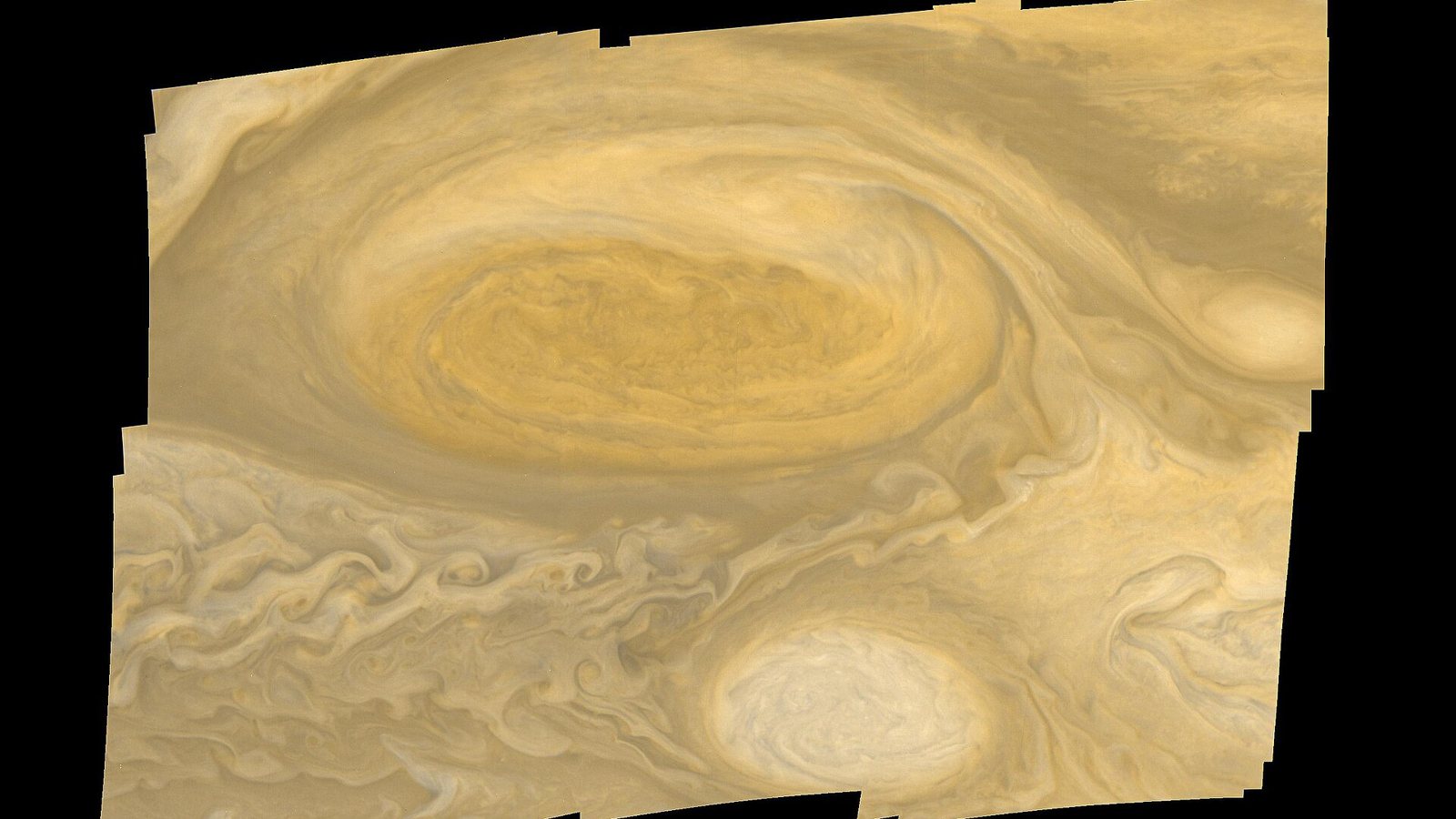
The exact formation mechanism of Jupiter's Great Red Spot remains hidden1. However, it most likely formed from a flow disturbance between two opposed Jovian zonal jets1. The storm is a swirling mass of clouds caused by tremendous winds above the rapidly spinning planet6. It maintains its strength due to jetstreams moving at 300 to 400 mph3. The storm exists because Jupiter has no solid ground to weaken it2. It is also sustained by a balance of energy flowing in and out of the storm4.
What the evidence shows
Formation and Dynamics
New numerical simulations rule out that the Great Red Spot formed from a superstorm or the merging of vortices1. It likely began as a flow disturbance between the zonal jets north and south of it1.
The storm is caused by tremendous winds that blow counterclockwise at about 250 miles per hour6. These winds develop above the rapidly spinning planet6.
Atmospheric Energy
The storm is caused by a balance of energy flowing in and out4. Energy flows in as the spot consumes smaller storms and mixes with the surrounding atmosphere4.
Energy is also radiated into space4. The storm may be shrinking because less energy is being fed in and more is slowly dissipating away4.
Color and Composition
The ruddy color is likely caused by simple chemicals being broken apart by sunlight in the upper atmosphere5. The spot's clouds are much higher than those elsewhere on the planet5.
One leading theory suggests a colorless layer of ammonium hydrosulfide could react with cosmic rays or ultraviolet radiation from the sun2. Researchers believe the color is a product of sunlight effects rather than chemicals coming from beneath the clouds5.
Our take
This part is our own interpretation, not a sourced finding.
It is surprising that the storm might be 'pretty bland' in color beneath its upper cloud layer5. This suggests the iconic red appearance is a surface phenomenon rather than a deep atmospheric trait.
What we can't say for sure
The formation mechanism remains hidden1. Scientists do not know exactly how or even whether certain chemicals react to give the spot its colors2.
Sources
- Sánchez-Lavega, Agustín. [2406.13222] The Origin of Jupiter's Great Red Spot. arXiv.org. research paper, accessed 1 November 2026.
- Jupiter’s Great Red Spot: A Swirling Mystery - NASA. NASA. official, accessed 1 November 2026.
- https://www.space.com/author/doris-elin-salazar. Jupiter's Great Red Spot Could Disappear Within 20 Years | Space. Space. other website, accessed 1 November 2026.
- https://www.space.com/author/robert-roy-britt. Jupiter's Great Red Spot Is Shrinking | Space. Space. other website, accessed 1 November 2026.
- Is Jupiter's Great Red Spot a Sunburn? - NASA Science. NASA Science. official, accessed 1 November 2026.
- https://www.space.com/author/space-com-staff. Jupiter Data Sheet | Space. Space. other website, accessed 1 November 2026.
Published 1 November 2026. Sources last checked 1 November 2026. Prepared with automated tools and checked against the sources named here: how we work. Spotted a mistake? Tell us.
Keep exploring in Intellect Plus
 VideoJupiter's Great Red Spot is shrinking, but the cause remains a mystery
 VideoJupiter's Great Red Spot may be starving for fuel
 VideoJupiter's Great Red Spot is a storm that refuses to die
 VideoJupiter's Great Red Spot hides roots 200 miles deep in its atmosphere
 CardJupiter's Great Red Spot is a storm bigger than Earth, and it is shrinking.
CardJupiter's atmosphere is a chaotic, fluid engine that lacks any solid ground to land on.
 VideoJupiter is not a failed star, but a remarkably successful planet
CardJupiter acts as a cosmic broom, sweeping the asteroid belt clean
 VideoJupiter is a massive, terrifying planet that still holds secrets
 CardJupiter’s faint rings are a dynamic graveyard of moon dust and cosmic debris
CardJupiter is the solar system's ultimate blueprint for origins
CardJupiter's Great Red Spot has been raging for at least 340 years