The celestial scavengers captured by the giant planets
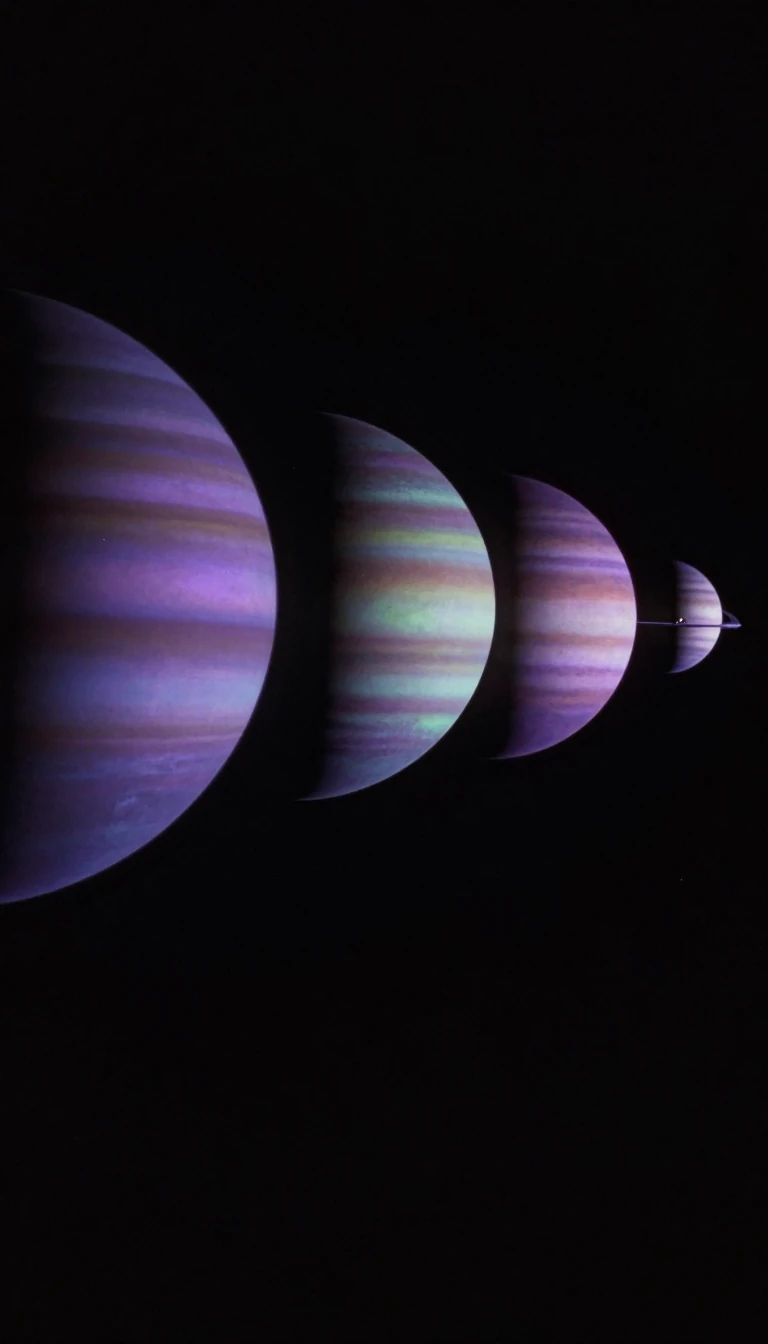
In short: They do not follow the orderly paths of regular moons. Instead, these irregular satellites drift in eccentric, tilted, and retrograde orbits. Far from being permanent residents, they are likely ancient wanderers, captured from the solar system's outer reaches by the gravitational might of the giant planets.
In the early history of our Solar System, the giant planets—Jupiter, Saturn, Uranus, and Neptune—acted as gravitational traps. Unlike regular satellites, which formed from the same disk of material as their parent planets, irregular moons were likely independent objects orbiting the Sun. The Nice model suggests these wanderers originated in a massive trans-Neptunian planetesimal disk, stretching between 24 and 50 AU, which was later dispersed by planetary migration.
The mechanism of capture is a complex gravitational dance. While older theories suggested 'gas drag' or 'pull-down' mass increases, these cannot explain the irregular moons of the ice giants. The prevailing theory is n-body capture: a three-body interaction that saps enough energy from a passing object to lock it into a permanent orbit. Some, like Neptune's Triton, may have even resulted from the capture of a binary object.
Today, these moons exhibit extreme orbital diversity. Retrograde orbits—moving in the opposite direction of the planet's rotation—are far more common, accounting for 83% of known irregular satellites. This asymmetry is driven by Coriolis acceleration, which provides a stabilizing inward force for retrograde objects. This stability allows some to persist at much greater distances from their planet than prograde moons, which are prone to being pushed away by solar perturbations like the evection resonance.
The population we see today is likely a fraction of a much larger original group. Over eons, relentless collisions have ground down the population, potentially destroying up to 99% of the initial mass and creating vast clouds of dust. What remains are often collisional families—groups of fragments sharing similar orbits, serving as a silent record of the Solar System's violent past.
Opens the Intellect+ feed with this card first. Swipe up for the next one.
Sources
- Summary by Intellect · source: Irregular moon
To cite this card, link to https://intellectplus.co.uk/app/space-irregular-moon.
How we source, check and correct cards: Editorial standards.
General information, not professional advice. Spotted an error? Flag the card or see corrections and complaints.
Intellect Plus is a visual educational discovery platform for exploring fascinating facts and ideas. Brain Food, Not Brain Rot. What is Intellect Plus?
Related
More in Moons · More in Space · Latest · A–Z · All topics
