Heian-kyō was a perfectly planned grid city that eventually outgrew its own rigid design.
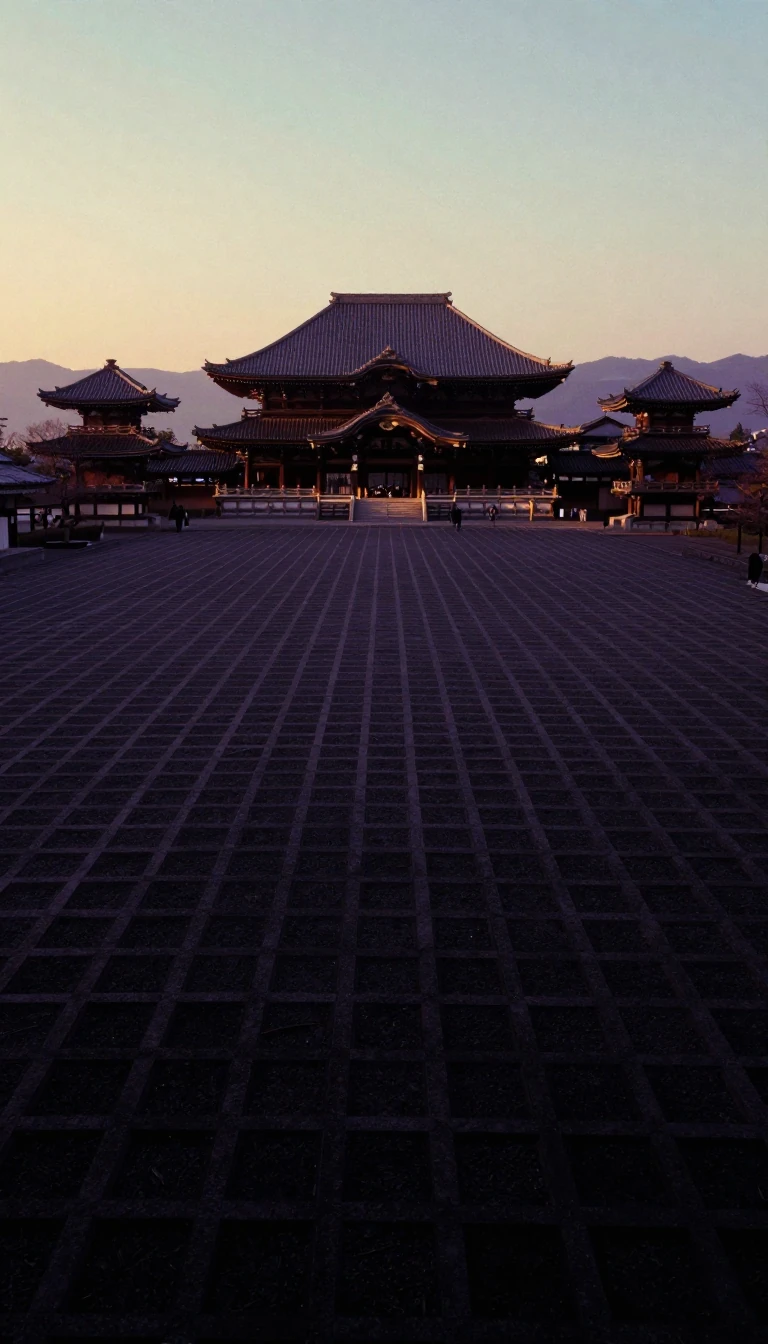
In short: Established in 794, Heian-kyō was Japan's imperial capital for over a millennium. Built on a strict rectangular grid inspired by Chinese urban planning, the city was designed with mathematical precision. Yet, as the city evolved, its original symmetry crumbled, giving way to the organic, medieval sprawl of modern Kyoto.
In 794, Emperor Kanmu moved the Japanese capital to Heian-kyō, a site chosen for its favorable landscape. The city was laid out as a precise rectangle, measuring roughly 4.5 km east to west and 5.2 km north to south. At its northern center sat the Daidairi, a massive palace complex housing the government. The city was bisected by the grand Suzaku-ōji, an avenue approximately 85 meters wide that ran from the palace to the southern gate, Rajōmon. This layout divided the city into the Left and Right Capitals, organized into a grid of numbered streets and blocks.
Despite its grand design, the city never achieved perfect uniformity. The Right Capital, situated on lower ground, suffered from poor drainage and gradual decline, while the Left Capital flourished. By the 11th century, the imperial family began favoring aristocratic residences over the original Daidairi, which was eventually destroyed by fire in 1227 and never rebuilt. As the population shifted northward and eastward, the rigid boundaries of the ancient grid became increasingly irrelevant to the actual urban footprint.
By around 1220, the name Kyoto had largely replaced Heian-kyō in common usage. While the Imperial Court remained in the city for centuries, political power had migrated to warrior governments like the Kamakura shogunate. The city survived repeated conflicts, including the devastating Ōnin War (1467–1477), and underwent major reconstructions under leaders like Toyotomi Hideyoshi. It was not until 1869, when the central government moved to Tokyo, that Kyoto’s formal status as the imperial capital officially ended.
Today, the legacy of Heian-kyō persists in the street patterns of modern Kyoto. The line of the ancient Suzaku-ōji is still reflected in the modern Senbon-dōri, and the city’s historical evolution from a planned, symmetrical capital to a medieval center remains a subject of study. The Kyoto Imperial Palace, while preserved at Emperor Meiji's direction, stands on a site distinct from the original ancient palace, marking the final transition from the city of the past to the Kyoto we know today.
Opens the Intellect+ feed with this card first. Swipe up for the next one.
Sources
- Summary by Intellect · source: Heian-kyō
- Also: Wikidata — Heian-kyō · CC0
To cite this card, link to https://intellectplus.co.uk/app/places-heian-ky.
How we source, check and correct cards: Editorial standards.
General information, not professional advice. Spotted an error? Flag the card or see corrections and complaints.
Intellect Plus is a visual educational discovery platform for exploring fascinating facts and ideas. Brain Food, Not Brain Rot. What is Intellect Plus?
Related
More in Historical cities, towns and archaeological sites · More in Countries & Cities · Latest · A–Z · All topics
