Dark matter haloes are the invisible scaffolding upon which all galaxies are built.
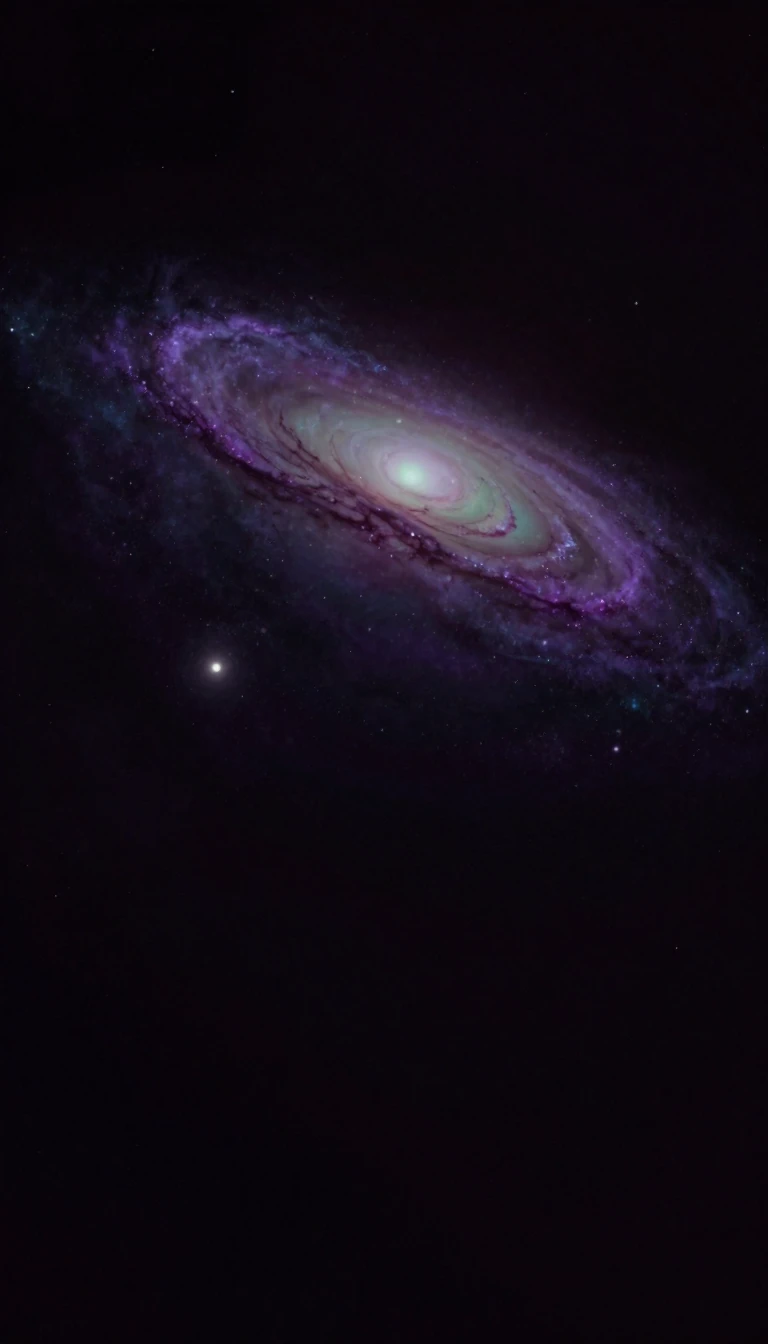
In short: These massive, unseen structures envelop galaxies, extending far beyond their visible edges. While we cannot observe them directly, their gravitational influence on stars and gas reveals their presence. Simulations now show a universal density structure for these haloes, spanning 20 orders of magnitude from Earth-sized masses to giant galaxy clusters.
Dark matter haloes are fundamental units of cosmological structure. They are regions that have decoupled from the expansion of the universe, containing gravitationally bound matter. Because dark matter is cold compared to baryonic matter, it was able to form these initial, self-bound clumps early in the universe's history. This process provided the necessary gravitational scaffolding for baryonic matter to overcome thermal energy and collapse into the first stars and galaxies.
The structure of these haloes is typically studied through numerical simulations, such as those using the GADGET-2 code. These simulations reveal that haloes grow through the accretion of surrounding material or by merging with other haloes. As they evolve, they form an ellipsoidal shape containing smaller substructures known as subhaloes. Researchers have identified a universal density profile, often referred to as the NFW profile, which describes how density changes with distance from the halo center.
While the pseudo-isothermal model was once a common way to describe galactic haloes, it fails to converge at large distances, making it an approximation at best. Modern understanding relies on the hierarchical clustering framework, where small-scale perturbations grow and collapse into small haloes, which then merge into larger systems. This model aligns well with observations of the Cosmic Microwave Background and the large-scale structure of the universe, confirming that these invisible haloes are essential to our current understanding of galaxy formation and evolution.
Opens the Intellect+ feed with this card first. Swipe up for the next one.
Sources
- Summary by Intellect · source: Universal structure of dark matter haloes over a mass range of 20 orders of magnitude - Nature
- Also: Dark matter halo
- Also: NASA Scientific Visualization Studio | Milky Way Anatomy
To cite this card, link to https://intellectplus.co.uk/app/space-dark-matter-halo.
How we source, check and correct cards: Editorial standards.
General information, not professional advice. Spotted an error? Flag the card or see corrections and complaints.
Intellect Plus is a visual educational discovery platform for exploring fascinating facts and ideas. Brain Food, Not Brain Rot. What is Intellect Plus?
Related
More in Galactic and extragalactic astronomy · More in Space · Latest · A–Z · All topics
