 Intellect Plus
Astronomy
1,544 cards. Each one is a 40-second story with a five-minute read behind it. Page 16 of 26.
 Why Betelgeuse's recent dimming isn't a countdown to a supernovaThe red supergiant Betelgeuse recently lost half its luminosity, sparking fears of an imminent cosmic explosion. While the idea of a local supernova is captivating, current scienc…
 Was a new calendar once a secret weapon for Elizabethan England?Explore the fascinating intersection of astronomy, religion, and empire through a story of a potential calendar revolution designed to undermine the authority of the Catholic Chur…
 Seeing the universe through a different lens: the Magellanic Clouds in ultravioletWitness the most detailed ultraviolet surveys of our nearest neighbor galaxies. This video showcases seamless portraits of the Large and Small Magellanic Clouds, revealing a hidde…
 How a 10,000-ton meteor explosion redefined our orbital tracking capabilitiesWhen a massive meteor exploded over Russia in 2013, it provided a rare opportunity to test high-precision satellite instruments. This video demonstrates how NASA's NPP data allowe…
 The Moon is not actually a steady face, but a wobbling sphereWe are taught that the Moon always shows us the same side. While technically true, a subtle lunar wobble called libration allows us to peek around its edges, revealing more of its…
 Why some pulsars act like spiders, devouring their companion starsIn the cosmos, certain binary systems mimic the lethal behavior of black widow spiders. This video explores the mechanics of these rare neutron star pairings and the extreme envir…
- Mapping the explosive aftermath of a massive stellar outburstAstronomers have used advanced spectral data to construct the first high-resolution 3D reconstruction of the Homunculus Nebula, a massive cloud of gas and dust ejected by the Eta …
 Inside the chaotic dance of one of space's most massive binary starsThis video explores the complex interaction within Eta Carinae, a binary system located 7,500 light-years away. Discover how massive stellar winds and extreme orbits create dramat…
 How a violent cosmic collision shaped the asteroid BennuExplore the turbulent history of Asteroid Bennu in this six-minute animation. Discover how a massive space collision created the debris that now drifts through our solar system.
 How a single planet can reshape an entire solar systemNASA scientists used a supercomputer to build a 3D virtual model of the Beta Pictoris star system. By simulating millions of years of orbital motion, they discovered how a planet'…
 How a single instrument revealed 3,000 passing cometsExplore a stunning visualization of the thousands of comets captured by the SOHO spacecraft. Learn how NASA and the ESA used a specialized coronagraph to peer around the Sun's bri…
 The cosmic gauntlet that erases the universe's highest-energy lightHigh-energy gamma rays from the distant past should technically vanish before they reach us. They face a cosmic gauntlet of starlight that converts them into matter. Yet, a massiv…
- A record-breaking pulsar discovered in a distant galaxyUsing the Fermi Gamma-ray Space Telescope, researchers have identified the first gamma-ray pulsar located outside our own galaxy. This discovery challenges our understanding of ho…
 Watching a year of solar evolution in just a few minutesExperience the constant, graceful movement of our sun's atmosphere through an ultra-high-definition time-lapse. This video compresses over 300 days of continuous observation into …
 A high-definition look at the Moon's shifting face throughout 2016This 4K visualization tracks the Moon's phases and libration at hourly intervals. It provides a detailed view of the lunar cycle as seen from the Northern Hemisphere, offering a p…
- A year of lunar movement captured in high definitionObserve the Moon's transformation throughout 201sing via this 4K visualization from NASA Goddard. This hourly breakdown provides a detailed look at lunar phases and orbital mechan…
 How NASA is sharpening its view of the high-energy universeBy re-processing years of data, scientists have unlocked a more detailed census of the sky's most extreme energies, revealing objects previously hidden from our view.
 The rare celestial alignment where Mercury crosses our sunWitness a phenomenon that occurs only about 13 times every century. This video features Dr. Alex Young of NASA's Goddard Space Flight Center explaining the mechanics and significa…
- How NASA plans to bring pieces of the early solar system back to EarthThis video explores the OSIRIS-REx mission, a journey to the asteroid Bennu designed to collect and return pristine material from the dawn of our solar system.
 Peering beneath the clouds of Jupiter during Juno’s latest close flybyOn February 2, NASA’s Juno spacecraft passed just 2,700 miles above Jupiter's cloud tops. This video captures the mission's fourth close approach, showcasing how the probe investi…
- Seven Earth-sized worlds orbit a single, tiny starNASA's Spitzer Space Telescope has identified an unprecedented planetary system. Watch to learn how this discovery of seven rocky planets around one star provides our best opportu…
 Seven Earth-sized planets discovered around a single ultra-cool dwarf starNASA's Spitzer Space Telescope has identified a remarkable planetary system. Watch to learn about the TRAPPIST-1 system and why these worlds are prime candidates for atmospheric s…
- Mapping the Milky Way with 1.7 billion stellar data pointsWatch Anthony Brown explain the second data release of the Gaia satellite. This unprecedented dataset provides a high-precision map of our galaxy's structure and history.
 Mapping the Milky Way with over one and a half billion starsExplore the unprecedented scale of ESA’s Gaia second data release, a galactic census that provides the most precise measurements yet of the stars, asteroids, and quasars in our co…
- How one space telescope is rewriting the history of our Milky WayThe Gaia space telescope is delivering a massive data revolution for astronomy. By providing precise details on 1.7 billion stars, it is providing the most comprehensive survey of…
- How Rosetta's high-resolution camera captured the secrets of a cometMeet the team behind OSIRIS, the high-resolution science camera that documented the Rosetta mission's final images and the search for the Philae lander.
 Why the shooting stars you see are rarely the rocks you findWhen a streak of light cuts through the night sky, you are witnessing a cosmic transformation. Most space debris vaporizes instantly, but a select few survive the fiery descent to…
- How the most complex observatory ever built will redefine our view of the cosmosDiscover the mission of the James Webb Space Telescope, an international collaboration designed to peer into the atmospheres of distant exoplanets and uncover the origins of galax…
 How scientists safeguard the legacy of the Rosetta missionEven years after the final data collection from Comet 67P/Churyumov-Gerasimenko, the work continues. This video explores the complex process of archiving and making mission data a…
- Will Comet 67P/Churyumov-Gerasimenko return to our skies?After the historic Rosetta mission, astronomers are preparing for the next close approach of Comet 67P. Discover how scientists are comparing past close-up data with future Earth-…
- How a European camera network tracks bright meteors through the atmosphereThis video introduces the FRIPON network, a system of over one hundred specialized cameras across Europe designed to monitor the skies for bright fireballs and track their descent.
- The legacy of a decade-long voyage into the deep solar systemWhile Rosetta's physical journey ended in 2016, its scientific life is only beginning. This video explores how researchers are still extracting secrets from the mission's vast dat…
- How a bug-eyed telescope could protect Earth from asteroid impactsThe European Space Agency is developing Flyeye, an automated telescope designed to scan the night sky for dangerous comets and asteroids.
 This tiny asteroid orbiting between Saturn and Uranus possesses its own ring systemMost rings in our solar system belong to gas giants, but 10199 Chariklo defies this rule. As the largest known centaur, this icy body maintains two narrow, mysterious rings. Astro…
- How Arabic diacritics turn a skeletal script into a precise phonetic guideArabic is a modified abjad where vowels are often omitted, leaving readers to rely on context. To bridge this gap, a system of diacritics called tashkīl provides the missing phone…
- Why the world's most iconic radio telescope fell into its own dishFor over fifty years, the Arecibo Observatory in Puerto Rico dominated radio astronomy. Its massive 305-meter reflector made history, from detecting the first extrasolar planets t…
 For centuries, humanity believed the stars and planets were embedded in rotating, physical spheres.Before modern physics revealed the vast, empty vacuum of space, scholars envisioned the universe as a series of nested, solid orbs. From Aristotle to the Renaissance, this elegant…
- Could a hidden planet be lurking on the opposite side of the Sun?The concept of a Counter-Earth, or Antichthon, has fascinated thinkers from ancient Greek philosophers to modern science fiction writers. While once proposed to balance the cosmos…
 Why space travel is less about speed and more about your fuel budgetIn space, you cannot simply steer like a car. Instead, navigation is defined by delta-v, a measure of the total impulse a spacecraft can generate. It is the ultimate currency of o…
 Hyperion is a tumbling, sponge-like moon that refuses to lock its gaze on Saturn.Most moons in our solar system are tidally locked, showing only one face to their parent planet. Hyperion, a jagged, potato-shaped moon of Saturn, defies this norm. It tumbles thr…
 What makes a planet? The surprising science of gravity and shape in our solar systemBeyond the eight official planets, our solar system is filled with gravitationally rounded objects. While the International Astronomical Union uses strict rules for planethood, ge…
 Two hundred twenty-four solar eclipses will grace our skies throughout the twenty-first century.The twenty-first century is a busy time for celestial mechanics. Between 2001 and 2100, Earth will experience 224 solar eclipses. While many are partial, the rarest and most drama…
- Mysterious Little Red Dots may be the missing link in early black hole growthThe James Webb Space Telescope has uncovered a strange population of compact, intensely red objects in the early Universe. These Little Red Dots appear in abundance shortly after …
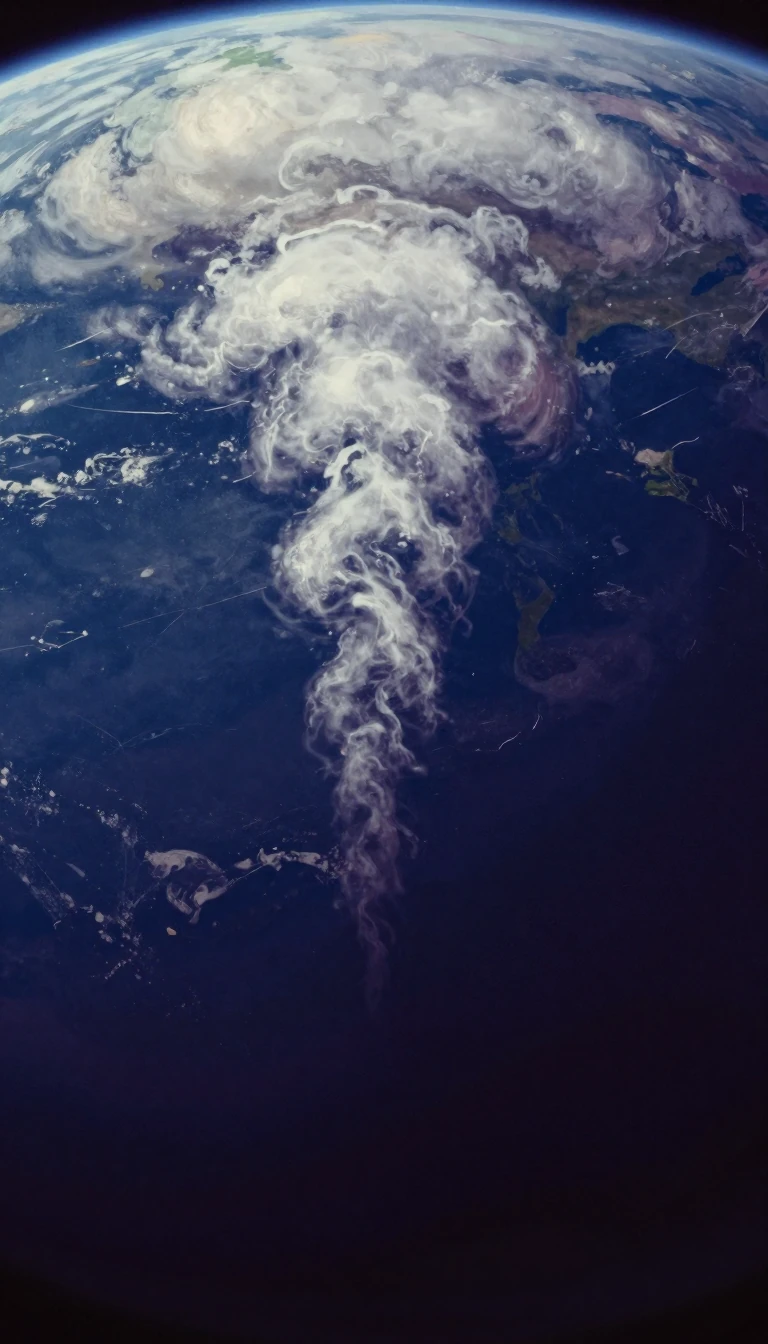 Why seeing Earth from space triggers a profound, life-altering shift in human perspectiveAstronauts often return from orbit with a transformed worldview, describing a state of awe that dissolves borders and political divides. Known as the overview effect, this phenome…
- Saturn’s outermost ring is a massive, invisible cloud of debris from a captured moon.Phoebe is a strange, dark wanderer orbiting Saturn in the wrong direction. Far from being a native moon, this irregular satellite likely originated in the distant reaches of the s…
 The lensless camera that captures the sun's path across the sky over monthsA pinhole camera is a simple light-proof box that uses a tiny aperture instead of a lens to project images. This ancient optical phenomenon, known as the camera obscura effect, al…
- Why ancient astrologers viewed the seven wandering stars as divine architects of human lifeLong before telescopes, ancient observers identified seven celestial bodies moving against the fixed stars. These planets, including the Sun and Moon, were not merely distant rock…
 How a secret printing language sparked the desktop publishing revolution and changed modern computing.Before PostScript, printers were limited to rigid, stamped characters. By treating every page as a programmable set of curves and lines, Adobe’s invention allowed for high-quality…
- Why rocket scientists intentionally burn fuel inefficiently to reach orbit fasterRocket engines are not just about raw power; they are delicate balancing acts of chemistry and physics. While you might expect maximum efficiency to be the goal, engineers often r…
 How Einstein’s first major breakthrough in gravity explains everything from Earth to black holes.In 1916, Karl Schwarzschild solved Einstein’s field equations to describe gravity around a spherical mass. This elegant mathematical framework, known as the Schwarzschild metric, …
 Why the Sci-Fi Channel rebranded to the sensational, trademark-protected name Syfy in 2009When the Sci-Fi Channel rebranded as Syfy in 2009, the move sparked widespread mockery and confusion. Beyond the phonetic jokes, the change was a calculated business maneuver to s…
- Why the Romans worshipped two different versions of the same Earth goddessIn ancient Rome, the divine personification of the Earth was split between two identities: Tellus and Terra. While often conflated, they represented distinct religious traditions.…
 Why the iconic 140-character limit was once the heartbeat of digital brevityBorn from the constraints of SMS text messaging, the original 140-character limit defined a generation of online discourse. While the platform has evolved into X, with expanded li…
 How the Soviet Union survived the crushing, furnace-like surface of VenusBetween 1961 and 1984, the Soviet Venera program sent eighteen probes to Venus. Facing atmospheric pressures nearly 100 times that of Earth and temperatures exceeding 460 degrees …
- The Vermilion Bird is a celestial guardian, not just a legendary fire-breathing creature.In Chinese astronomy, the Vermilion Bird is one of the Four Symbols, representing the south, summer, and the element of fire. Often confused with the legendary fenghuang, this spi…
- For decades, astronomers were convinced a hidden planet orbited between Mercury and the Sun.In the 19th century, the brightest minds in physics were certain a planet named Vulcan existed. It was the only way to explain Mercury's erratic orbit using Newtonian gravity. Yet…
- Why white noise is a statistical model, not just a hissing soundWhite noise is often mistaken for simple static, but it is actually a precise mathematical concept. Defined by a flat power spectral density, it represents random signals with equ…
- How NASA combined Hubble and Spitzer data to fly through the Orion NebulaBy merging visible light from Hubble and infrared data from Spitzer, NASA has created a three-dimensional fly-through of the Orion Nebula. This multi-wavelength visualization reve…
- Are we the weird one? How scientists hunt for life on distant, alien worlds.Earth is our only known example of a living planet, but the universe likely teems with billions more. By studying our own world's unique conditions—from its distance to the Sun to…
 Hubble captures the most primitive comet ever seen on its maiden solar system voyageComet K2 is a rare visitor from the distant Oort Cloud, currently making its first and only journey through our inner solar system. By observing this icy traveler while it is stil…