How spacecraft hover in empty space by dancing around invisible gravitational balance points
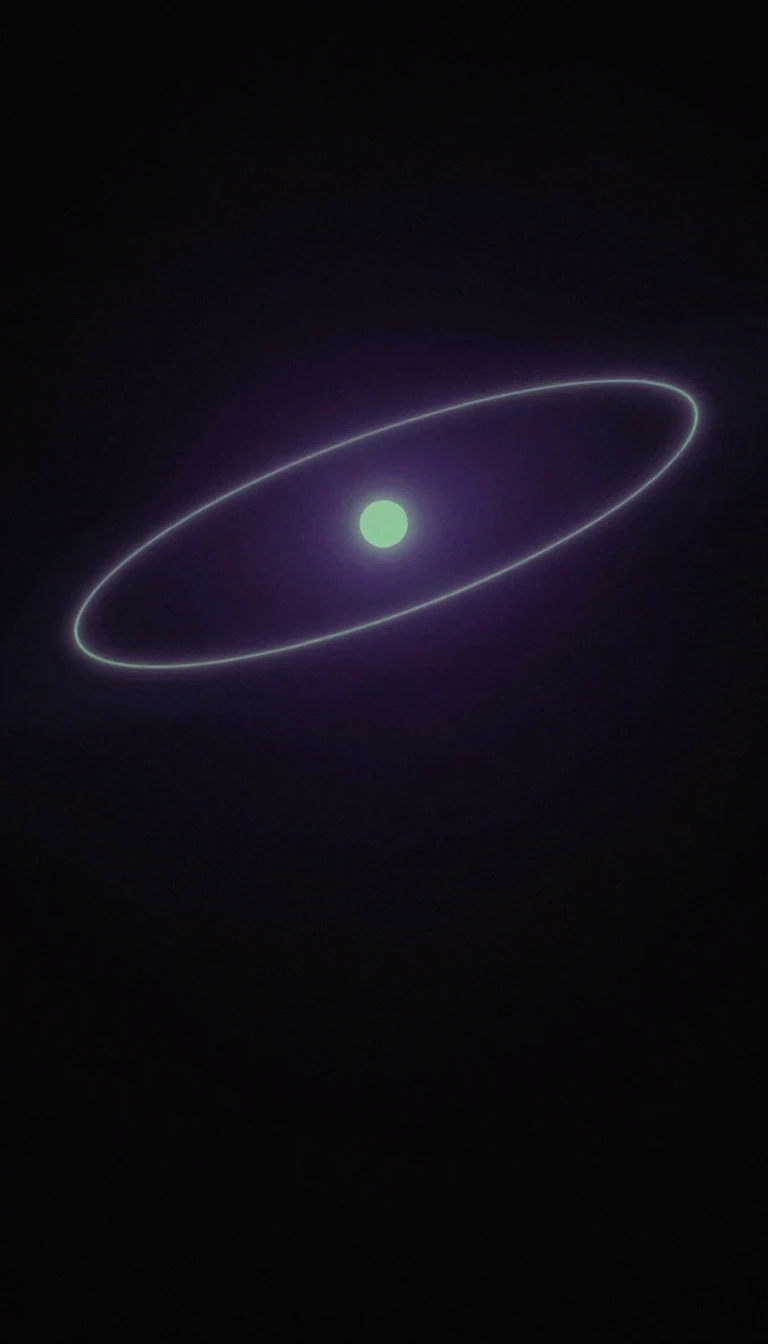
In short: A halo orbit is not a circle around a planet, but a complex loop around a Lagrange point—a spot where gravity from two bodies cancels out. These orbits allow satellites to maintain a constant view of specific targets, like the far side of the Moon or the Sun, using minimal fuel.
A halo orbit is a periodic, three-dimensional path that exists near the L1, L2, or L3 Lagrange points. Unlike traditional orbits that circle a massive object, these trajectories emerge from the delicate interplay between the gravitational pull of two large bodies and the centrifugal and Coriolis forces acting on a spacecraft. Because these paths are inherently unstable, satellites typically require active station-keeping with thrusters to remain on their intended trajectory.
The concept was pioneered by Robert W. Farquhar in 1966, who envisioned using such an orbit for a communications relay beyond the Moon. While his initial proposal for an Apollo-era relay went unused, the theory matured significantly over the following decades. In 1973, Farquhar and Ahmed Kamel demonstrated that specific Lissajous orbits could be transformed into periodic halo orbits by balancing in-plane and out-of-plane amplitudes. By 1984, Kathleen Howell refined these calculations using numerical methods, revealing that stable orbits exist for various mass ratios between planetary bodies.
Practical application began with the ISEE-3 mission in 1978, which successfully orbited the Sun–Earth L1 point. Since then, these orbits have become vital for deep-space observation. The Solar and Heliospheric Observatory (SOHO) arrived at L1 in 1996, while modern missions like the James Webb Space Telescope and Euclid have utilized halo orbits around the Sun–Earth L2 point. In 2018, China finally realized Farquhar’s original vision by placing the Queqiao relay satellite at the Earth–Moon L2 point, enabling the historic 2019 landing of Chang'e 4 on the lunar far side. Most recently, in January 2024, India’s Aditya-L1 entered a halo orbit around L1, maintaining a period of roughly 178 days at a distance of 1.5 million kilometers from Earth.
While halo orbits are precise and periodic, they are distinct from the more common, non-periodic Lissajous orbits used by missions like Gaia. The complexity of these paths continues to evolve, with researchers developing models like the Quasi-Bicircular Problem to better navigate the gravitational nuances of the Earth–Moon–Sun system, ensuring that humanity can maintain a constant, reliable presence in the void of space.
Opens the Intellect+ feed with this card first. Swipe up for the next one.
Sources
- Summary by Intellect · source: Halo orbit
To cite this card, link to https://intellectplus.co.uk/app/space-halo-orbit.
How we source, check and correct cards: Editorial standards.
General information, not professional advice. Spotted an error? Flag the card or see corrections and complaints.
Intellect Plus is a visual educational discovery platform for exploring fascinating facts and ideas. Brain Food, Not Brain Rot. What is Intellect Plus?
Related
More in Celestial mechanics · More in Space · Latest · A–Z · All topics
