 Intellect Plus
Science
17,267 cards. Each one is a 40-second story with a five-minute read behind it. Page 206 of 288.
Subtopics: Acids and bases · Algebra · Alloys and ceramic compounds · Analysis · Applied mathematics · Atomic and molecular physics · Atoms · Basics · Biochemistry · Biochemistry and molecular biology · Biological processes and physiology · Biology · Biology and health sciences: General · Biology basics · Calculus and analysis · Cell biology · Cells · Chemical elements · Chemistry · Climate · Cold · Color · Computer scientists and programmers · Condensed matter physics · Discrete mathematics · Earth science · Electricity & magnetism · Electromagnetism · Elements · Entropy · Everyday Science Questions · Evolutionary biology · Famous equations · Famous experiments · Found by OrchestratorBot · Foundations · Functions · Future Frontier · Genetics and molecular biology · Geology · Geometry · Glass · Global Curiosity Questions · Heat · How Did the Dinosaurs Become Extinct? · How Things Work: Gas from Source to Supply · How Things Work: The Journey of Crude Oil · Human body & genes · Ice · Infinity · Inventors and engineers · Isotopes · Light · Magnetism · Materials · Mathematicians · Maths · Measurement · Mechanics · Microbiology · Minerals & crystals · Molecular compounds · Nature: How Long Can It Live? · Nuclear physics · Number theory · Optics & light · Organic compounds · Other · Particle physics · Physics · Physics basics · Pre-modern figures · Prime numbers & number theory · Probability · Proof · Pseudoscientists · Quantum · Quantum Biology · Reactions and synthesis · Relativity · Research methods · Researched · Salts and ions · Science basics · Scientific discoveries · Scientific instruments · Scientists, inventors and mathematicians · Separation processes · Social scientists · Stars · Statistics and probability · Theoretical computer science · Theory · Thermodynamics · Thermodynamics & heat · UK & Ireland: science · Units & measurement · Volcanoes · Water · Waves · Women in science
 Young tableaux are the elegant visual language of complex group representation theoryIntroduced in 1900, Young tableaux transform abstract group representations into intuitive, grid-based diagrams. By filling these shapes with numbers, mathematicians can calculate…
 Is a single point the only way to visualize a zero-dimensional topological space?In mathematics, zero-dimensional spaces defy simple intuition. While a single point serves as a basic graphical illustration, the formal definition relies on complex topological p…
 A zero of a function is simply where the math hits the ground.In mathematics, a zero is an input that forces a function to output nothing. Often called a root, these values are the x-coordinates where a graph touches the horizontal axis. Und…
 Aconitic acid: The versatile organic compound hiding in your food and chemistry labsKnown for its pleasant winey taste, aconitic acid is a tricarboxylic acid that exists in two distinct isomeric forms. While it serves as a common food additive and flavoring agent…
 How a simple chemical reaction creates enough heat to melt solid steel instantlyBy mixing aluminum powder with metal oxides, you can trigger a violent, self-sustaining reaction that reaches temperatures hot enough to liquefy iron. Known as the aluminothermic …
 Why mathematics rejects the infinitely large and the infinitely smallThe Archimedean property is a fundamental rule that prevents numbers from being infinitely large or small relative to one another. By ensuring that any two values can eventually e…
- How to locate any point using the physics of a balanced center of massImagine describing a point not by fixed grid lines, but by the weight needed to balance a shape. Introduced by August Möbius in 1827, barycentric coordinates treat geometric verti…
 Hidden within every triangle are two mysterious points that share a single, elegant angle.Named after the French mathematician Henri Brocard, these two special geometric points reside inside any triangle. They possess a remarkable property: the lines connecting them to…
 Why a simple toy reveals the physics of buoyancy and the ideal gas lawA Cartesian diver is a classic scientific experiment that uses a small, submerged tube to demonstrate the mechanics of pressure and buoyancy. By squeezing a water-filled bottle, y…
 How mathematicians use chain complexes to measure the hidden holes in complex shapesA chain complex is an algebraic structure that acts as a diagnostic tool for topological spaces. By organizing groups and homomorphisms into a sequence, mathematicians can calcula…
 Why do solids hold heat? The 1912 model that solved the mysteryIn 1912, Peter Debye revolutionized thermodynamics by treating atomic vibrations as particles trapped in a box. By applying the physics of sound to a solid's lattice, he successfu…
 How physicists track quantum systems when they are not perfectly isolated or knownIn quantum mechanics, state vectors are limited to pure, isolated systems. To handle the messy reality of mixed ensembles or entangled particles, physicists use the density matrix…
 Dichlorine monoxide is a volatile, explosive gas used to bleach wood and treat pools.This reddish-yellow gas, known as dichlorine monoxide, is as unstable as it is useful. While it serves as a powerful biocide and industrial bleach, its tendency to decompose—and o…
 Why the conical flask is the unsung hero of the modern chemistry labInvented in 1860, the Erlenmeyer flask transformed laboratory work through its simple, tapered geometry. By allowing for vigorous swirling without spills and efficient boiling wit…
- Why the most important points in a triangle always align on one invisible pathIn geometry, almost every triangle hides a secret alignment. Leonhard Euler discovered in 1765 that a triangle's most significant centers—the orthocenter, circumcenter, and centro…
 How to distill complex data into a few hidden, underlying driversEver wonder if your dozens of data points are actually just symptoms of a few invisible forces? Factor analysis is the statistical sleight of hand that transforms messy, correlate…
 Why some shapes are too complex to be one-dimensional but too simple for twoIn geometry, we are taught that lines are one-dimensional and surfaces are two. Yet, nature is rarely so tidy. Fractal dimension allows us to quantify the complexity of irregular …
 How a University of Chicago meteorologist turned tornado wreckage into a global scientific standardBefore Ted Fujita, there was no consistent way to measure the ferocity of a tornado. By analyzing the debris left in the wake of storms, he created a scale that transformed meteor…
 How a simple board of pegs reveals the hidden order of chaotic systemsThe Galton board is a deceptively simple device that transforms chaotic, random bead drops into a perfect bell curve. Invented to visualize the central limit theorem, this machine…
 How many holes does your coffee mug have? The surprising math of genusIn mathematics, genus is a way to measure the topological complexity of an object. While it sounds abstract, it essentially counts the number of holes in a surface. A sphere has z…
 The mesmerizing motion of a lava lamp is actually a complex fluid physics experimentInvented in 1963 by Edward Craven Walker, the lava lamp is more than a psychedelic relic. Beneath its glowing exterior lies a delicate balance of density, heat, and surface tensio…
 The limaçon is a geometric shape that mimics the graceful, spiraling path of a snail.Known as the Pascal's Snail, the limaçon is a fascinating curve generated by rolling one circle around another. Depending on the placement of a fixed point, this shape can morph f…
 Why teams of horses could not pull apart two simple brass hemispheresIn 1654, the Mayor of Magdeburg staged a dramatic spectacle to prove the crushing weight of the air we breathe. By creating a vacuum between two sealed brass bowls, he rendered th…
 Matroids: The hidden mathematical structure unifying linear algebra and graph theoryMatroids are elegant structures that abstract the concept of linear independence. By stripping away the specific details of vector spaces and graphs, they reveal the underlying ru…
 How Mendeleev used Sanskrit to name elements that had not been discovered yetWhen Dmitri Mendeleev published his periodic table in 1869, he left deliberate gaps for elements he knew must exist. To name these placeholders, he borrowed Sanskrit digits—eka, d…
 Before calculus, mathematicians calculated complex areas by systematically exhausting the space within a shape.Long before modern calculus, ancient scholars solved the geometry of circles and spheres by inscribing polygons within them. By increasing the number of sides, they squeezed the u…
 Can a rigid shape navigate a tight corner? Geometry finally has a definitive answer.The moving sofa problem asks for the largest two-dimensional shape that can slide through an L-shaped hallway of unit width. While it sounds like a simple furniture-moving dilemma…
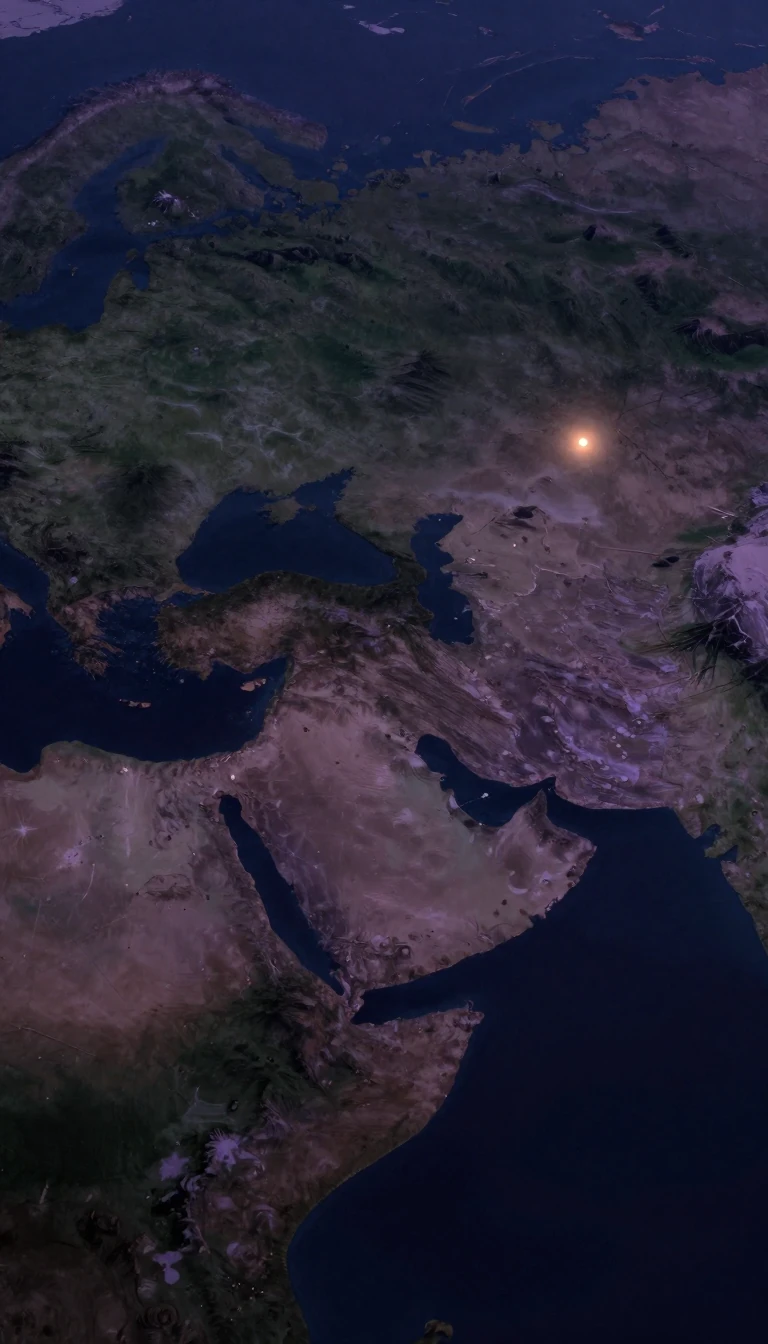 Did modern humans evolve globally or just replace everyone else from an African base?The multiregional hypothesis suggests humans evolved as a single, continuous species across the globe for two million years. While the African replacement model remains the domina…
- How a century-old chemical reaction feeds the world and fuels modern industryThe Ostwald process is the silent engine behind global agriculture. By converting ammonia into nitric acid, it provides the essential raw material for the vast majority of synthet…
 Before genes, Darwin proposed that our entire bodies sent particles to our offspring.In 1868, Charles Darwin introduced pangenesis, a bold theory suggesting that every cell in an organism sheds tiny hereditary particles called gemmules. These particles supposedly …
 This tar-like substance is actually a liquid, but it takes decades to prove it.Pitch appears solid enough to shatter with a hammer, yet it flows with extreme viscosity. Scientists have spent over a century running experiments to capture this movement. One fa…
 How Andrey Kolmogorov turned the chaotic nature of chance into a rigorous mathematical system.In 1933, Andrey Kolmogorov transformed probability from a loose collection of ideas into a formal axiomatic structure. By defining the rules governing outcomes and events, he crea…
- A pycnometer is the precision tool used to determine the density of liquids and solids.To measure the density of a substance, you need a precise volume. A pycnometer is a specialized glass vessel designed to hold an exact, known volume of material. By weighing the v…
- Sedenions are 16-dimensional hypercomplex numbers that defy standard algebraic rules of multiplication.In the realm of abstract algebra, sedenions represent a 16-dimensional structure built from octonions. While they retain some familiar properties, they abandon the alternative alg…
 How Chemists Replicated and Eventually Surpassed the Versatility of Natural RubberFor decades, scientists struggled to recreate the complex structure of natural rubber. By shifting their focus from chemical mimicry to physical performance, they unlocked a new e…
- Why the fossil record is a filtered lens, not a perfect history bookFossils are not mere snapshots of ancient life; they are the survivors of a brutal, selective gauntlet. Taphonomy, the study of what happens to an organism between death and disco…
 How a simple belt and a tin can revolutionized the study of atomic physicsIn 1929, Robert Jemison Van de Graaff built a device using a silk ribbon and a tin can to generate 80,000 volts. This elegant machine, which mechanically transports charge to a ho…
 Why female mammals turn off half their genetic potential to survive early developmentFemales carry two X chromosomes, but a double dose of X-linked genes is lethal to early embryos. To survive, mammals perform a radical biological feat: they systematically silence…
 Can a book about the universe's origin contain only one single mathematical equation?Stephen Hawking’s 1988 bestseller, A Brief History of Time, aimed to explain complex cosmology to the general public. Warned that every equation would halve his readership, Hawkin…
 Beyond the frying pan: The complex science of the humble sunflower seed oilSunflower oil is more than a kitchen staple. From its ancient origins in North America to its role as a modern industrial powerhouse, this versatile fat is shaped by genome-level …
 The scientific classification that tried to group everything from kelp to malaria parasitesOnce considered a major branch of the tree of life, the Chromalveolata was a bold attempt to unite diverse organisms under a single evolutionary origin. Though the group has since…
- Beyond the beach, this common brown seaweed is a master of biological development.Fucus, the brown algae carpeting rocky shores worldwide, is far more than simple beach debris. These resilient organisms serve as critical model systems for understanding how cell…
 These microscopic parasites are actually our closest evolutionary cousins in the animal kingdomLong dismissed as mere fish-killing pests, Ichthyosporea are now recognized as a vital window into the origin of animals. These unicellular eukaryotes share a deep, complex histor…
 The secret to the success of 11,000 fern species lies in a single cellLeptosporangiate ferns dominate the fern world, comprising the vast majority of all living species. Their name reveals their unique evolutionary edge: unlike other ferns, their sp…
 The mysterious fungal subphylum that may have enabled the first land plants to survive.Mucoromycotina are elusive molds that defy easy classification. Once lumped into the now-defunct Zygomycota, these fungi are essential decomposers and ancient plant partners. Whil…
 Before the modern synthesis, biologists debated several mechanisms that challenged Darwinian natural selection.While the fact of evolution is widely accepted, the mechanism of natural selection has faced persistent scrutiny. From the 19th-century eclipse of Darwinism to modern molecular de…
- Climate change adaptation is more than just building walls against rising sea levelsAdaptation is the strategic process of adjusting to both current and anticipated climate impacts. While often associated with physical infrastructure like seawalls, it encompasses…
 Was life once thought to be exempt from the laws of physics and chemistry?For centuries, a stubborn belief called vitalism suggested that living organisms operated by a mysterious force beyond ordinary science. It took the synthesis of urea and the rigo…
 Classical mechanics was born from the need to explain why Earth moves unnoticedFor centuries, Aristotelian physics insisted Earth stood still at the center of the universe. When Copernicus proposed a moving Earth, he shattered this worldview but left a dange…
 For two centuries, scientists have known that burning fossil fuels warms our planet.Long before modern climate models, 19th-century researchers identified the greenhouse effect and linked industrial activity to rising temperatures. What began as a curiosity about…
 For centuries, humanity viewed electricity and magnetism as entirely unrelated, mysterious natural phenomena.Long before modern physics, ancient civilizations observed the strange pull of magnetite and the static charge of rubbed amber. While these forces were documented as early as 800 …
- Energy is not a physical substance, but a mathematical constant governing all natural phenomena.We often speak of energy as if it were a fuel or a fluid, but physics tells a stranger story. It is not a concrete mechanism, but a numerical quantity that remains stubbornly unch…
 Why Einstein’s theory of gravity transformed from a neglected idea into modern physics' foundation.Albert Einstein’s general relativity redefined gravity not as a force, but as the warping of space-time. Though initially met with uncertainty—even by Einstein himself—the theory …
 Materials science is a modern discipline born from the urgent necessity of wartime engineering.For millennia, humans manipulated matter through alchemy and trial-and-error. It was only during the mid-20th century that the field coalesced into a formal, interdisciplinary sci…
- Why did classical physics fail to explain the light emitted by a red-hot object?Classical physics predicted that a hot body would emit energy at an infinite rate at high frequencies, a failure known as the ultraviolet catastrophe. This glaring contradiction f…
 Before Einstein, physicists believed light required a mysterious, invisible medium called the luminiferous aether.For decades, scientists struggled to reconcile Maxwell's electromagnetic equations with the laws of motion. They hypothesized an immobile aether to carry light waves, leading to a…
 Why modern physics abandoned the dream of finding the ultimate, indivisible building block.For centuries, philosophers and scientists chased the idea of an indivisible atom. Today, we know that atoms are mostly empty space, and their constituents are not solid objects b…
 The periodic table was not just a scientific breakthrough but a bold, debated prediction.Before the periodic table became a cornerstone of chemistry, it was a controversial, fragmented puzzle. While many scientists struggled to organize the elements, Dmitri Mendeleev …
- Why the science of heat and work began with the quest to measure motionThermodynamics is the study of how energy shifts between forms, but its origins lie in early attempts to quantify mechanical work. Before we understood heat as atomic motion, thin…
 Before oxygen, chemists believed fire was a physical substance called phlogiston hidden inside materials.For over a century, the greatest scientific minds believed that burning was not a reaction with oxygen, but the release of a trapped element. This invisible, fire-like principle, …